May 31! What?
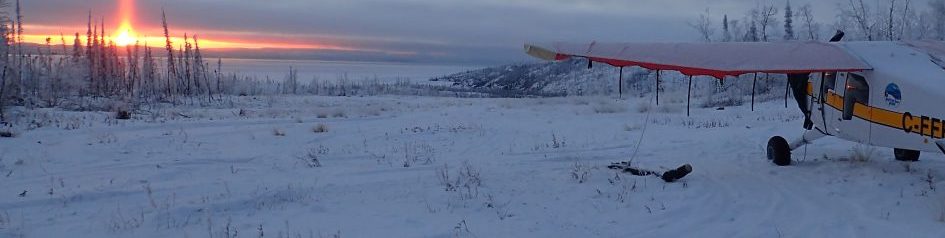
Tonight I’m 150 miles northwest of home, up at Wekweeti, Northwest Territories, a small Tlicho community of maybe 150 souls, once known as Snare Lake or Snare Village. It’s been a long eight days of flying the Husky on fat tires, first from the Gacho Kue diamond mine airstrip and then from the little airport here. Thousands of miles flown already, with one day left to go — all of those miles low and slow and watchful, 70 knots and 45% power and two notches of flaps down as we troll along the sand-and-gravel eskers snaking across the Barrens. We are looking for active wolf dens at the precise time of year when the wolves are most likely to be sticking close to home, while the pups of the year are born. It is a project for the government wildlife department, and I’m flying with one of the biologists. He is a friend I have known for years, and we chatter away on the intercom as we keep eyes glued to the ground on each side of the plane, hour after hour.
These are some beautiful days in the far north with winter giving way to spring and the first inklings of summer. We’ve been landing on smooth white ice whenever we need a break, to stretch our legs and clear our heads or eat our lunch. The ice is changing by the minute, by the hour, and by the day — and it is important to keep that fact in mind — but it is still strong and white on the bigger lakes beyond treeline. In some places the ice is so smooth and consistent and strong I swear you could land a Lear Jet on it and touch down at over a hundred knots on those funny little nitrogen-filled tires. Climb out, take a leak, and roar back up to 41,000 feet.
Some amazing sights, and some very long empty miles in between. Every now and then one of us will adopt a David Attenborough accent and intone, “The Barrenlands are a misnomer, for in fact the tundra is teeming with life.” Yep, there’s life here. We’ve seen some big white wolves, a griz with her two newborn cubs, herds of muskox with their own young (and one confounding group of 70, with nary a newborn in the entire group), some moose, a few straggler caribou drifting lazily toward the coast, and the other day a big golden eagle out the port window, sharing the airspace with us. Hundreds of white ptarmigan going brown by the day; geese, falcons, ground squirrels. And, Sir David, a whole lot of rock, lichen, sand, gravel, and ice, all swept by a cold wind. As I’ve written elsewhere, it’s more a land of physics than biology, when you come right down to the nitty gritty.
Seen some worrisome sights, too. The water is astonishingly low throughout the north, as spring comes on. Hundreds of thousands of miles of freshwater shoreline look exactly as if the tide has gone out. Only thing is, instead of expecting a rise within six hours, we might reasonably pin our hopes on something like six years.
My grandfather had a few pet phrases, and the other night at about three a.m. — the hour at which Napoleon Bonaparte claimed there were few brave men — one of them was thrumming through my head: “A day late and a dollar short.” He used that one to describe anyone who hadn’t quite gotten their act together in time to be effective. Some of his others were, “You zigged when you should have zagged,” and — for pompous gents needing to be brought into humble focus — “He still puts on his trousers one leg at a time.”
I was feeling anything but brave the other night, lying there fretting about what lies ahead. And I mean this in a broad context, not a personal one. The low water, the wildfires already burning in May, (although some of that threat, at this writing, seems to have passed. Let’s have a tentative “Hallelujah” for that.) And just a vague sense of unease that is never helped by an evening dose of headline news.
In the wee hours of the night the specter of low water struck me as a portent of malevolent change. And that led me to wonder whether we (the big “we,” as in humanity) are going to wind up “a day late and a dollar short.” Oh, I hear all the talk, but talk is cheap. There is talking, there is hand-wringing, there are warnings and admonitions, and there is doing, changing, and stepping up. I wonder, can we curb our insatiable appetites, listen to what the earth is telling us, mend our ways, forego some of our ridiculous luxuries, and toe the line? Do we collectively have the cojones to do what we know needs to be done, or will we order up another bowl of guacamole from the irrigated avocado groves, and continue to fiddle while Rome burns? I don’t know; you tell me. Some days, I am cautiously optimistic. I see hopeful signs, and you likely see some too, wherever you are, and the news of those hopeful signs is too easily smothered under doom and gloom.
What’ll it be today? Pollyanna, or Cassandra? Or Joe Friday — “Just the facts, ma’am.” All I know is I keep waking up hearing Grandpa Jim: “Smarten up there Buster, or you’re gonna wind up a day late and a dollar short.”
 "bushedpilotblog" Dave Olesen