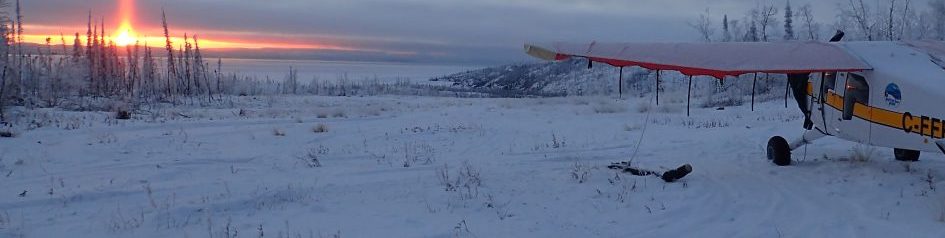
Long Ago, But Not Far Away (about 140 feet)
What a month. What a week. What a day. I said we should buckle up, right? But holy shamoly.
It’s the last night of the month, and I was working on something else, but it’s been a long solo day in deep cold and all I have gumption for tonight is to post these closing passages from “Lighting Out,” the second chapter of my 1994 book North of Reliance. Now it is year 38 here, almost 33 years since I wrote that chapter, and when I happened across it again the other day the tone of it (so… confident? brash? glib?) made me pause, and cringe, and smile.
And oh yes, since you asked, we’re still together, and stayin’ warm.
_______
I proposed marriage to Kristen one morning in 1988, with the thermometer at fifty-two below zero. We were sitting by the big south window in the little eight-by-eight-foot cabin we’d built that first autumn at the Hoarfrost, “the cracker box,” as our neighbors called it. It was February, the month that always looms as a troublesome one in the northern bush. More feuds, petty disputes, grand schemes, vicious gossip, and sweeping changes have been born in February than in all other months of the year combined. It is a month to endure, and a month to be careful.
We were trying to see the future that morning. Kristen had been invited to join a group of six women who would paddle the 600 miles of the Back River the following summer. It was a choice, and it brought into focus the question that was looming over us that February: what to do when winter ended? When there was more to do each day than buck wood, stoke stoves, cut new trails and run the dogs… what would we do? Spring was coming. Already the daylight lasted until 5:30 in the evening, a two-hour gain from the solstice.
“We could get married.” That is how I first broached the idea. Casually, as if I’d said, “we could build a shed,” or “we could enter that dogsled race in Fort McMurray.”
Kristen asked me to repeat myself. I gazed out through the window at the thermometer, still stuck at fifty-some below, and back at the lovely dark-haired woman with the skin peeling from a recent frostbite on the tip of her nose, that nose that had been split down the middle by the handlebar of a sled almost exactly a year earlier, on a steep drop to the Yanert River valley in Alaska.
“Will you marry me?”
Silence. A pinging from the sheet-metal stove.
“Yes.”
February was beaten, and our days here took a giant step more deeply into permanence. Now year by year I watch the log walls of that tiny cabin weather and darken. I will always remember that there, right there, we decided to get married.
A few nights later I passed the news out over the HF bush radio: “Kristen and I are going to get married.” Richard Black’s voice crackled back from his camp seventy miles to the east: “Well, now you’ll have someone to keep you warm all your years at the Hoarfrost.”
________________
A Lighting Out will, one hopes, lead to an Arrival. The lighting is the easy part; the arrival takes years. A part of arriving here has been to get a clear view of my motives; another part is the comprehension of my range. What is the extent of my territory? Where will I concentrate my efforts?
If a person owns a certain acreage, that must be a help. This forty, this quarter-section, this yard and garden plot help to focus and narrow the attention. Here I own a single acre, a square 200 feet on a side. Beyond that in all directions lies uninhabited land and lake, all belonging to that vague Canadian government entity, The Crown. Of course my range must spill out beyond this acre. Learning how far it goes in any given direction is a part of finally arriving here.
It is taking me a long time to grasp the scale of this country. Its resources are more sparsely scattered than were those of my old stomping grounds. The animals that live here have a wider range; the fish grow slowly and do not make such dependable and prolific spawning runs. Soil is a precious rarity and the trees grow tall only in sheltered pockets of fertile ground. Stands of stunted, twisted spruce cover most of the lowlands and dwindle to a few hardy individuals on the ridge tops.
The enormity and emptiness of the country at first inspired me with visions of a huge territory. I would learn it all, from Aylmer Lake to the Thelon River, south beyond the Snowdrift River, west to the road-heads at Resolution and Yellowknife. Flying my small plane helped bolster those early notions of a vast range, but the longer I live here the smaller my territory becomes. The part of the landscape that feels truly familiar to me, and those certain places that have gained a personal significance – here I killed a moose, here we camped in that storm – is much more limited than those first grandiose visions would have had it.
Country seen from an airplane, however low and intricate the flight, is not truly encountered. Only when I slow down and walk, stand behind a team of dogs, or paddle along in a canoe can I match the input of impressions to my capacity for interpretation and memory. It is only that realm within which I need no map, in which if pressed I could sketch an accurate map, that will become my range. From anywhere within it I could always find my way home, on foot or by canoe, with no supplies enroute.
In his essay “Walking” Thoreau wrote “There is in fact a sort of harmony discoverable between the capabilities of the landscape within a circle of ten miles’ radius, or the limits of an afternoon walk, and the threescore and ten of human life. It will never become quite familiar to you.”
I differ a bit with his limits – twenty miles, round trip, being more than an afternoon walk for me, but his idea is accurate. In every season since I arrived here I have found myself for one reason or another in some spot ten miles or less from our cabin, but as new and unfamiliar to me as the headwaters of the Nahanni or the coast of Labrador. I come ashore on beaches I have never seen before, or follow flocks of ptarmigan into a hidden stand of tall straight spruce. Despite its paucity of species and the relatively simple chains and webs among them, despite its straightforward geology and steady, dependable climate, this land still overwhelms my ability to know any more than a tiny tract of it.
Thoreau’s circle of 315 square miles, when skewed by the shape of the shoreline and the slant of these northeast-southwest watersheds, is the approximate size of my range. The area takes me well up the Hoarfrost beyond treeline, in a swath a few miles wide. It runs east and west along the coast of the big lake, and up other drainages I have come to know. Those creeks have no names on the map; we know places by the names we have given them: Hawk Owl Creek, The Big Burn, Windy Lake, Obelisk.
My restlessness has met its match. Gradually those old envies, that feeling that perhaps I was born too late, slips away. I lit out; at last I begin to settle. In The Big Sky, A. B. Guthrie summed it up well: “The feel of the country settled into Jim, the great emptiness and age of it, the feel of westward mountains old as time and plains wide as forever and the blue sky flung across. The country didn’t give a damn about a man or any animal. It let the buffalo and the antelope feed on it and the gophers dig and the birds fly and men crawl around, but what did it care, being one with time itself? What did it care about a man or his hankerings or what happened to him? There would be other men after him and others after them all wondering and all wishful and after a while all dead… He clucked to his horse and rolled in the saddle to its downhill jolt.”
 "bushedpilotblog" Dave Olesen