It’s a time of the year when I do not spend much time writing, but I do spend many hours thinking about things other people have written. Snippets and quips, germane lines and sentences, nuggets that ring true. Alone up at 7,500 or 9,500 feet, heater on just a bit, -2 degrees Celsius out the window, the sweaty smoky summery world far below, I do love my job. Most days.
If there has been a theme to this season of floatplane flying, for our little mom-and-pop business, it could be summed up with an imaginary ringing of the phone, and someone launching breathlessly into a harried message (choose an accent): “Yes we were going to come on that date but we are coming two days earlier now, although our luggage has been lost and there’s been a strike so we may be delayed and we would like to change our pickup date and there are some other people coming also and once we are there we would like to stay a little longer than originally planned and we think there will be some other changes because of smoke and weather and wind but we’ll sort those out when we arrive. Uh, if we arrive.”
My dear wife has always maintained that “flexibility is the key to happiness.” This season has been a good one for us to implement that motto. “Nod, smile, and send out the invoices” has been one of our other muttered mottoes, if I am to be honest.
And now it’s nearly done with. Most of the summer float work is finished. Adventurous and inspiring people have been moved here and there, radio-telemetry widgets and gizmos have mostly been retrieved, the geologists have their samples back in the lab, and most of the canoers are back where they live, although there is one trio that is tonight hunkered down, wondering when the 50-knot gale and sideways snowstorm hammering the lower Back River south of Gjoa Haven is going to ease off.
The other day I went northwest from here to retrieve a little gizmo that has to do with a caribou study. It had fallen off a caribou’s GPS location collar at a pre-determined time and day in August, but of course at an utterly random location, caribou being caribou and — thank heavens — still free to move where and when they will. To say that this widget was a “fur piece” from here would be an understatement. It was a straight line distance of 331 Nautical Miles, about 612 kilometres, so bucking a headwind it took me nearly four hours to reach the site in the Husky on floats. (I had a much faster trip home, perched up at ten thousand feet, above a pall of wildfire smoke, in clear cool air, listening to music on the headset. Tough life some days, yes.)
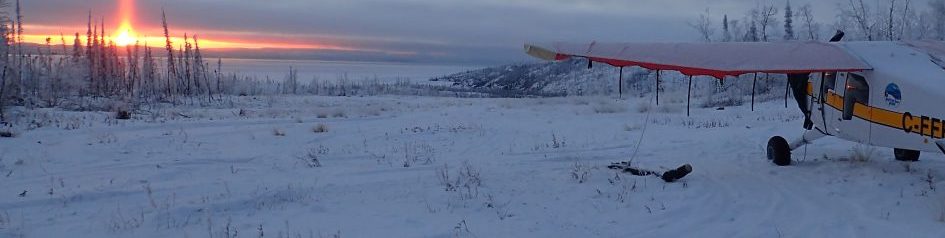
The gift of my day (apart from the invoice generated) was to set down in a part of the north I have only crossed over in winter, and there to be utterly alone, and to have some quiet time to walk around. (Hard at work searching for and retrieving the widget, mind you.) I was about a dozen miles north of the northeast arm of Great Bear Lake. Great Bear is the largest lake completely contained within Canada. An awe-inspiring deep, vast basin of cold clear water. (The only three larger lakes in North America — Superior, Michigan, and Huron — all border the U.S., but Great Bear (#4) and Great Slave (#5) are within our borders, entire.)
Which brings us to the “Bear” part of Great Bear. For years now I have been fascinated by a fact pertaining to barren-ground bear history, a fact borne out by careful reading of old written accounts from the first Europeans to traverse this part of the world, and confirmed by conversations with native old-timers in the small villages and settlements of the far north. Nowadays we have the barren-ground grizzly wandering right across the barrens, north to the Arctic coast, and clear down in Wapusk National Park at the southern extreme of Hudson Bay. We see one here at the Hoarfrost River at least once every few years. But less than a hundred years ago, the many trappers and hunters traveling the barrens immediately north and east of here made no mention of grizzly bears — in their memoirs, their books, or their conversations. Arctic brown bears were known to be encountered only way off to the northwest, in the region of, yep, Great Bear Lake.
Samuel Hearne in 1772, George Back in 1833, Warburton Pike in 1889, David Hanbury in 1902, Ernest Seton in 1907, John Hornby and Helge Ingstad in the 1920’s — all of them in their written records agree that the brown bears of the tundra were far to the northwest, along the upper Coppermine River, and east along a narrow strip of coastline toward Tree River and Bathurst Inlet. That was where they lived, and elsewhere on the Canadian tundra they were vanishingly rare or completely unheard of. I find this gradual barren-ground grizzly range expansion fascinating, because so often we tend to think of things, especially wild and natural things, as fixed and static. The “status quo.” Think again. Nature, it seems, does not do “status quo.”
Another tidbit — nowadays we don’t see very many moose around here in summer. Down here, on the shores of McLeod Bay, I have not seen a moose since sometime last winter. Decades ago, we saw moose and moose tracks and moose sign around home in every month of the year, as we came and went. Not any more.
Come November, and on through the winter, we see plenty of moose. Where are they summering nowadays? They are up on the tundra and seemingly happy to be there. I had thought, when our neighborhood burned eleven years ago, that by around 2025 we would be awash in moose, but apparently they find the barrens even more appealing than the slowly re-greening burn. Is that a function of warming weather? Maybe.
And yet (there’s always an “and yet” in these matters, I think) the muskox herds are still piling pell-mell southbound into the jackpines and aspen of the boreal forest, now crossing the 60th parallel into northern Saskatchewan and northwestern Manitoba, apparently hellbent on grazing and browsing downtown Winnipeg, if not Chicago. Could it be that they appreciate the absence of grizzly bears once they get into the boreal forest? (Grizzlies being one of the few effective predators on muskox.)
I muse about such things when I am perched up at the top edge of “Low Level VFR Airspace.” Maybe it’s borderline hypoxia. I muse about lines from song lyrics, too, and about passages from books I’ve read. There are two such fragments that have been much on my mind lately. I’ll leave you to chew on them, and ramble off ’til next month.
First, a line from a character in Cormac McCarthy’s novel The Crossing, the second book in his Border Trilogy:
“He said that most men were in their lives like the carpenter whose work went so slowly for the dullness of his tools that he had not time to sharpen them.”
And then, from “Gravity” written by Robert Lee Castleman, sung by Alison Krauss on the album Lonely Runs Both Ways.
“All the answers that I started with / Turned out questions in the end.“
 "bushedpilotblog" Dave Olesen