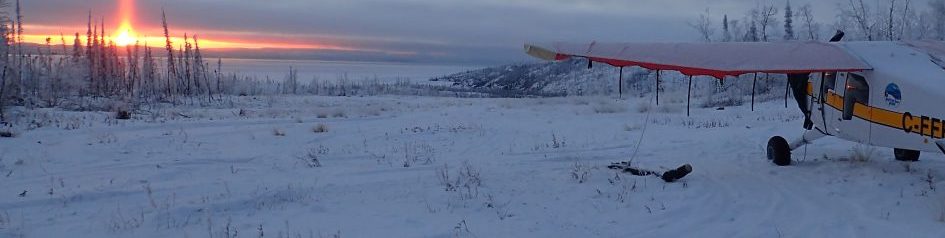
It is late on the final evening of the month and I am in Yellowknife for the start of a round of wildlife survey flying, and I am attempting to do three things within the coming hour:
- Put out at least some semblance of a post here, so as not to break my string of “one per month”;
- Warm this little three-season trailer up above 10 degrees C. (50 degrees F.) before I turn in for the night; and
- Turn in for the night.
As I have written here in November at least once in the past, I consider November the finest month of the year for indulging the luxury of that mysterious animal necessity called sleep.
I got to thinking again about sleep back in late October, when some truly lousy weather forced me to set down about sixty miles northeast of Fort Nelson, B.C., at sunset, and quit trying to make VFR flying conditions out of what were rapidly turning into hardball IFR conditions. I was alone, bringing the second of our two little bush-planes down to the airport at Fort Nelson, on floats, there to land on the grass infield alongside runway 08-26, and call it a float season finished at last.
The weather forecast that day had been calling for improvement along the 500 miles between our home base and Fort Nelson, but as we all know, “them are only forecasts.” I had been making steady progress with a few diversions, hour after hour at 90 or 95 knots, keeping sight of terra firma, but as I closed in on Fort Nelson things took a dramatic turn for the worse. And then, as if to add insult to injury, I saw what was causing part of the problem. Struggling along down low, throttled back, a notch of flaps down, cursing and muttering, I looked through the clag beneath and around the plane and suddenly realized — with a whiff all too familiar across the continent these past few years — what I was dealing with. Yes, there was snow on the ground. Yes, some of the smallest lakes were already iced over, and yes, there was a nasty mix of cold drizzle and mist in the air, but there was also smoke. Wildfire smoke rising in wisps and narrow plumes, right from the snow-covered spruce bogs.
I think I uttered a few words that might have astonished my elders, but then I knew deep-down what I needed to do, in the minutes that were left in that day, the 21st of October. I needed to find a lake that looked like a decent bet not to freeze overnight, check its shoreline and look at its water for depth and reefs, and put the plane down. In other words, I needed to give up on the idea of reaching my destination.
This can be a difficult decision for a pilot to make. We don’t make it very often. Not to turn back, not to go forward, just to put down and quit before somebody gets hurt. But it is, in my experience, a relief to come to that decision.
I came across a passage by Jeremy Jones, writing in Mountain Gazette about his life as a snowboard aficionado, dropping down vast steep slopes of untracked powder snow, and it made me nod my head:
“One critical skill is learning to turn around… ‘I haven’t turned around in a while’ is reason enough to reverse course… It’s a muscle that needs to be flexed… “
I had a nice campout there on the snowy shore of Outaanetdeya Lake. Being late October, it was chilly, but I had ample blankets and bedding, and a little pup tent. (I had forgotten just how little it is.) I usually get a bit of grief from my mechanic friends at Fort Nelson, when I come there for inspections, because I do carry a surfeit of “survival gear” in my planes. But they were not chiding me the next day, when I did finally show up, because they knew that the night had been chilly and very long. “Get any sleep?” And I could honestly answer that yes, I had gotten sleep, a good solid ten hours I bet, worrying only a bit that overnight the lake was going to freeze and force the little floatplane to dabble in a new career as an icebreaker. But in the long hours of darkness I could still hear the chuckle of little waves lapping the boggy shoreline a few feet from my bed, so I rested assured.
Which brings me finally around to Sleep, and to something that dawned on me a few days after that impromptu campout. Training in Survival should add one more factor to the “Rule of 3’s” — the reminder that in a survival situation we can last 3 minutes without air, 3 hours without shelter, 3 days without water, and 30 days without food.
Next time I get a chance to lecture on that topic, I am going to add one more, and that is Sleep. Often we do not stress Sleep in training for and considering survival. To keep going with the “3 theme”, may as well make it a nice even 30 hours without sleep, at most. Because yes, you can perhaps go that long, but you are nowhere near competent or capable or even coherent as that 30-hour mark comes close.
Good night, sleep tight…
 "bushedpilotblog" Dave Olesen