The End — and the Start — of A Long Cold March
Don’t knock th’ weather. Nine-tenths o’ th’ people couldn’ start a conversation if it didn’ change once in a while.
- Abe Martin’s Primer : The Collected Writings of Abe Martin and his Brown County, Indiana, Neighbors (1914).
This post is going out, as is my habit, in the final few hours of the month. Deadlines are wonderful things, wonderfully effective at getting things done, even when self-imposed — as this one is.
Sometime around the Vernal Equinox, which this year fell on March 20th, I caught wind of some reporting that March 2026 has been the coldest on record for some parts of the Northwest Territories.
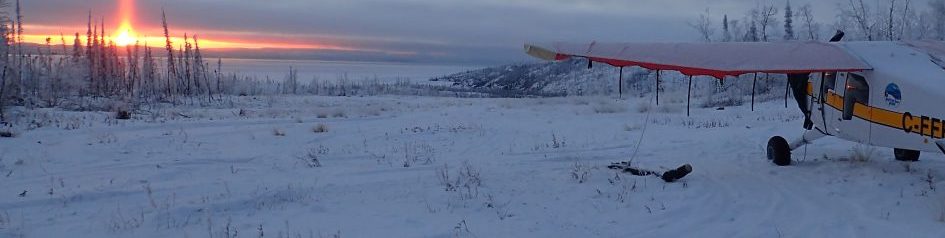
I was away from home on a wildlife survey flying job, and given what we were putting up with in the cockpit of the airplane and on the ground trying to keep the airplane warm and happy, the claim did not surprise me. It has been a relentlessly cold month hereabouts, but the word that it was setting some sort of record did make me resolve to dig a little deeper on that topic when I got home. Last night I did, hauling out our handwritten weather records that stretch back to 1987, and examining every month of March from start to finish. The records are mostly intact, and mostly useful. There are missing years, from the bygone early ‘90’s when we would go off on the dog mushing race circuit and shut the place down completely, and from a year when we languished in the downpours of coastal British Columbia for an entire winter of island life and instruction in wooden boat-building.
I went through all the months of March, here at Hoarfrost River, back to March of 1988. And yes, March of 2026 takes the cake for cold. Granted, this is not a huge span of time, but it is most of my adult life, so it is not a tiny snippet of time either.
My notation last night was not overly scientific, but I am confident it would hold up in the court of public opinion, so to speak. For each of the months of March here for which we have records – nearly forty different Marches – I jotted down a tally of the following:
- Number of Days with a Maximum temperature above freezing (0 degrees Celsius);
- Number of Morning Observations with a recorded temperature of -15 degrees C. (5 above, F.) or warmer;
- Number of Morning Observations with a temperature of -30 degrees C.(-22 F.) or colder;
- And finally, the number of 24-hour lows recorded at 40 below zero or colder (minus 40 is the same in both flavors, C. and F.)
And yep, this past month, ending tonight, took the prize.
- No days above freezing;
- only two mornings with a temperature warmer than -15 (+5 F.);
- nineteen mornings with a temperature of -30 (-22 F.) or colder;
- and seven dips into the minus 40 and below range, including at least two mornings when Fort Reliance (ten miles from here) was listed by Environment Canada as the coldest spot in all of Canada, at -45 C. / -49 F.
What interested me was the broad spread of the various March temperatures over the years, the trends of some years to be steadily warm or steadily cold. If there is a real trend over time I am not statistician enough to detect one. And no, I am not a “denier.” Nor would I use the word “believer,” because this business of planetary warming is not some sort of a religion. It’s reality, and it is an existential threat. (Which perhaps we richly deserve, but our children do not.)
The real race in the end came down to a comparison between March 1997 and March 2026, and I had to resort to another set of numbers to break the stand-off. On 21 days out of the month, compared day by day, the daily high was warmer in 1997 than it was in 2026. (Heck, we had a day not long ago when the day’s high was -37 degrees.) Case closed, I figger.
That’s my post. So Long ‘til April. April showers bring May flowers, right? Somewhere.
________________________________________________________________
For those three or four of you whose eyes have not glazed over yet, I will make a play on words and offer up another snippet from a story in progress. I have shared a couple of these excerpts from this tale here already, in May and December of 2023.
This one, like the passage above, has to do with A Long Cold March. Here we have young Telhiruk setting off from the Crystal Island cabin on Artillery Lake, autumn 1930, on his solitary trek east to rejoin his people somewhere east of the upper Thelon. And never to be seen again, except perhaps once, when the final diary entry made by Emil Bode, for December 5, 1930, noted: “Foggy found Tollaru today.” Found him alive? Found his body? We shall never know, because no one ever saw Emil Bode alive again either. The plot thickens.
…Knox and Hoare had drawn a big sketch map on a beautiful big piece of white paper that Billy had brought up from the police post at Reliance. A rare thing in that part of the world. One morning in early September, about two weeks after Olson and Bode had stopped and crossed with Lanner, Knox came into the cabin and was surprised to find Telhiruk inside, leaning over the map.
“Good one, eh? You like it?”
Telhiruk nodded, and spanned the sketch map with his right hand stretched wide, marking off hand-spans as if using a caliper. He set out three spans to the Thelon valley, east of Tyrrell’s big lake, and looked up at Knox again, his eyes bright.
“What? You measuring? You thinking of going east?”
Telhiruk smiled.
“I need you here. You stay over winter and we can get you back to Baker before spring. Billy‘ll be after me to come, sure as anything. That oomingmuk does not give up.”
Telhiruk stayed quiet, looked again at the map, and walked out the door.
Knox followed him. It was a cloudy day with some drizzle and some fog lying on the tundra to the east. The snow from a few days before had melted away. The breeze was starting to come up southwesterly, and warmer. Telhiruk lit his pipe again, and Knox lit his own.
“It might be late to start for home now,” Knox offered. “But some ice might make it go faster, I guess.”
Two nights later, after their dinner of fish and bannock and oatmeal with berries, they both lit up pipes and sat on the front step of the cabin.
Knox said, “You been thinking about the winter? What I said?”
Telhiruk turned and cocked his head. “Yes. Yep.”
“And?”
“I wanna go home. I wanna walk. East. People will be out there. I can find ‘em.”
“Regular throne speech for you my friend. Holy crow.” Knox laughed.
Knox blew a couple of perfect smoke rings. He had very little doubt the lad could do it. He was smart and savvy and quick. Strong. His joints didn’t ache in the night or come morning. His eyes were sharp, and he was a hell of a walker and one hell of a marksman. It was, what, sixty miles or less straight east to the shore of Tyrrell’s big lake, and maybe thirty more to the Thelon. East of the Thelon, somewhere, there would be Huskies. Should be. Could be.
It got darker. Knox coughed softly and spit. “I’m off to sleep. Tomorrow we should go across by Rat Lodge. Maybe caribou on that side now.”
Telhiruk nodded.
“And if there are we best be drying some meat for you.”
####
The next morning it was obvious to Jack that Telhiruk was bound and determined to go. And after a night of thinking on it, Knox had concluded that it might well be done, and if the lad was going to try it he would do his best to help get him ready, after all Telhiruk had done the past year and more.
The weather turned warm and fine again. The next day they slid the eighteen-foot square-stern into the lake after breakfast and chores and for the first time ever the little Johnson kicker caught and ran on the first wrap and pull of the cord. Knox laughed.
“Well I’ll be jiggered my friend. This must be a lucky day.”
The wind had dropped and Artillery Lake was a wide blue ribbon barely riffled with patches of cats-paw wavelets. The sand-cone called the Rat Lodge was the most prominent landmark on the entire west shore. They crossed to it in under twenty minutes and Knox steered north up the shoreline. On that west side of Artillery the trees kept on north for about fifteen miles, and sure enough, there were some caribou now hitting that shore, trickling in from the northwest. Bulls, most of them, in prime shape. It was a day of a few seconds of shooting and hours of cutting up and packing meat. By sundown the canoe was heavy and the two men’s hands were crusty with blood. The kicker started again on the first pull and Knox laughed and said, “Somebody likes this plan I think.”
Four days flew past in a frenzy of meat-drying and smoking, cutting hunks of fat into small cubes, repairing bits of clothing, and debating in gestures over pieces of gear. By then Knox realized he was almost as excited about Telhiruk’s prospects as his sidekick seemed to be, as the days kept up blue and the nights got colder. After all, it could be under twelve days to the Thelon if the smaller lakes all froze good and hard, and no snow came. Maybe two weeks for a walker like Telhiruk, and maybe even just a week or two past that might be some Eskimo camps, on the west side of Dubawnt. Knox almost wished he was free to try it himself.
… The night before Telhiruk left, Knox took out a wooden box he had been carrying with him for two years. Clear spruce boards edgewise, half an inch thick and dovetailed corners. It was varnished and tight, with a fitted lid and a carrying strap of lamp-wick, about a foot long by six inches, eight or nine inches deep.
Knox set it on the hewn table in the cabin and pried the lid up. He had packed in sixty rounds for the .30-30, six candles, three brass match-safes, a screw-top metal can stuffed with tea bags, his own pocket whetstone, and another screwtop can of ground coffee beans. He took his weigh-scale from the shelf and set the box on it.
“Eight pounds even,” he said. “That’s heavy. What do you think?”
Telhiruk smiled. Nodded.
“Yeah, I think so too. You take it. When it’s empty you can burn it. You might be needin’ a little fire about then, eh?”
Telhiruk nodded again.
Knox laid out the big map he and Billy Hoare had been working on just before they had headed east in 1929. He leaned over it and Telhiruk stood and leaned alongside him.
“Well, tomorrow morning I’ll bring you over to shore. The glass is holdin’ steady and high. This weather does beat all, I’ll say that.”
In the morning, the second to last day of September, Knox came down the path to the canoe where Telhiruk had set his packsack, rifle, and the wooden box with the lampwick strap.
“You have to carry the box in your hand?”
Telhiruk nodded.
Knox shook his head. “No room in the packsack?”
Telhiruk shook his head no.
“Well, I guess you should have some space in there soon enough. After you eat some grub and dig out your woollies. And wear out your first and second and third pairs of socks.”
They pushed off and paddled the short bight that separates Crystal Island from the east shore of Artillery. The canoe shushed up onto the crescent of sand beach there. Telhiruk hopped ashore dry-footed and pulled the gunwale around. Lifted out his gear.
“Good luck lad. Wish I could convince you to stay around.”
Their eyes met and in the folds of Knox’s creased face and bushy brows there was a faint flash of warmth.
“Steer clear of any Chips. They’re not going to be good to you. You steer clear. Your people ‘ll be out there once you get east of the Thelon. Hell, you know that, what ‘m I sayin’? And there’s white men out there, scattered around. Most of them will help you. They know you. Others prob’ly won’t. You know the ones.”
Knox had said all this already. He was just talking to fill the moment. He stuck out his hand and Telhiruk took it, not a grip but just limp, as his people did it. He hoisted the packsack. Rifle to hand, wooden box. He smiled at Knox with those perfect white teeth he had. Knox gave a comical sort of half-grunt and cleared his throat, as Telhiruk turned and strode away from the beach.
Jack Knox stood and watched him go, after well over a year pretty much cheek by jowl, envying mostly the spring in the younger man’s step. He thought he might never see the lad again. But he might yet, too. At a spur of outcrop up the hill Telhiruk turned once to look back. Knox had shimmied a little forward in the canoe and was paddling away. Telhiruk walked east.
 "bushedpilotblog" Dave Olesen