Archive

Uncategorized


Call me odd but I do love Winter.  

I love it and, truth be told, every spring I am a little sad to see it end.


Here in the high north I love its breadth: those dark mornings now five months past,

Sitting by the crackling stove sipping coffee – ah, no rush,

                 quarter to seven and still three hours ‘til sunrise.

And its depth: those coldest days, the days we just stayed close to home,

Cancelling work, splitting wood, gathering spruce tips for the dogs’ houses,

                their barks an icy fog at forty-five below.


And now at last I love its sloppy sunlit finish:

Working all day in shirtsleeves, bare-handed for the first time since September,

Swinging a big hammer

In time

                to the music of the rushing creek and the robin’s song.

The what?

Ovibos, aka “Musk Ox.” (As with “Great Slave Lake,” a name change would be welcome, but not likely.)

The Arctic explorer Vilhjalmur Stefansson, hunting these animals high in the Arctic archipelago in 1914 and 1915 to feed his dogs and his men, called them Ovibos, short for their full Latin name, Ovibos moschatus. The Inuit call them Oomingmuk. The local Chipewyan Dene here have a name for them too, of course, and I have been told several times what it is but today I can’t recall it. (I’ll get back to you on that in Part II.)  In Scandinavia, where animals from Canada’s Banks Island were brought to live in the mountains, they are moskuss.

When I first came to live at the Hoarfrost River in 1987 I flew a little 1946 Piper J-3 Cub. That was a bare-bones airplane – no electric system, no flaps, and a 90-horse Continental engine that burned a little less than 5 gallons of car gas per hour. I didn’t do a lot of “recreational flying” in those days, but to be honest I did more than I do now. Meaning that maybe once a month I would just “throw off the traces” and go for a joy ride on a nice day. One of my favorite local flights was to head 40 nautical miles northeast from McLeod Bay to the east shore of Artillery Lake (yet another odd name when you think about it.)

There was a small herd of about 8 or 10 muskox living there, on the hills abeam Crystal Island, and if I looked carefully, flying low and slow in the Cub on a day with good spotting light, I could often find them. It thrilled me to see them, for they were such a vivid symbol of the Arctic. I suppose they were also, especially to me in those days, a clear re-assurance that even though the rocky shore and deep water of Great Slave could on most days easily pass for Lake Superior’s Pukaskwa coastline, and the inland lakes hereabouts look a lot like parts of the Quetico-Superior where I had come from, I was now living right on the edge of something else – the high, far north. Hard by the country of these prehistoric-looking denizens of the very limits of Ellesmere Island and the perimeter of Greenland. For me the muskox herd on Artillery was as potent a stamp of “Arctic-ness” as a polar bear – and there they were, a mere 40-minute flight from my new home.

And that was how things remained for about 18 years. If we were lucky or looked hard we would see muskox on tundra flights, or on canoe trips way out on the Thelon and up in the headwaters of the Hoarfrost near Walmsley Lake. I remember hearing, on the HF radio one winter night about 1990, that Richard and Lance out at Lynx Lake had seen a herd come past, and it was noteworthy enough that they talked about it. In July 1992 a visitor in summer hiked 3 miles north of the homestead and came back to tell Kristen that she had found qiviut – the fine downy under-hair of muskox – clinging to bushes up there. Kristen noted the news in our weather and observations log, which I just dug out to check the date (thankfully that thick binder of records and notes was down here in the workshop and escaped the fire last summer). That find in 1992 was never considered more than a complete fluke by any of us. Roger, both then and now our nearest neighbor, ten miles across the bay, sometime back in those early-90’s years told me that he had had “this weird dream – we were on the shore of McLeod Bay, and there were muskox there!” We laughed together at the absurdity of his vision.

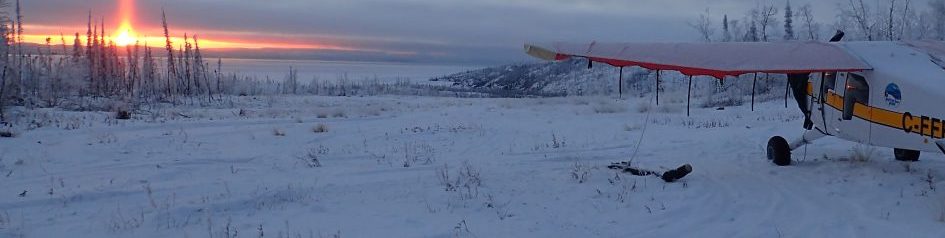
On June 5th, 2005 that premonition changed abruptly to reality. It was a warm sunny afternoon and I was out on the candled ice in front of our home, checking on the Husky bush plane which had in 1994 taken over for the old J-3 Cub. It was on its big tires, anchored to log deadmen under the melting ice, a few hundred yards out beyond the band of open water which had already formed near shore. I made daily walks out to it even if there was no flying work, to measure the ice and assess just how long the plane could remain parked there before float season needed to start.

As I strolled back toward shore after a look at the plane, happy that the ice was still 35 inches thick and quite solid for most of that thickness, I spotted a big black-and-tan animal on the east beach along the outlet of the Hoarfrost. A bear, I thought. But only for a split second, because unless bears had suddenly started to bunch up in herds of a dozen or more, this was something else. I stared, as dumbstruck by the sight as if I had just seen a pink elephant on a city street. Muskox. Ovibos. Oomingmuk. On the bank of the river, on the shore of McLeod Bay. This was unbelievable.

I ran as fast as I could to the edge of the shore lead, slid the aluminum canoe off the ice edge and into the water, paddled to shore, and rounded up Kristen and the girls. We set off, paddling hard for the river mouth. The herd was still calmly loitering through the alders and spruce and out onto the narrow scrim of cobble at the water’s edge. We counted 21 animals altogether, including 7 calves. We paddled slowly as we approached, and then stopped paddling and just drifted. The only sounds were the clicking of Kristen’s camera shutter and the occasional deep chuff or “ugh” from one of the animals. After at least five deliciously slow minutes they ambled up and away from us, into the trees. We paddled home.

One of many turning points in the time we have lived in this place, that day. That was ten years ago. In every year since, we have seen more and more muskox around here. One memorable morning a few years ago a herd walked up within spitting distance of the guest cabin. Ovibos have now become the most common large mammal (or “charismatic mega-fauna” as some would phrase it) that we see here – more common than moose, more common than bears, wolves, or wolverine. More common even than caribou – at least these years, in the wake of the huge burns and the recent drastic dip in local caribou numbers. This is fascinating to me. Even more fascinating is the fact that we are now north of many large herds, and that there are countless muskox – literally hundreds upon hundreds of animals – happily residing year-round down in the jackpine and poplars along Nonacho Lake, and far southeast from there.

The resurgence raises many baffling questions, and no one I have talked to so far has any solid answers. For starters, with the Arctic climate steadily warming, why are these marvelously cold-adapted mammals spreading their range so dramatically south? For another, why in all these years have I flown over only one spot where I can say for certain that a muskox had been killed by wolves? And is it true, as I hear, that even while these muskox march steadily farther into the boreal forest, the populations on Banks Island and other areas of the high north are collapsing?  Why, and how, and where will this resurgence, or colonization, or whatever it is, lead Ovibos over the coming years and decades?

I delight in these questions. It is re-assuring to me, in this age of such confident forecasts and solemn sure-fire pronouncements, to find Science more or less stumped by the sheer serendipity of wild Nature.  The other day, flying alone on a caribou survey for the territorial government, I counted 107 muskox, all well to the south of here, all far from the tundra.  Clearly, the resurgence is still on the advance. And having these shaggy beasts with their flowing thick coats join the local menagerie is still a thrill to me.   Oh and then there is  the welcome variety that two of them have in recent years added (legally, I hurry to add) to the Hoarfrost menu, and those luxurious – non-shedding! – sleeping hides spread on the floor of a winter tent at 40 below zero.

To Be Continued…

A note on comments – I am happy to hear from interested readers, but the posted “comment” feature of the blog set-up has for various reasons left me a little uncomfortable.   I do reply to email and postal mail, though.  Those addresses are:

dave@hoarfrostriver.ca

or Hoarfrost River, via PO Box 607

Yellowknife NT

X1A 2N5

Canada


Good day from the Hoarfrost at a solid 40 below.  Sun streaming in — each day a little higher and stronger.

A few days ago I received an e-mail from Gary Youngblood, whom I met in Fairbanks in 2004.  That day — our only meeting — he flew down from his new post at Bettles Alaska and became the new owner / pilot of our first Aviat Husky, C-FMCN.  Those who know me from back then will remember MCN as an Air Tindi workhorse during the halcyon years 1994-2004, when it flew far and wide around the high north, even making junkets on float-flying contracts up to Gjoa Haven, Igloolik, and Bellot Strait at the north tip of the Boothia Peninsula — the farthest north mainland point in North America (please correct me if I am wrong.)  MCN was in fact named for dear old McDougal, my Iditarod leader those years and in 1993 a nominee for the Golden Harness Award.  McNoodle was his nickname, thus MCN.

I do not know Gary well but I gather that he has had a wide-ranging and influential career with the U.S. National Park Service.  Thus he has lived out one of my Illinois boyhood dreams as to “what I am going to be when I grow up.”  (The others included FBI agent and astronaut… wow, how did I wind up shoveling dogshit at the Hoarfrost River?)

Gary’s roots are in Georgia, so please read his words slowly, with a soothing drawl.   Like my other friends from the Deep South, he strikes me as a true gentleman in the finest sense of the word.

Here below is a part of his note.  I emphasize the phrase that struck a deep chord for me as I read it.  It is that sense of not being singled out that I think is most important as we roam the burnt landscape that surrounds us here now.  Sadly, for Kristen and I, Gary’s phrase “it was just the system operating as it always had” takes on a sad double meaning vis a vis our ongoing discussions with the territorial wildfire suppression people.  After all is said and done, the fact remains that there was a well-equipped fire crew camped just a few miles away, for two solid weeks before the fire took out our house and guest cabin and the rest. Complacency carried the day — both their complacency and our own.

Well, read on — that aside of mine is not the topic here.

Dave,

…Your last blog struck a cord and I feel I may have something to share. In 1988 the fires of Yellowstone National Park changed the place I loved for the rest of my lifetime. I had lived and worked there since 1978. I had some of the exact feelings expressed in almost the same words you have used.

There were many small changes noticed in the ecosystem over the next 25 years. Burned areas that never before had been drifted were noted for the wind rows of snow. It was apparent that temperatures were colder in places where the trees had provided cover in the past. New species of raptors and greater numbers were observed due to the rodent population explosion after the fires. As you would imagine, some species suffered and some prospered. It was amazing to watch the ecosystem heal. Many more surprises were noticed, as you mentioned you expected.

My job assignments took me away from Yellowstone in 1990 and I returned in 1994. The healing that had continued in that time amazed me. There was joy over the following 10 years in watching a system heal itself. It was not the same as before the fires, neither was I, but it was beautiful in a different way. It came back gangbusters!

Those who were there in 1988 still talk about the fires and what we lost but also about the process of an ecosystem coming back that we were privileged to watch. I suspect the wildfires will be a touchstone for the rest of your life, as the Yellowstone fires of 1988 have been for me. I can now look back and appreciate that it was not done to me, it was just the system operating as it always had.  [emphasis mine — D.O.]

Finally, I hope you and your family find happiness and peace in whatever path you decide to take.

Gary Youngblood

Chief Ranger (retired)Gates of the Arctic National Park and Preserve; Yukon-Charley Rivers National Preserve


Birch leaves rustle in a light northeasterly breeze. A crisp -35° morning, but I am working (cleaning the dog yard if you must know) and my hat is off.  I pause and listen, struck by such a familiar sound so completely out of season.  A sound of July, the rustle of those leaves – yet no mistake, there it is again. The leaves are all a pale brown, clinging to their branches, toasted and killed by that blast of heat as the fire swept through. They did not drop in autumn, and when they will fall I do not know. They hang suspended, taken aback by the onslaught, as if uncertain what to do next.  Just like us.

January now. We remind each other we said we would take the winter and into spring. No big decisions for a year. Think on it, sleep many nights on it, walk and talk on it. Halifax? Red Lodge? Saskatchewan? Iceland? Stay? Go?

Questions. One is: is it more courageous to stay and re-build, or to find a new chapter in life somewhere else, and leave this place and these years as the treasure they have been, a saga lived and now complete? Hard to say which choice would demand more gumption, but I suspect that all things considered it would be the leaving. Which of course leads to another question: must we always choose the most courageous path in life, the path least traveled? What about that other path – the one of least resistance? The path that is simply more appealing, and never mind all the rah-rah about courage and gumption?

And what about love, and marriage? Our deep love for this place and our long marriage within it and with it bind us to it, scarred and disfigured though it now is. Hills and hollows, trails and shorelines, all so intimately familiar, are now all littered with black and ruin.  But it is still the same place, all the same places, known for years and with their stories dear to us.  Just as the visage of a beautiful loved one, wrecked and mangled in some awful accident, would still be the face and essence of the person we love.

Birches rustling in a January breeze. That’s a new one. I wonder what other surprises are coming. Surely there will be many.  Another one the other day was similarly subtle — the timbre of sounds up in the woods now is different.  “The woods” being now just acre upon acre of spindly charred spruce stems.   I shouted something to the dogs and was struck by the brittle ring of my voice, what with all those echo-dampening spruce needles gone.  A million trees burnt, moss and lichen gone, for miles nothing but clay and ash and rock beneath the snow. Oh yes, there will continue to be surprises, oddities, things never imagined, like the rustle of leaves at 35 below.

On January 6, 1873, John Muir wrote: “Instead of narrowing my attention to bookmaking out of material I have already eaten and drunken, I would rather stand in what all the world would call an idle manner, literally gaping with all the mouths of soul and body, demanding nothing, fearing nothing, but hoping and enjoying enormously. So-called sentimental, transcendental dreaming seems the only sensible and substantial business that one can engage in.”

This morning, a hundred and forty two years on, I concur. I  gape with John Muir for a while, then pick up the pail and shovel and keep scooping the dog yard. (When in doubt, stick with what you know!)    


Crosscut,

The bucked piece of spruce stands end-on in the snow.

The years catch my eye, all laid out there,

A concentric story plain as newsprint.

I set down the maul, and read.

Here at the tiny center it started,

Eager, young, steady eighth-inch rounds,

A lucky stem, happy in the sun.

Then some narrowing, a gradual bending out of round,

Some shading or competition maybe, to the southeast or southwest.

Thirty-five rings out, a stub of branch

Starts, then ends, swallowed up, thwarted.

A spur that ended only as a hard knot.

More years of rapid growth, another narrow decade.

Lean times, dry or cold or cloudy summers.

Eight decades out, a black line on one edge here – fire scar.

That one catches my eye.

Yes, I think, it had burned up there, a small area on the edge of the airstrip.

That time the rains must have come quickly after the lightning,

And kept on coming for a few days.

Getting out there now, 110 years,

Still a few good years,

Sixteenth of an inch or better, 

As this past spring came on, dry and cool after a cold dry winter, the life was out here,

At the flowing and growing edge,

This year would have been a very narrow ring,

Almost invisible without a glass, just beneath the rough and tumble bark —

But there will be no ring.

The bark is burned completely black on this chunk.

About 130 years on, it didn’t squeak by this one.


Wide rings, narrow rings, wide rings, thwarted knots, charred scar… more growth,

All those days in the sun, all those summers storing up, reaching, and now all black around.

Pick up the maul again.

Cleave it with a single swipe – the rounds just fall apart in this deep cold.

One final burn, and up the chimney.

Another Solstice past,

We survivors all start round the sun again.


Freeze-Up

A week or more sooner than we have learned to expect it, comes this most welcome gift of late autumn. In the starlit blackness there is no splash of waves, and at first light we can discern no bank of fog lying offshore. Deep cold, nearly thirty below zero, and more of the same in the forecast. Dead calm, and on the weather charts no tight isobars warning of a fresh gale. This will do it.

The bay, an honest seventy miles long and nearly ten across, has once again been transformed by the ever-astounding physics of water and ice. So recently a churning, steaming confusion of sharp-peaked waves and viscous November rollers, it is today one smooth pane of frosted glass. It is a blank white page, upon which now for six or seven months we all – fox, wolverine, sled dog, wolf, snowmobile, ski plane, caribou – will inscribe the story of another winter.

But first things first – bring all the ice skates in from the shed and warm them up by the stove!

Heard on the local CBC this morning — (I paraphrase, but almost verbatim):  “Although the Yellowknife Bay is frozen and people are walking and skating on it now, the ice may not be as thick as normal at this time of year — be sure to check the web for updates on ice thickness.”

An image comes to mind — man venturing out on smooth new ice, smart phone in hand.  Cautiously he moves forward, intent on the little screen, cold fingers scrolling down the menu…

There is a race horse on the thoroughbred circuit called All I Can Say Is Wow.  (I love race-horse names.)

For the latest news on the publication and distribution of my book Kinds of Winter please see the post called Announcement, from August 2014,

I have updated that August announcement post today.  There is a link there (and at the bottom of this post)  to the publisher’s catalog web page, from which the book can be ordered directly, at the best price, within the coming week or so. 

Your local independent bookseller or library should be able to order the book now, for shipping November 10. 

And of course the friendly local folks at  Amazon and all the rest are standing by in Calcutta, eager for your credit card number…  See lines above.

I will put out one more update when this all falls into place, which should be next week.

Here is the link to the WLU Press web page for the book:

Kinds of Winter

November 5, 2014

Today I am updating this page — the book is now coming out.  I am told it will start shipping November 10.  I have not seen it yet myself in the final form, so I look forward to that.  It is a hard cover book, and your best bet is to order it directly from the publisher, wait for it to show up at the library,  or — better yet — to buy it from your local independent bookseller.  Those stores need us.  Imagine losing them.  Not good.  This is to be a hard cover book, and it is not cheap.  I have no say in that part of the process, and no slice of the $$ pie at this point.  I do however stand firmly behind the decisions and experience of the people at Wilfrid Laurier University Press who make the calls on pricing and marketing.  It is a tough business.

Here is the announcement from August:

Amidst the aftermath of the recent fire, and as we look ahead at the effects that our losses will have on the future of our life at the Hoarfrost, there are a few bright spots.  This announcement is one of them.

In February 2002 I began an annual series of four solo trips by dogteam, heading out once each winter from our home at the Hoarfrost for a journey to one of the four cardinal directions:  South in 2002, East in 2003, North in 2004, and West in 2005.  I was at that point in my life just winding up a long and rewarding run as an Iditarod, Beargrease, and Yukon Quest competitor.  The non-competitive “compass point trips” were a long-held dream of my life as a musher. It was time for me to make that dream come true, and for four years, with the generous support of my family, I did.

Another part of that dream was to write a book about the trips — a book I envisioned as a rambling mix of travel journal, musings, observation and reflection.  Over the years 2002-2008, the book gradually took shape as a manuscript.   In about 2009 I began “shopping it around” with agents and publishers.  As is common experience with such efforts, there were many dead ends, long waits, some days of sheer frustration, and many rejections varying in tone from kind to terse.

Finally in October of 2012 there came a break.  A chance Yellowknife reunion with Mike English, a professor of Geography at Wilfrid Laurier University, sparked a conversation about my writing. I had known Mike for years from our time together up at the Daring Lake research camp, and he has always spoken kindly of my 1994 book North of Reliance.  When I told him of the new manuscript and the four trips, he offered to make a connection on my behalf with WLU Press.  That led to a query, a conversation, and at last a signed contract.

And now, after years and much effort, it is done.  The book has taken on a life of its own, as such projects do, and it is about to see the light of day.  Many people have worked to move it ahead, and I am happy to announce that it will be published this autumn.

The publicity people at the press encouraged me to send out a note and to post a link to the book’s online announcement here at the blog.  Not being too tech-savvy, I have followed the instructions to create the link.  I hope I have succeeded.

Here is the link (if I have done this properly):  Kinds of Winter

Title: Kinds of Winter

Author: Dave Olesen

Publisher: WLU Press at Wilfrid Laurier University, Waterloo Ontario  (Life Writing Series)

Issued in print and electronic formats.
ISBN 978-1-77112-118-7 (bound).—ISBN 978-1-77112-069-2 (pdf).—
ISBN 978-1-77112-070-8 (epub)

Thank you to everyone who has helped this project come to this announcement.

Dave

Now it is mid-August. I guess it is time to say something here. Cool weather has already come back, and some darkness in the middle of the night. The nightmarish heat and thick smoke of July is mostly past.  Night before last a downpour came, with thunder and sheets of rain – the first real rain we have had since sometime in the autumn of 2013.

Last night the ENR crew of 3 came by in their boat, to coil up hoses and pack sprinklers, stow the broken fire pump and shake hands again, inquire about the renovations at the big log workshop where we will winter.  Then off down the lake to stay ahead of a forecast overnight wind storm.

“Nature bats last.”

Easy to say, glibly and nonchalantly, with the right tone and the right stance. Wise words. Wisdom a little more difficult to acknowledge when she does step up to the plate and knock one’s entire life off kilter.

On the morning of the 4th of July I was up at the Daring Lake camp about 150 miles northwest of our home. It was just another day of Husky flying, with a wolf study and a grad student, checking out wolf den sites and looking to come up with a pup count at each of them. It was a summer morning, with a fresh breeze piping up from the east and a bit of tundra coolness in the air after the heat and flies of the day before. I sat in the office tent and tossed a back-and-forth Skype communication with Kristen, who was alone at the Hoarfrost River.

04/07/2014 7:28:21 AM

Dave: good morning, how is it there. cooler today up here with an east wind and no smoke.

Kristen: In a word. Smokey.  a bit of wind here too but I can only see a couple miles out on the lake. have a good day.

Dave: love you. flight plan on file here.

Kristen: OK xo love U 2~ me

And by that night, everything had changed. Our beloved house was gone, with everything in it. 17 years, 20-some since the first logs of its walls were cut and hauled and peeled and stacked. Gone too, the beautiful log guest cabin, apple of my log-builder’s eye and home to so many people doing so many different things over the 10 years of its life — for these buildings do seem to have had lives — gone, two sheds stuffed with the coming winter’s firewood — gone. The rest of it given up for lost, saved by sprinklers and hoses and lake water pumped at the eleventh hour.

By mid-morning on the fourth of July, two hours into the day, there was a full gale blowing here. Winds gusting over 30, peak gusts above 40 knots. The smoldering taiga-edge fire I so casually described in my blog posting of July 1, poised about 6 nautical miles northeast of us, began to run. Really move, as fires rarely do here. The swath of blackened ground lying northeast of us now has to be seen to be believed. That fire ran down those long sloping valleys stuffed with a hundred years or more of dry fuel. Ran and blew and must have also tossed some burning embers well ahead of itself to leap and speed its movement.

Kristen knew early on in that day that all bets were off. Despite her calls for help no one came or responded. “We have you on our radar” “We’ll send a plane out this afternoon to have a look” “The remote sensing image still shows the fire 9 kilometers from you.”

By mid afternoon she had fought her battle with every bit of strength and savvy she had, our little pump and hose “like a weasel pissing” by the time the long run of hose had reached north of the house.  The flames were in sight, a few meters back from the house, with the guest cabin already beginning to burn. She was driving the skid-steer, dumping sand in a last-ditch line south of the house, when she saw a hare bolting from the forest edge, and it struck her that this was it. She did what any sensible person – all alone after many hours of exhausting struggle and mounting fear and unheeded calls for assistance – would have done in her situation. She switched from fight to flight, turned the entire kennel of 44 dogs free to fend for themselves, took her camera and a laptop and her little carbine .44, a handheld phone receiver, left the communication systems turned on up at the doomed house, somehow wrestled the boat into the crashing waves and around the tip of the island to the lee side, and from the boat began sending messages and trying to make still more phone calls. The subject line alone still gives me a gulp whenever I see it, still sitting down there below a long line of condolence and assistance messages in the Inbox.

Re: FIRE IS HERE SEND HELP

THE FIRE IS HERE. I AM OUT IN THE BOAT, DOGS ARE LOOSE BUT IT IS STARTING IN ON THE HOMESTEAD.  HELP.

KRISTEN


Nature had stepped up to the plate.

Times like these, the remoteness of this place comes into sharp focus. Water bomber planes were inbound from Yellowknife, flying an hour or more with the 35-knot headwind right on their nose, following the “bird dog” lead plane that would show them where to drop, but by the time they arrived there was nothing to be seen but a solid wall of smoke. Hot brown thick smoke, the smoke of a raging inferno. There would be no drop. It was all going. There was nothing more to be done as Kristen sat helplessly in the boat, still trying to send communications, talking to the bird dog pilot on 126.7, trying to keep the dogs from fighting as they crowded around the boat out on the tip of the rock island. Our nearest neighbors Roger and Libby and their two teenagers Gus and Winnie arrived, after a harrowing 20-mile journey hugging the coastline in their two small boats, the waves of McLeod Bay huge and wild and white-topped. Roger went ashore with Gus and Winnie, and a 100-pound bottle of propane exploded almost at the same time they disappeared into the smoke.  Thankfully, they all emerged.  That was that.  No one with an ounce of sense was going back in there now. Then, a while later, a lone helicopter with 3 already exhausted fire fighters called in from another fire a hundred miles west, one pump, a length of hose, a few sprinklers. The pilot just at the brink of turning back in the smoke, his visibility down to a matter of a few yards. Then through the smoke he caught a glimpse of an empty fuel drum at the cache, and he kept coming. Had he not made it in, I doubt we would have any buildings at all left now.  By the time I taxiied in from the east, having landed several miles down the coast where I could still safely do so, there were sprinklers raining cold lake water down on the perimeter.  The wind had died.  It was nearly midnight. 

At about 1 in the morning, a final image of that night which I will never forget: one of the young firefighters went up to the smoldering house and heated his hot-dog dinner up on a stick.  I chided him about it, and he looked sheepish. “It’s o.k., really, you go ahead and heat your hot dog up.  May as well get one last bit of use out of the old place…”  We both laughed softly.

We have our shop, our sauna, our barn and sheds, our tools and boats and the planes and the office of our little flying and guiding business. But the heart and soul of the place is gone. The house is just a pile of charred and twisted rubble. I can scarcely bring myself to walk up there these days, so mostly I don’t. It will be a while. That lovely, quirky, cozy log and timber castle we had built – a thousand or so square feet in three stories, and all the special “stuff” of each of us four – books, carvings, photos, gifts… All the warts and foibles of my amateur carpentry, which even my most talented friends could not completely cover over as we built the place. The kitchen and its nooks and crannies and treasures, the clothes in long drawers beneath our beds upstairs.

Time to pick up the pieces.   Hell, it’s not like we are the first people to ever lose a house in this world.  A long-ago friend of mine sent what words he could offer. He called up an image I had forgotten, of the fellow staffer who would stand up at the close of the Sunday meetings at the Boy Scout camp where I worked for four summers in my teens. Delivered tongue in cheek, I suppose, in those days, with a suitably ponderous tone and a furrowed brow: “Endeavor to Persevere.” Roger, wilco.