Archive

Uncategorized

Morning, Hay River.  Dark and windy.  A week until the earliest sunset of the year, fourteen days to the Winter Solstice, and a little over three weeks until the days truly begin to expand at both ends.  This is my 25th autumn at this latitude (we missed one when we wintered down at boatbuilding school in 2000-2001.)  The darkness at this season is less oppressive than it was many years ago, in the old shack at the Hoarfrost, with its hissing gas lantern and finicky kerosene Aladdins.  These days at home we enjoy the moonlight blue of LED’s, a wonder at only a few watts each, and the old standby propane mantles help warm the tone of the lighting. 

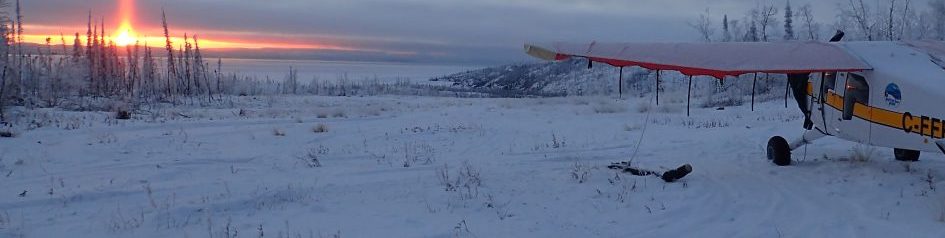
Here in Hay River where I am posted with the Bush Hawk on a 50-hour moose survey, there is electric lighting and plenty of it.   Bulbs and switches take the sting of long darkness away, until the moment at the start of each working day when I put on my headlamp and stride across the dark apron of the airport terminal, to the Bush Hawk parked out on the edge in the blackness.  I slip a hand under the thick insulation of the engine covers, and reassure myself that it is indeed warm in there.  Then I begin an hour or so of intermittent work.  First I plug in the cabin and cockpit heaters, so that the gyros and instruments can warm up.  I don’t leave those plugged in overnight simply because I don’t trust them.  The wing covers come off, the fuselage is swept, the tires and skis are scrutinized in the beam of my headlamp.  I go back into the warm terminal, now beginning to fill up with waiting passengers for the various scheduled departures on the airlines.  I phone Arctic Radio in North Bay Ontario and file a flight note for the day. 

I go out again, sweltering after fifteen minutes indoors wearing my thick clothes.  The frigid breeze is a stimulant and — lo and behold — there is some light in the southeastern sky.  I uncover the engine completely, check the oil sump with the dipstick, and climb into the cockpit.  Startup goes smoothly, and I warm the engine for about five minutes.  Shut down again, cover the engine again, leave the cabin heaters running inside the cockpit. 

Nearly light now.  The headlamp is stowed in my breast pocket.  I go inside and meet the survey crew — Sonny from Hay River, George from Kakisa, Karl from Fort Smith.  We look at the map and talk about the plan for the day.  We file out to the plane, stow all the covers and heaters, and taxi out.  For a few hours, wedged between dawn and dusk, we fly low and slow over the scrubby bog and forest west of Hay River, and south of the Mackenzie River.  We see some moose, and a few boreal caribou.  Mostly we see snow and trees and a very few outcrops of rock.  The day begins to wane.  It is becoming dusky again, and by the time we turn final for our landing the runway lights are blazing brightly.  It is not quite legally “dark” but it is getting closer by the minute.

Taxi to the fuel pump.  The crew jumps out and people groan and stretch a little.  They flee to the terminal and the truck.  “9 o’clock again tomorrow?”  Karl delivers them back to town, and in an hour or so, when I have finished fueling the plane and putting it to bed for the night, I call him for a ride.  In only sixteen hours it will start to get light again. 

It is autumn, and moose hunting season, and around here that has become a bigger deal than ever.  From a practical standpoint nowadays moose are the most reliable and attainable large meat animal in the neighborhood.  Used to be, twenty years ago, that moose were nice to have but the caribou were the real focus of meat-gathering.  I miss those days.   Also, in those days, it seemed easier to focus on my moose hunting – to decide, about September 21st (since we don’t have a freezer big enough to stow a moose it has to be cold enough weather for hanging until freeze up) that it was time to start and just get with the program:  early morning after morning, out in the boat; down to the old burn east of here; walk, stand, sit, sip cocoa or coffee; try a few amateurish moose bellows and grunts; listen.  Go back home.

Eventually that routine, based more on persistence and stubbornness than any real proficiency, resulted in success.  There is one place down that way where I could stand right now today and throw a stone to the precise patch of ground where each of six moose fell dead over the years.  That includes one that I didn’t kill, a mature bull killed by a big pack of wolves – but that is another story.  That one square mile or so was moose central those years, and we counted on it. 

Now many aspects of those early hunting years have changed.  The burn where I love to hunt moose was burnt back in the late 1970’s.   Year by year it has grown in, and it is not nearly the moose pasture it was 20 years ago.  Biologists have told me that moose use of a burn habitat peaks at about 14 years after the fire.  Here I think it might be a little longer than that, but eventually any burn will grow back and its attractiveness to the moose will decline. 

It seems, too, that my ability or resolve for stringing together day after day of steady morning moose hunts has shifted or passed away.  We are in a constant state of change here as a family, with the girls growing into young adults, and the demands of running a little air charter business, and the usual round of autumn projects demanding time at home.  I think the days of full family support for my 50 or 60 hours of moose hunting (and maybe no success!) began to wane a few years ago, and will likely never come back.  There was one memorable year when it seemed like I could not do anything right when it came to moose hunting.  I flubbed chance after chance, some of them seeming to be almost too perfect to mess up – i.e. two moose on an island and me, with rifle, in a boat — and we went into freeze-up eating fish and wishing for a caribou herd to show up.

The Bathurst caribou herd began a precipitous decline in the early years of the new millennium, and luckily for all of us (and for them) the Territorial Government wildlife people accomplished a harvest restriction which appears to have saved them from a truly disastrous bottoming-out, a la the cod in Newfoundland.  First the resident non-native hunt (i.e. us white people who live in the NWT) was curtailed, then stopped completely.  That was followed almost immediately by a complete and total stoppage of outfitted trophy hunting.  Then the real political hurdle came – trying to somehow curtail the Native hunt – First Nations, aboriginal, Metis people.  Even that has now been accomplished. 

Until those population numbers turn around, we will not see the opportunity to hunt caribou here.  If anyone had told us 20 years ago that there would come a day at the Hoarfrost River when we could not legally shoot a caribou, and a winter when we might go for months without even seeing a caribou, we would never have believed it.  But then again, had the same person told us that one day we would see muskox strolling along the beach here and hardly remember to remark about it at the dinner table, we would not have believed that either.  The other night, out cruising the shore with Kristen – looking for moose or a black bear – we spotted two muskox in 10 minutes, both of which were evidently loners and probably old bulls.  My trigger finger was twitching, but until our muskox tag comes from Lutsel K’e, we will desist.  The muskox in this neighborhood are doing very very well.

So it is moose.  The rut is on, the cold weather has begun to set in, and the season has been open since September 1st.  It runs until the end of January.  This focus on moose meat plays out in several ways here.  First, I adjust my flight paths whenever I am out flying, in order to try to include a careful scouting of the shoreline east and west of us.  Second, we try to get out at least once a day in the boat or on foot, armed and ready, looking and walking ashore, standing, sometimes calling, sometimes being quiet.  And third, I sometimes even go out in one of the planes – preferably the Husky with its quiet ease aloft and its minimum fuel burn – simply to scout for moose.

Which brings us to the question – if you have an airplane, aren’t you more or less guaranteed to get a moose if you try?  After all, there is no limitation whatsoever on “land and shoot” for moose here in the Territories.  Moose can be shot by a hunter standing on the float of a taxiing plane, and many in the Territories are.  I have myself shot several moose that were spotted from the air.  But only once, in 1998, have I landed on a moose AWAY from the shoreline of McLeod Bay, shot it, and loaded it piece by piece into a plane (the Husky) to transport it back home.  That process is, in short, difficult and unpleasant, and messy and hard on equipment.  Small floatplanes make wonderful moose-spotting machines, and terrible moose-hindquarter transport machines, especially for one man working alone. 

So I will live the next weeks in hope – there will be moose sighted, I am sure of that.  What I really want is that one along the big lake, preferably within two or three hundred yards of the shoreline, preferably early enough in the day that we can find home without having to shut off the outboard and howl from the boat, and listen for the dogs here to answer us and guide us in to our dock through the cold blackness of an October night.    


Cool rain in August, after the sun and heat of July.  The bay a sheet of dull gray metal, the sky a perfect match to it.  Now it gets dark again at night, and the days slip steadily toward autumn.  The wild blueberries are ripe and now almost over-ripe.  A bumper crop two years in a row, with warmth and moisture all timed perfectly for them, in alternate waves since early summer.

I love the return of darkness to our nights, and of weather that makes a sweater feel good in the morning.  I will miss the plunges into lake water, naked and dusty and sweating after work, but given the choice I will take the coolness.  The sauna will come back into use again by September, making a skinny-dip into the deepest lake in the Western Hemisphere thinkable for a couple more months.

The mosquitoes have eased, after a summer that – again like last summer – never really saw them get going.  One of our girls remarked wisely that when we get another normal summer of bugs around here, maybe next year, maybe the year after, it is going to be a rude awakening.  Yes indeed.

And the lake is up –the lake which we thought was perhaps down for good – conspiracy theories of our water robbed by the tar-sands denizens of Fort McMurray all swept aside at least for now, as the lake comes up and steadily keeps rising, even into early August.  It is matched by the river, full to its banks and flowing fast and white as it drops over the final miles into the lake.

I didn’t set out to say so much this morning.  Cool rain in August, after the sun and heat of July.  The bay a sheet of gray metal, the sky a perfect match to it.

Paul Rosset, 1956 – 2012

Paul loved the art and science of aviation. He loved airplanes, helicopters, torque wrenches, sparkplugs, rotor blades and propellers. He loved to talk about engines and compressions, airspeeds and approaches. Flying with Paul, sitting in a camp with Paul, or watching Paul work on a routine 50-hour inspection, I always learned something from him.
When the winds blow hard, a small aircraft is nothing more than an insect or a sparrow. Of course even a big airplane is nothing but a leaf in the wind when faced by the forces that move air and water and weather around this planet. Paul always took care to remind us just how delicate our machinery is, and how much it needs our care and attention to detail, in order to face the forces of nature.
When officials wade into the debris to investigate a tragedy, there is always talk of decision making. There are decisions that lead to other decisions, and those lead to the next and the next. In the cold light of analysis it is all too easy to view these chains of events as logical and direct and explainable, devoid of all the human side of our thought processes. But they are not.
The decisions Paul made that day in the Yukon led him along, moment by moment and mile by mile. We must remember this – Paul was not one to panic and he was not one to lose his cool. At some point he may have realized that he had no truly good options — a man who always seemed to make the careful correct decision, realizing that his options had become very few, and that all of them were bad.
But even then Paul would have continued to think and to decide. I believe that in those final seconds he was still thinking and deciding and acting, and that because of those final seconds and the choices he made, we are today mourning Paul, but the two people flying with him have survived. It was likely Paul who limited the scope of this tragedy. Hard words to say, but important — Paul and all of us can rest assured that to the very last split seconds of his life, he did his very best. When it came to flying and to turning wrenches, he expected no less of himself, and he expects no less of us who are still here.

Late morning.  Cool breeze and warm sun.  Plane heeled up on an open crushed-shale beach, a hundred miles southeast of the Hoarfrost and maybe twenty miles south of Taltheili Narrows.  My passenger Bruce, a research geologist with the Geological Survey of Canada, is off up the hill with his hammer, pounding off chunks of 1.8-billion-year-old outcrop, examining them for clues to… to something he could take several days to try to explain to me in layman’s terms.

I sit on the float step in the shade of the wing, writing up my logbook, making a few notes to myself in my “brain” – the little notebook I carry in my shirt pocket.  40 minutes pass.  This is one of the many versions of a day’s work.  It’s a good morning to be a bush pilot.

A scuffling sound from up the hill.   Bruce returning to the plane?  No, can’t be, not from that direction.  More sounds, gentle footfalls, rustling of leaves.  I tense.  There he is, or she – surely one of the most unlikely creatures to tread this miraculous planet.  Porcupine.  Blonde, comical, shambling, totally absorbed in his morning stroll.  Oblivious – for who, or what, would dare mess with him?  He ambles into plain view not 30 feet from the tail of the plane.  Up on his hind legs to grasp a willow shoot with both front paws, his bright-pink mouth and tongue turned toward me.  Eyes the epitome of “beady,”  but evidently not very sharp, because he makes absolutely no sign to show he has seen me.

He saunters off, pausing every two or three feet to pull down a tendril of shrubbery and eat a few leaves.  I return to my Journey Log:  “11 July, off Izok 1432 direct Yellowknife, down 1627, 1.9 hrs. air time.” 

From the point to the south the unmistakeable cackling scream of a bald eagle, in syncopation with the alarm cries of six or eight gulls.

Bruce appears, smiling, his packsack heavy with brick-size chunks of grey stone and holding in his hand a foot-square slab of dark-gray shale, a perfect 5/8” tile that could have been cut on a saw.  “Found your tile roof,” he says.  “It’s just up there laying around…”

We load up, push off.  Nose out of the quiet cove and into swells building from the southeast.  Taxi at least a half mile to find some shelter from the small island and narrows to the north.  Full throttle, a few bounces off wave-tops, airborne, and climbing in a gentle bank to the south toward Blanchet Island, the eagles and gulls circling below us in aerial combat, Mr. or Mrs. Porcupine somewhere down there in that green lake-edge, filling his odd niche in the neighborhood, living his unlikely life.

This little riff is about Garbage.  And clutter, or “stuff.” And Life beyond the Landfills.  And perplexity, bordering on pessimism.

In late July we will mark the 25th anniversary of my permanent arrival at the Hoarfrost River.  On the evening of July 27th, 1987, the steel-hulled freighter Hearne Channel rounded the headland to the west and dropped anchor offshore.  Aboard were my father Jim, myself, the boats’s owner and captain Dave Smith, 19 huskies, and a mixed load of freight including 5000 pounds of Glencoe Husky dogfood, about 20 sheets of plywood and some framing lumber, a 16 foot Lund skiff and a 17 foot Seliga canoe, 14 steel drums of fuel including one of kerosene and one of white gas (“Coleman fuel”), about 1800 pounds of dry, canned, and basic groceries; at least two tons of my tools, books, and clothing; four  dogsleds and a big crate of dogsledding gear; skis, tents, snowshoes, rifles, fishnets, ice chisels, and so on.  There were airplane tires and skis, for the 1946 Piper Cub which was already over in Reliance on floats.  As if that was not enough, we were towing two boats behind the freighter – a 26-foot fiberglass replica of a fur-trade North canoe, and a refurbished 17-foot Thompson runabout built of lapstrake mahogany plywood.  Also with us that night were a father-and-son pair of canoers headed east, Pat Leonard and his son Marcus, along with their canoe and their supplies for a trip down the Thelon River.  We had picked them up along the way and given them a lift.  (Pat didn’t like dogs, at all, as it turned out, which was unfortunate for him given our situation on board.)

It was, as Dave had wryly remarked as we had finished our loading back at the dock in Yellowknife about 28 hours previous, “a July load.”  By that remark I gathered he meant that it was so far over the 20,000 pounds he had quoted me as a load that he was glad it was July – typically the calmest of  the four months of ice-free water here.  The scuppers of the boat were maybe five inches from the waterline.  Luckily, we had – as Dave had hoped – nothing but mill-pond glassy water for 210 miles, from Yellowknife Bay right to the beach of the Hoarfrost River.

It was early evening, hot, calm and buggy on shore.  We ferried the dogs ashore and tied them out on a picket line.  After a day or so I ended up just  turning the dogs loose for a few days, until we got our first simple dogyard set up with posts and chains and makeshift A-frame plywood houses. (Watching how they spent those days, absolutely free to do whatever they wished and roam wherever they wanted, has always been a salve to my conscience when I keep dogs in their yard all summer, because they chose to do virtually no roaming, in the hot July and August sun, but found some sand and sprawled in it for 23 and a half hours a day – which is exactly what they do in the dog yard in summer.)  The dogs set ashore, we opened a bottle of whiskey that had belonged to my grandfather, and which we had saved for the occasion.

Wonderful memories, exciting days, our life here still a complete mystery to us back then…

My point here this morning, though, is still coming.  I arrived with a lot of stuff, yes, 25 years ago, but it was a drop in the bucket compared to the sheer volume, variety, and sprawl of… depending on our mood – stuff, crap,shit, froo-froo, garbage, clutter – that festoons our little acre of paradise now, 25 years later.

This is one of the unexpected lessons which our life here has brought to us.  We – Kristen and I – both grew up in little towns in the Midwest, where a household’s refuse and trash could be placed out by the street on the proper day of the week, and – poof – it would simply disappear.  We knew where it went, because on days when we had too big a load for the Garbage Men, my Dad and I could load up the trunk of the Pontiac, or even a wooden trailer to be towed behind it, and go directly out to the city dump.  There we could back right up to the nearest smoldering, stinking pile, and heave the leaves or woodscraps or broken dishes or, well, absolutely anything out – and drive away, consciences clean, problem solved.

Now, here, for 25 years, it has been different.  This summer is going to go down in memory as the Great Muckout, or the Quarter Century Cleanup, as we wade through the piles and layers of accumulated Stuff, in our various sheds and shops.  It has come to the point where in some of our buildings a person can hardly walk, much less have any hope of actually finding anything.  So it is high time for a Cull.  Some of the junk will be burnt, some will be shifted out to our own little version of a landfill or midden heap, some will just be stacked and organized more neatly, (probably just a reprieve from eventual incineration) and some of it will be shipped off to Yellowknife, fittingly enough, on the same Hearne Channel under the same Captain Dave, when he arrives next week with our annual load of airplane fuel and propane cylinders.  Once it goes back to Yellowknife, a kind friend has even offered to take charge of whatever “clutter” we decide to send west – books, children’s shoes, tin cans and glass bottles for the recycler.

But far outweighing any still-useful tidbits, there are mountains of Crap that at this point are just plain “landfill fodder,” and that is the truly perplexing, disheartening or enlightening part of this process..  I have, for instance, the accumulated headlamp parts and pieces from 15 years of long-distance dog racing.  That, in case you can’t imagine, is a lot of headlamp Stuff, and almost every bit of it is now obsolete and useless.  The headlamps themselves are all fitted for incandescent bulbs, which suck the life out of a battery about 20 times faster than the new LED’s.  A lot of the wiring and battery cases have a heavy component of molded plastic, which really should not be burnt (as my daughters remind me), and there are many “garbage conundrums” like dead lithium, nickel cadmium, and alkaline batteries.  There are plenty more utterly useless relics, like the old rechargeable screwdriver my sister gave me once at Christmas.  It is, like the headlamp stuff, now obsolete, useless, made of metal and molded plastic and filled with some sort of rechargeable battery and wiring.

And on it goes.  There is no curb to set this junk out to.  It will not go away easily, or mindlessly, and there is a BIG pile of it.  A quarter century of it, 200 miles from the nearest landfill, and no road from here to there.  Hmmm.

40 years ago, when I was a Boy Scout at Canyon Camp, one of the long-haired and hip Nature Merit Badge instructors (it was the early 70’s) gave us his lunchtime lecture on The Four Laws of Nature.  These were coined by Dr. Barry Commoner, a Founding Father of the North American environmental movement.  (Note — Commoner just died, age 95, in September 2012.)

I still remember them:

1)   Everything is connected to everything else.

2)   Everything must go someplace.

3)   There is no such thing as a free lunch.

4)   Nature knows best.

And now I stand knee-deep in the back shop, holding in one hand a broken plastic ladle and in the other a trapezoidal sun-cracked chunk of three-quarter inch polyethylene, once the source of sled brushbows and now the epitome of modern-day garbage.

It is a rainy gray day.  I am not sure if I should burn these things, bury them, or just stack them neatly off to one side where maybe one of my descendants can make that decision for me.  What I know for certain is that this is not the last of it, and that on this planet of 7 billion, I am not the only one wondering what to do with all this Stuff.


22 June, first day of summer; cool with a north wind gusting to nearly 20 knots.   Mosquitoes are out in force now, for the first time truly inside the house if a door is left open for even a moment.  Time to find the bug coils and light one at the entry-way downstairs.  The aroma of smoldering pyrethrins will mark the next few weeks around here. 

11 a.m., homeschool in progress.  Annika finishing a lesson in her electrical assembly course, Liv down to the final few hours of 7th grade with a grammar test emphasising subordinate clauses.  Me trying to help them, but feeling more and more redundant as they charge down the home stretch of a year of kitchen-table schooling.

Piston aircraft engine sound, inbound from the south.  “It’s a white plane on amphibs; it looks like a 185,” proclaims Annika.  The plane passes over the homestead and circles back out over the bay.  The no-nonsense style of flying, and the amphibious floats on a Cessna, mark him in my mind as one of a couple of different pilots, both experienced former airline captains who travel up this way on long tours in summer. 

The girls are excited.   I suppose as much by the break in routine as in the prospect of the visit.  Liv jumps up and runs out onto the balcony.  “Yep, it’s landing.”  Comes back in, puts a kettle on.  “Are you coming down to the beach Dad?”

Odd, my dismay.  Here we go again.  Summer has started now.  “No, I am not going down there.  You can go meet them if you want.”  I feel a sudden weariness, an odd tension and cynicism.   It is the mark of 25 summers of drop-in visitors, arriving on our doorstep day after day, by boat, by plane, by kayak and canoe, all with the same polite and predictable questions – home power, home school, number of dogs in the kennel…  fine people almost every one of them, day after day, month after month through summer after summer. 

Many years ago, a newcomer to the country, I would arrive in my boat at Trophy Lodge in Reliance.  I was always somewhat surprised that my two friends there, Lance and Richard, did not come down to the dock to greet me and walk back up to their quarters with me.  It was always the same – unless they happened to be out doing something, they would not come down to meet me.  Once I came up to their house, though, they would greet me and make coffee and we would visit.  Sometimes they would walk with me back to the dock. 

Now I have come to understand.  Today I wait in the house, and the girls go down.  On another day in the days that stretch out now for two solid months here, I may even go so far as to drift silently back into the edge of the woods and just wait until the people go away.  It has happened, strange as it may sound. 

They come up the path with the girls and into the house.  They are pleasant.  It is nice to see them.  We have met before.  He is, as I thought, the retired airline captain from Salt Lake, this year travelling and camping with his wife.  She is a lawyer, and runs a firm, and has checked in by satellite phone that morning from their camp to see that everything is humming along in her absence.   I warm to the occasion, make them tea and myself a strong cup of coffee, hear about their mechanical woes with a Continental 0-550 which he has decided to run past its 1700-hour TBO.  Questions about homeschool; a quick perusal of Liv’s spelling word list – “elasticity – wow, those are some hard words…” 

Out to the dog yard, the usual questions.  We stroll down to the dock and they say good-bye and board the plane…  A long slow taxi south into the bay, to turn and take off directly back toward shore into the  north wind.  A low pass, propeller snarling at full power, and gone. 

Summer has begun. 

“I grew up with the confidence that the greatest privilege was to be alone and have all the time you wanted. That was the cream of existence. I owe everything that I have done to the fact that I am very much at ease being alone (emphasis mine). It’s a good predisposition in a writer.”

— Marilynne Robinson, author of Gilead.

Gusty west wind and a brief burst of rain yesterday afternoon.  A few final shards of ice blew east down the bay, like bergs calved on some distant shoreline.  The bay will be ice free within a few days, I think.

In the sunshine of late morning I donned rubber boots, coveralls, latex gloves, and everything short of a clothespin for my nose, and set to work stretching  the cow moose hide from last December, down on the beach next to the tail of the Bush Hawk.  It has been soaking on a rope tether alongside the little stub dock there, an ice water bath for the past three weeks.  Most of the hair has slipped but it is not all coming free.  What struck me once again is just the sheer volume of thick warm hair on the hide of even a small moose.  Bushels and bushels of it, four inches thick, every hair a slender hollow cylinder.  Moose are an absolute miracle in this country.

The time to sleep is no longer the standard Hoarfrost River Dairy Farmer schedule of 9:30 p.m. to 5 a.m.  The time to sleep now is about 2 a.m. to 9 a.m.  It takes hours for the upstairs floor of the house to leak off its accumulated heat, for the dogs to romp and play from 10 to 2 after a day of lying semi-comatose in the hot sun, and for the mosquitoes to have their snacks and leave us alone in our beds. 

Well here goes.  

Went to the boat today; took off winter cover and troubleshot the bilge pump auto switch (blown fuse).  Another winter behind her (him).  What a beautiful little harbour.  (Harbor for you south of 49, or west of about 135?) Caught two nice trout along the shore of BlueFox.  On the grill for Father’s Day dinner.  

Hey that wasn’t too difficult — blog blog blog.  Is blog a verb or a noun?  Or like “run,” i.e. both?