I send this month’s post off into the ether as a response to reality.
“Response to Reality” is part of its theme, but there are some writerly realities I am trying to acknowledge and respond to by re-hashing, revising, and re-posting it. To wit:
1) The original version, posted November 2018, ran to nearly 2300 words.
2) Hardly a soul out there ever reads anything that long, on their screens, for kicks. (And yes, it has taken me a few years to realize this.)
3) Its message and its facts are interesting enough to me that I think they might interest other people – if only I can whittle them down.
And hey, I had fun writing it, about six years ago, and if you want to find the yawn-worthy original version, it’s still there in the Archives.
Here goes. E.B. White is rooting me on, I can feel it. (“Omit Needless Words!”)
My goal today is to dismantle a persistent myth about life in the far north. The myth is that somewhere just north of Winnipeg, (or is it Edmonton?) lies a vast region of endless winter darkness, where legions of forlorn Canadians, Alaskans, Greenlanders, Scandinavians, and Siberians all stagger around for months on end, fumbling with headlamps and flashlights, yearning for the return of the sun – which comes back in, oh, April or so?
I am often taken aback by the assumptions people make about light and dark in the far (and not-so-far) north, and I often find myself trying to set people straight. For instance, an Ottawa cab driver. When I told him I lived near Yellowknife, he replied, “Oh, way far north – so up there it is dark for six months, then light for six months?”
Or another brief exchange, down in Minnesota, when a neighbor of my mother asked about our winter darkness: “Are you and your family into that part of the year when it’s always dark?”
“No,” I replied to these questions – meanwhile rankling ever so slightly at the insinuation that to endure such abject misery one would have to be a little low on imagination, or gumption — “it’s never always dark where we live. For that you have to go way north of the Arctic Circle, and even up there they get way more daylight than most people think. Way more than Minneapolis or Ottawa, for sure, over the course of an entire year.”
If you will read all the way through this post, I think you will be surprised. I was surprised myself, several times, as I delved into the details of daylight, twilight, and latitude.
We are now a week past the Autumnal Equinox, and in the North we are losing daylight hand over fist as winter looms ahead of us. It can be a gloomy time of year for some people. That dark juggernaut hurtling toward us, and the turning point still three months away, at the Solstice, when we will start to claw back some light again, minute by minute, day by day.
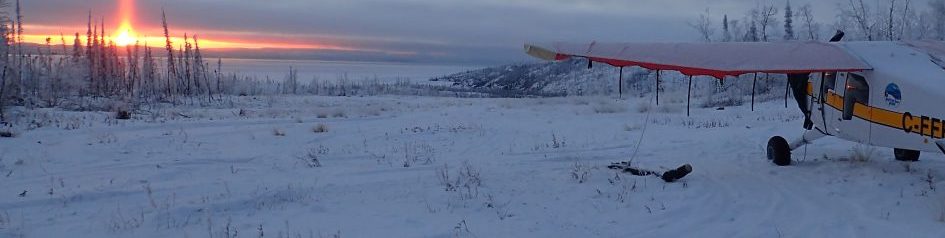
The thing to be thankful for, I find, is twilight. At this latitude, 63 degrees North, the morning and evening twilight make up a big chunk of each day’s total light. This “useful twilight” lasts longest in winter, when the days are shortest. Morning Civil Twilight begins when the sun is six degrees below the horizon, on its way up. If you are up early and outdoors, civil or “useful” twilight starts when you can turn your flashlight or headlamp off, and still get your chores done or see where you are walking. At the other end of the day, evening twilight officially lasts until the sun slides more than six degrees below the horizon, on its way down. In aviation, the time from Civil Twilight in the morning to Civil Twilight in the evening is usually called “Legal Daylight,” because between those limits an airplane can take off and land without any legal requirement for lighted runway markers.
In the North, with the sun on a shallower trajectory through the skies, the day’s two periods of twilight become a significant portion of each day’s usable light. Where I live, on the shortest days of winter, the sum for the day is about four-and-a-half plus three, that is, hours of sunshine plus hours of usable twilight. That is well over seven hours of useful daylight. That’s a lot more than zero — and that’s as low as we go.
Take it to the extremes and this light-and-latitude concept becomes clearer. At the equator, the sun rises straight up and sets straight down, plus or minus some variation. This makes twilight at tropical latitudes a very short part of each day, because the sun “moves” up or down through those six degrees just below the horizon in a few minutes, whether rising or setting.
At the other extreme, the two Poles, the sun never gets very far above the horizon, but it rises on the spring equinox, stays up for about six months, circling endlessly around the horizon in various arcs, and then, at the autumn equinox, sets for six months – just as the Ottawa cab driver thought it did in Yellowknife.
But… (There’s always a “but,” right?) The poles get more daily light than the equator, and there is no tidy straight-line increase. In fact, the maximum annual allotment of daylight (sunlight plus useful twilight) is at 69 degrees latitude. That is the latitude of the northernmost points of the North American and European continents, i.e. around Barrow in Alaska, Taloyoak in Nunavut, and Tromsø in Norway. At this most illuminated latitude, 69 degrees, there is one pesky detail, and it is one that I would find hard to endure, year after year. You’re above the Arctic Circle, and the glowing orb of the sun itself does not clear the horizon at all between the first of December and the tenth of January.
Moving south from there in search of the really sweet spot, where the sun will always rise and set and stay up for some hours of every day of the year, while still trying to maximize the total hours of sunlight per year, we get to the low 60’s of latitude, or about the latitude of Yellowknife, Anchorage, Reykjavik and Oslo. Between late May and mid-July, thanks to Civil Twilight, there are still six straight weeks of 24-hour daylight. No Midnight Sun, but plenty of Midnight Sunlight.
If your eyes haven’t glazed over yet – as my dear wife’s eyes do when I get truly fired up about all of this – I commend you. Just read on a few more minutes, because there is one more crowning detail, a gift for those of us in the Northern Hemisphere.
The northern hemisphere gets more sunlight per year than the southern hemisphere. The explanation of this discrepancy still sort of loses me, just as parts of my Astronomy course at college once did, but this daylight difference between the hemispheres has to do with the speed and shape of the earth’s orbit around our dear old star.
All of this, from twilight to latitude to hemisphere to annual averages, is more clearly explained and well illustrated by Brian Brettschneider, an Alaskan climatologist, here:
https://us-climate.blogspot.com/2015/06/daylight-and-twilight.html
Alas, the folklore of a half-year purgatory of frigid winter darkness, lying just north of Winnipeg or Edmonton, will be hard to dispel. It appeals to people’s abiding fascination with Misery and the Far North. Writers, musicians, and poets — including many who should know better — like to milk the drama of this fascination. Watch for it.
I may have re-written all of this just to cheer myself up. And if so, it seems to be working. Have a nice night, wherever this finds you. And hey, I just saved you over 1100 words. (You’re welcome.)
Footnote: If you want to generate a printable year-long table giving times of every day’s sunrise, sunset, twilight, local noon, plus total and average daylight, for your precise location, all courtesy of the National Research Council of Canada, go to:
https://www.nrc-cnrc.gc.ca/eng/services/sunrise/advanced.html
 "bushedpilotblog" Dave Olesen
You must be logged in to post a comment.