This month’s dispatch from the Hoarfrost River Home for the Chronically Bewildered is more nuts-and-bolts than usual.  My goal is to dismantle a persistent myth about life in the far north. The myth is this: Just north of Winnipeg, (or is it Edmonton?) there lies a vast region of endless winter darkness, where legions of forlorn Canadians grope around like cave bats for months on end, fumbling with headlamps and flashlights, yearning for the return of the sun – which comes back in, oh, April or so?

If you will read all the way through this post, I think you will be surprised.  I was surprised myself, several times, as I delved into the details of daylight, twilight, and latitude.

About a week ago I went to fetch water from the margin of the shore-fast ice.  This can be a pleasant chore at this season, on the good days, because the ice is thin and the edge of it is so well-defined that a few swipes of the axe open a bucket-sized hole for dipping.   Plus, there is a thin skiff of snow on the beach, making the job even simpler, because the full pails of water can be tugged up to the barn or the house aboard a rugged plastic toboggan of the type sold in Alberta ranch-supply stores as a “calving sled.” Of course there are some days in early winter here when water hauling is all but impossible, with big waves battering the edges of shoreline ice, and miniature icebergs growling against the shallow lake-bottom.  This turns the water to a tannish gray soup worthy of the Missouri or the Mackenzie at flood stage.  But those days are the exception. We try to stockpile some clear drinking water in reserve for those storms.

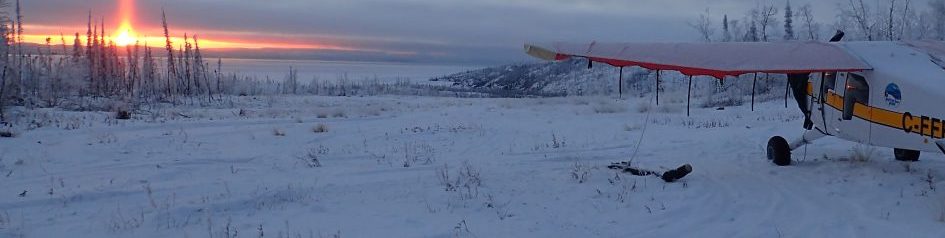
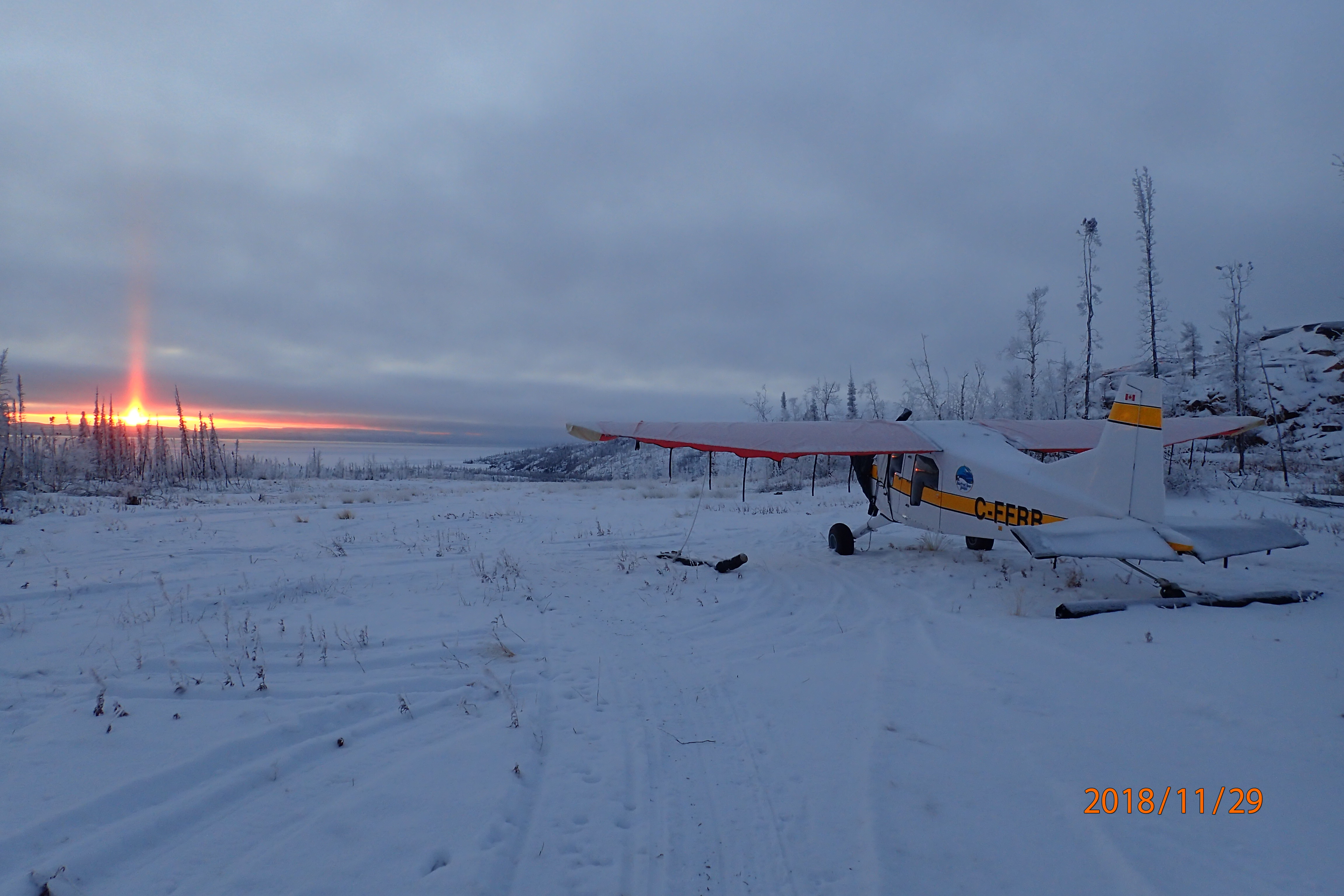
As I strolled down to the shoreline with my empty pails, the sun had not yet risen but it was already full daylight by any measure. At this latitude, very close to 63 degrees North, the morning and evening twilight make up a huge and significant part of each day’s total light, all year long. And by a happy gift of solar angles, the period of twilight lasts longest in winter, when the days are shortest.  As I stood there with my sled and pails, I admired the alpenglow dawn that was already shining on the topmost rocks of the big bluff north of our place, as the first rays of sunrise struck the peak.

It was quarter to ten or so in the morning, which may seem very late for a sunrise in late November, although as I have mentioned here before, our home clocks at the Hoarfrost are skewed out of sync with astronomical reality, because we have for 15 years or so opted not to change our time settings all year long.  (Mark my words, in a decade or two changing clocks twice a year will be a thing of the past. It is just plain silly.) We are north of Saskatchewan here, at longitude 109, and we prefer to stick with our sensible neighbors down in that prairie province, who remain yearlong on Mountain Daylight or Central Standard Time (same thing, 6 hours off UTC). This does make morning light come “later” and evening light last “longer,” at least on the clock. It’s all smoke and mirrors, really, but it works for us.

The sun that was beaming on the top of the bluff, while I was still working in a pre-dawn twilight (at least officially), started my delving into the details of light and latitude.

I have often been taken aback by the glib assumptions people make about light and dark in the far north, and I often find myself trying to set people straight. A classic example was a brief interchange in Ottawa in September 2015. I was down there to do some talks and readings from my book Kinds of Winter. The cab driver and I were talking as he delivered me to a hotel for the night.  When I told him I lived east of Yellowknife, he immediately replied, in a thick Slavic accent, “Oh, way far north – so there it is dark six months, then light for six months?”  “Well, no,” I said, “I live near Yellowknife, not at the North Pole. We get a lot of light in a year, and in winter.”

And a month or so ago, down in Minnesota, a friend of my mother asked about our winter darkness: “Are you and your family into that part of the year now when it’s always dark up there?”  Her tone was all gentle pity and perplexity, as if she was politely interviewing someone from an obscure religious order, whose adherents were bound to a dreary regimen of annual winter fasting and flagellation.

“No,” I replied, “it’s never always dark where we live. For that you have to go way north of the Arctic Circle, and even up there you get a lot more daylight than most people think.  More than Minneapolis, for sure, over the course of a year.”

The key to all of this is twilight. Morning Civil Twilight begins when the sun is 6 degrees below the horizon, on its way up. If you are up early and outdoors, civil or  “useful” twilight starts when you realize you can turn your flashlight or headlamp off, and still get your chores done or see where you are walking.  At the other end of the day, evening twilight officially lasts until the sun slides more than six degrees beneath the horizon, on its way down, and you realize that it’s become too dark to be running a chainsaw, or shooting at a ptarmigan, or that you better turn the back porch light on if the kids are still out there playing catch (do kids still play catch in the backyard? I gather I’m showing some ignorance here.)

The principle is somewhat (but not precisely) akin to that first dawn sunlight hitting the high spots and peaks, while the valleys are still in shade.  One of my favorite phrases, coined by an author writing about a long-ago canoe trip down the Mackenzie River, is “the North is an immense mountain laid out flat.”   The result of this, with the shallower angles of the sun’s path through the skies at higher latitudes, is that in the North the day’s two periods of twilight become a significant portion of each day’s usable light.

Take it to the extremes and this concept becomes more clear. At the equator the sun rises straight up and sets straight down, plus or minus some variation. This makes twilight at tropical latitudes a very short part of each day, because the sun “moves” up or down through that 6 degrees just below the horizon in a few minutes, rising or setting. I have never been to the equator, or even close to it, but someday I would like to visit there, if only to experience that amazingly abrupt change from day to night, and night to day.

At the other extreme, the two Poles, the sun never gets very far above the horizon, but, simplified a little for the sake of this discussion, it rises on the spring equinox, stays up for about six months, circling endlessly around the horizon in various arcs, and then, at the autumn equinox, sets for six months – just as my friend the Ottawa cab driver thought it did in Yellowknife.

But. (There’s always a “but.”) The poles do get more daily light than the equator, but there is no tidy straight-line increase. In fact, the maximum annual allotment of daylight (sunlight plus useful twilight) turns out to be at 69 degrees latitude.  That is the latitude of the northernmost points of the North American and European continents, i.e. around Barrow, Alaska and Tromsø, Norway. The middle high latitudes, from, say, the high fifties to the mid-seventies, maximize the total illumination, the sum of daylight and usable twilight. At the latitude of the northernmost mainland in Europe, Asia, and North America, the sweet spot is reached, and the yield, at 69 degrees North, is the highest average daily total illumination over the course of an entire year – a whopping 15.1 hours of illumination per day.  This is direct sunlight, i.e. sunrise to sunset, plus civil twilight added onto each end of that.

At this most illuminated latitude, 69 degrees, there is one pesky detail, and it is one that I think I would find extremely hard to endure, year after year.  At 69 degrees North the sun does not rise at all between the first of December and the tenth of January.  Still, on Winter Solstice at that latitude, there are just under five hours of useful (Civil) twilight.  But no sunshine for almost 7 weeks, only twilight.  That’s a stretch.

Moving south from there in search of the really sweet spot, where the sun will always rise and set and stay up for some hours of every day of the year, while still trying to  maximize the total hours of sunlight per year, we get to – well, we get to the low 60’s of latitude, or about the latitude of Yellowknife, Anchorage, Reykjavik and Oslo. And on the flip side of winter, thanks to our friend Civil Twilight, even though the sun sets here on every night of the year, there are still six straight weeks of 24-hour daylight in late spring and the first month of summer.

If your eyes haven’t glazed over yet – as my dear family’s eyes did about three days ago when I got truly fired up with writing (and talking) about all of this – I commend you.  Just read on a few more minutes, because there is one more crowning detail, a gift for those of us in the Northern Hemisphere.

It is this: the northern and southern hemispheres are not mirror images of each other when it comes to illumination, even at precisely the same latitudes north and south.   The northern hemisphere gets more light per year. The explanation of this discrepancy did at first sort of lose me, just as parts of my Astronomy course at college once did, but this daylight difference between the hemispheres has to do with the speed and shape of the earth’s orbit around our dear old star.

All of this, from twilight to latitude to hemisphere to annual averages, is very clearly explained and well illustrated by Brian Brettschneider, an Alaskan climatologist, here:

https://us-climate.blogspot.com/2015/06/daylight-and-twilight.html

Alas, the persistent folklore of a purgatory of winter darkness, lying just north of a 50-something mid-latitude, will be hard to dispel. It appeals to people’s perverse and well-entrenched fascination with Misery and the Far North. Authors and poets milk the drama of this, even those who really should know better.  Here is a character from Rudy Wiebe’s widely acclaimed historical novel A Discovery of Strangers, describing the onset of winter for Franklin’s overland expedition in 1820-21, near the present-day location of the village of Wekweeti:

“And the sun did lie lower and lower on the horizon until it disappeared altogether and we lived in an endless darkness for over a month, relieved only by stars and moon and the aurora, or firelight.”

Hold on here. The location of Fort Enterprise, as Franklin called the site, at 64⁰ 28’  North (X 113⁰  06’ West), would have had, and still does have, on the very shortest day of the year, no less than three hours and 55 minutes of direct sunlight, plus two hours and 50 minutes of useful morning and evening twilight, boosting total daylight time to 6 hours and 40 minutes on the winter solstice“An endless darkness for over a month” simply does not happen there. Never has, at least since the Earth adopted its present orientation in space. The myth persists. As in so much writing about the far north, it seems to be too hard to resist a little exaggeration. Hyperbole makes for dramatic images, and it may help everybody down in Ottawa, Toronto, Minneapolis, and Chicago feel better about their long dark winter nights.

Six p.m. as I proofread this. Twilight has faded away.  Today, the last of November, we’ve had our 5.63 hours of sunlight, and our 2.12 hours of twilight, and Ottawa has had its 9.03 and 1.11; Chicago its 9.37 and 1.03. Over the course of the year, the average total daily illumination in the three places is: Hoarfrost River: 14 hours, 45 minutes;  Ottawa: 13 hours, 20 minutes;  Chicago: 13 hours, 12 minutes.

It will be dark tonight for many hours, up here and down there.  There are many weeks of this ahead.  We will all be glad when once again the swing of solstice passes and we start to gain a few minutes of daylight again.

Perhaps I have written all of this just to cheer myself up. And if so, it seems to be working.  Have a nice night, wherever this finds you.

Footnote: If you want to generate a printable year-long table giving times of every day’s sunrise, sunset, twilight, local noon, plus total and average daylight, for your precise location, all courtesy of the National Research Council of Canada, go to:

https://www.nrc-cnrc.gc.ca/eng/services/sunrise/advanced.html

If you run into problems with that, drop me a line.  This is one of the few things I know how to do on the confuser and the inter-web. I enjoy it, and I can help if you need it.  daveolesen@gmail.com  


“The old Imperial sun has set, 

and I must write a poem to the Emperor.

I shall speak it like the man

I should be, an inhabitant of the frontier,

clad in sweat-darkened wool,

my face stained by wind and smoke.

   — John Haines, from “The Sweater of Vladimir Ussachevsky”


“I’d rather wake up in the middle of nowhere than in any city on earth.”

   — Steve McQueen


I’ve been “out,” that is, away from home, for the past sixteen days, most of those days at various places in western and northern Canada, and six nights down in what I used to jokingly call The Excited States of America. That old joke is now wearing a little thin, I’m afraid. As are tempers and discretion and polity and a whole lot of other things, both above and below the forty-ninth parallel.  And, nope, I haven’t got an intelligent or enlightening word to offer on that topic here, so I will not try.

Now I’m home. Got home on Monday, touching down in the Bush Hawk on its fat autumn tires, up on the bench of snow-covered sand a mile uphill from our place.  I was as tense as usual flying out from Yellowknife, having traded the floats in for tires, yet still aloft over miles of open water, and I was as tense as usual to get the plane down and stopped in the sloping 500-some feet offered by our “airstrip.”  As usual, this was not a problem – but if ever I cease getting nervous on short final to a landing up there, that will not be a change for the better.  Butterflies and sweat are such wonderful aids to concentration.

Once the plane was tied down and blanketed with fabric covers on its wings and cockpit and cowling, and once the chores were done and the dogs were fed (alas, no stars o’er head that night; sorry, Robert Service) I walked to the lakeshore in the deep dusk.  There is a humped granite island that juts right out into the bay a hundred yards south of our waterfront.  We still call it “the island,” because back in our early years here it truly was an island, but it has been only a rock peninsula (Latin, almost-island) since about 1993, when the lake level started to drop off.  A narrow spit of sand connects it to the shoreline, where decades ago we could paddle through with a canoe between shore and island.  Across that spit a wire cable is slung on tripods, carrying current from our thousand-watt windmill. The windmill is mounted on a thirty-foot steel pole on the crest of the “island,” and it is highly praised here in these dark windy days of autumn, long after the solar panels have called it quits for about the next four months.

Sometimes I walk out there to have a look at the guy wires on the windmill, but the other night I walked out there only to lie down.  I’d been looking forward to doing so for over a week.  Just to stretch out prone on the cold smooth slab of granite there, a few feet from the edge of the lake, and let all that time down south in the frenetic world “outside” begin to wash away.  I just needed that place that night; I needed to feel that rock of home right there beneath my spine.  It had been quite a time away from everything I love here, and most of the past week of it had not been at all pleasant (think low-end motels, unexpected delays, days at the mercy of schedules not my own, the weather giving some tense moments as I finally flew north, and all of this endured essentially in solitude, which does get old after a while even for a solitary soul like mine.)

I am always happy to come home, but the other night happy to be home does not even come close to what I was feeling.

I lay there for a long while. Quiet sloshing of waves on ice-coated bedrock. Cloud cover thick and the night truly dark. My mind running back over the weeks away, and to the wide world out there, stretching away beyond the horizon to the south…


From a Baffled Admirer


Okay, I’ll come right out and say it.

You have my grudging admiration.

Grudging, I suppose, only because it has never come easy

for me to admire you.


Tonight you have my admiration,

because after two weeks immersed in your world,

I honestly can’t see how you do it.

I wonder whether I could ever live as you do,

and handle it all with such aplomb,

such unruffled patience and resilience.

Lately, more and more, I think not.


So tell me, friends, how do you do it?

How do you cope and juggle and keep it all between the lines?

The lines both real and metaphorical: 

those scary white and yellow ones blurring on either side of the car at eighty per,

our three-ton nine-foot ride nipping past a forty-ton ninety-foot semi in the dark on I-94;  

and all those other lines, laid out straight as if to define the edges

of all that rush and whirr and whiz bang?


Day after night after morning after evening

you nonchalantly poke at keypads,

step to one side and fire off a text message from the grocery aisle,

like a battle-hardened infantryman calling in air support,

scroll down screens and ask omniscient Siri for answers,

and all to the tune of those incessant

beeps and chimes and dingalings.


And it never seems to faze you!

Likewise the hundred and some channels of blood, gore, and trash

on the motel tee vees,

the grim-faced pat-downs at Security,

Inter-web, hyper-text, Twitter feed,

and Orwell’s dire vision borne out before our very eyes,

34 years past 1984.

You all just carry on, make small talk, and smile. 

You’re pleasant. You’re cool, calm, and collected. It’s amazing. 

You’re amazing.


Come right down to it, the answer is: I honestly don’t know how you do it.  

And I don’t know if I could ever learn to do it.

This old sled dog just can’t learn all these new tricks.


I am happy to have made it home,

to be lying here looking out

over dark cold water.

Still, happy as I am

on this third-to-last day of October, twenty-eighteen,

I cannot help but wonder

where the rest of you are tonight.

And how it is

that the human race has become so utterly entranced,

so clearly infatuated,

so savvy and adept and calm,

while immersed in that rush and whirr and whiz-bang?


It beats me.

It truly does.        


When a pilot files a Flight Plan with Air Traffic Control, there is a rapid-fire exchange of numbers and codes, times and altitudes. In among those numbers is, of course, “total number of persons on board.”  Old-school Flight Service briefers often use a vernacular for this and ask for “souls on board,” as if to say, just give me the total number of human beings inside the machine at liftoff, regardless of whether they are pilots, passengers, flight attendants, mechanics or skydivers. It is a concise way of pegging the number. And at times thought-provoking.

A week ago today, on one of the only sunny days that this entire September 2018 has offered up, my daughters and I organized a fly-in surprise party to mark Kristen’s passage to an age where she can swim for half-price at some community swimming pools.  Her birthday is in October, but by October there is little chance of a pleasant floatplane fly-in here on the taiga.

The day depended completely on the weather for the flight, and the wind and water for landing here. As Sunday approached I was watching the forecasts.  There was some optimism in the public weather forecast, some pessimism in the marine forecast issued for boaters, and not much definitive to be gleaned from the aviation weather maps. My fingers were crossed. The incoming plane was a Twin Otter from Air Tindi, and the Twin Otter on floats can handle some big waves and swells, but I knew there was a good chance that even if the day was warm and sunny, a southerly wind here could make us cancel the flight and the party.

It is a little-known fact of wind and wave physics that in autumn, when both the air and the water are colder than in summer, a given strength of wind, say 10 knots, will generate a bigger and more powerful set of waves and swells. The reason is that both the air and the water become denser as they cool. The cold wind pushes with more force and the cold waves formed by the dense water have more mass and momentum – the water weighs more and so does the air.  I am a little out of my depth here, but that is how I understand it. It is a concept I believe, because I see it borne out every fall when colder air pushes on cold water and creates bigger, more powerful waves than at any other time of the year.

The mild sunny weather that made last Sunday so nice came at the price of a breeze from the south. A south wind, and especially a southwest wind, is the most troublesome wind direction here at our place, because of our exposure and the “fetch” that the waves have as they march down more than 60 miles of open water. Big waves and swells are the bane of floatplane pilots. As I have written before, a floatplane is a marvelous and useful contraption, but in truth it makes a very poor boat.  If a boatbuilder set out to break most of the rules of boat design, the result might be something like a floatplane:  huge wind-catching area above the water, with absolutely no ballast down deep under the surface to stabilize all that sail area. It is only a small exaggeration to liken a Twin Otter on floats to a small schooner, complete with topsails, perched on a pair of oversized canoes.

On the morning of the big day I snuck out from the house with the portable satellite phone, to pass the weather along to my old friend Mike Murphy, who was to fly the plane in from Yellowknife.  He was concerned by the southerly breeze and the waves it would generate here.  “Do you think we can do this?” he asked in the blunt style which is his trademark.  “Yes,” I said, “but Mike, just know that if you get out here, and you don’t like the look of it and you head back to town without landing, I understand and I’m good for the cost of the flight, no questions asked.”

When the plane appeared overhead Kristen was out picking berries, taking advantage of the only warm sunny morning we had seen for weeks.  The Twin circled several times, as Mike and Joe looked over the options.  Between the two of them, and with another life-long pilot, Kim Zenko, sitting back among the passengers, there were something like 60,000 hours of bush-flying experience looking down and assessing the wind and water situation at that moment. Mike set up for an approach into the sheltered bay east of the river, and after touching down he rounded the point and began taxiing toward the river.  I was out in our skiff, to show Mike the channel into the river mouth, and I could see the plane’s wings rocking wildly as the jumbled swells rolled beneath the floats.  I could well imagine the scowl on Murphy’s face, having sat beside it in the cockpit many times in my co-pilot days 25 years ago.  After a few tense moments he turned back north into Gyrfalcon Bay, where he had landed, and nosed the tips of the floats onto a rock slab there. With the plane secured to shore, I shuttled the 18 “souls on board” across by boat to the homestead in three trips back and forth. Once we were all assembled at our place the day turned sunny, mellow, and happy.

Golden September warmth, laughter, good food, sober strong coffee for the pilots and the boat driver, beer and wine and some other concoctions for the rest, music and birthday cake for everyone. Kristen was astounded and surprised. A rare and unforgettable event, to have such a big group of long-familiar faces assembled at once, here in the far reaches of the hinterland.

In early afternoon Mike asked if we could go across by boat again and check on the plane, before the music got started inside the workshop. We motored over and saw that the plane was sitting fine and steady, lines all taut to shore. But as we came back across in the boat, Mike and Joe and I could tell that the pesky southerly wind was shifting ever so slightly, probably imperceptibly to almost everyone else at the party.  The breeze, which that day never got above 10 or 11 knots, had veered 30 degrees or so, from south-southeast to south-southwest.  This new direction, if it sustained itself, would expose the calm refuge of Gyrfalcon Bay to mounting swells.  Not good.  Some frowning and murmuring and squinting amongst the pilots.  We stood together out on the sand and looked at the big pennant up on its tall pole, and out onto the water.  We struck a deal.  Instead of starting to shuttle everyone back to the plane at 5, we would start at 4.  The planned music would have to be cut pretty short.

We went inside the warm workshop and Ryan and Claire started into their repertoire. Angel from Montgomery, a Hoarfrost River favorite by John Prine, had been among my few specific requests for this day, and Ryan started us off with a fine rendition of it. I was sitting on a bench next to Joe Reid, the second pilot that day, and I could tell he was watching the wind and the waves intently.  At one point he leaned over and whispered to me, “Look at the wind — I think it’s calming down.” Captain Mike was inscrutable, eyes closed, either listening to the music or just trying not to rush out the door and insist that we all get going.

At 3:53, between songs, Mike asked what time it was.  I smiled and said, “Let’s get going.  We’ll take one boat load and all the gear from here, and everyone else can walk to the river and we’ll shuttle two trips from there.”

We had everyone to the plane within 45 minutes or so, and when the door was closed I backed away in the boat.  I motored over to the north island and climbed onto its rocky top.  The wind had settled by then; the protected bay was smooth, and I listened to the roar of the Twin’s turbines as the plane taxied up to the head of the shallows and turned south for the takeoff run. I thought of the day, of the connections and friendships of all those people, and of the wind and the waves and the decision to cut the music short and get going while the going was good.  No regrets. The sound of the engines rolled off the cliffs and the spray flew up.  Airborne. Climbing and banking, water streaming and sparkling off the tails of the floats.

Two hours later the wind had dropped almost to calm, and we chuckled as we looked out on the lake. Decisions are made on what is happening — not on what might happen. Souls on board, safe and sound. 


It’s a gamble, anywhere, building a house. A game of chance. As we mark the second year of raising a two-story log octagon here at the northeast tip of McLeod Bay, 210 miles up the coast from Yellowknife (lumber yard, hardware store, saw-chain shop, beer supply), it strikes me that while some of the stakes seem higher out here, others, thankfully, are a lot lower.  That is to say, no blueprints, no building code or inspectors, no underwriters or premiums, and no mortgage.

Common sense (that rare bird nowadays), talented helpers, and the funds we have set aside for this will together carry the day. By the time the snow flies, we hope, the roof will be on and work inside can proceed over winter. The perspective I try to hold in mind is that it’s a game of both skill and chance like most good games. There is a set of rules, and a start, and a finish.  And this, too:  if it’s not fun, why play?


The game goes on for months.  Every day we walk up to the site poker-faced.  Get out the steel measuring tape, bubble level, and framing square. Find the hammers, sledges, chisels, saws, and fat sharp auger bits.  

We shuffle and deal. Off to one side, morning after morning, sit those two old card sharks, Entropy and Decay.  Gravity takes his usual seat, down low, almost out of sight. Someone yanks on the generator, and someone calls down a measurement.  A circle-saw starts turning gasoline into sawdust and noise. 

Just before morning coffee, somebody floats a question. “Hey, depending of course on the roof being sound, will you old curmudgeons give us a hundred and fifty years here, if we support these upper joists with a full-length timber, then brace, notch, and pin them, and slather the tenons with linseed oil and turpentine?”

“You do all that and we’ll see your one -fifty and raise you fifty,” comes the answer from down near the first-floor posts.  Both twenty-four-foot girders nod.

“But you people do remember“ – it’s a joist, chiming in – “that what we’re making here is just a wager, not a warranty.  That this is all coming down, one way or another, someday.  You’re keeping that all in mind?”

“Yeah.  We know.  We are.”

Okay then, we’ll see your raise.  We’ll bet the whole two hundred, what the hell.  Brush on the oil and whack those four down.   

Flying a trio of university geologists from the Tree River camp on the Arctic Coast east of Kugluktuk, Nunavut. A three-day stint of short hops, hours of waiting, pails of rocks.  Base camp a bastion of old-school fishing-camp ethos (meets modern barbless catch-and-release.) The arctic char are starting their annual run upriver, and the fishing lodge on Great Bear Lake is offering overnight fly-ins to the mouth of the Tree.


This morning in the kitchen shack

the camp man Shane watched me make my lunch:

store-bought bread, Kraft crunchy peanut butter,

some Swiss cheese and leftover breakfast perogies.

“Here Dave, grab a kiwi – these aren’t gonna last long

and we got no more guests ‘til Sunday.”


Graham, the geology prof from Edmonton,

quipped in his droll British accent

“One might marvel at the carbon footprint of those kiwis.”

Yes, one might.  One does.

Still I took Shane’s point –

In three days these weary kiwis so far from home

would be in the garbage pit upriver.

I slipped one into my lunch bag.


Now 3 p.m., the plane’s floats pulled up on a polished slab

of a saltwater cove on Coronation Gulf.  The Northwest Passage.

Snow still speckles the hilltops, but there is no sea ice in sight.

I reach into my knapsack and pull out my kiwi.


Growing up in Illinois, I never even knew what a kiwi was, except as a nickname

for New Zealand troops in the histories of World War Two I’d read.

Apples, yes, corn and tomatoes, squash of course,

and citrus fruit from Texas, by truck, in season.

But kiwis? mangoes? avocados?  pomegranate? Nope.  Not a chance.

And – we never missed them.


I am struck by this as my sharp knife slices the fuzzy kiwi

and the peelings drop into the Arctic Ocean.


Sometimes in life I wish I did not have so many doubts about it all.

I mean all of it:  airplane, kiwis, flown-in fishermen, the Tim Horton’s drive-throughs…

I wish at times I could just relax and enjoy,

with a big dumb grin pasted to my face,

the sheer wonder of a kiwi east of Kugluktuk

on a sunny July afternoon.


I eat it all, looking out over the blue Arctic sea.

It tastes good, and utterly superfluous, and wrong.

And no, try as you might,

You won’t convince me otherwise.


Mid-June, McLeod Bay.  Two degrees overnight, four degrees now.  Clear and calm, and a thin layer of fog blankets the near horizon of ice.  The sun is well up in the sky and it is not yet seven in the morning.   It is June mornings like this, just before Summer begins, when I most love the season that  has not even officially started yet. July gets all the rave reviews from most of our non-native northern friends, but here at our place not one of us lists July as a favorite month.  In fact it is not even very high on the list. 

A friend from southern Minnesota called last night and told about a daily heat advisory there, steamy air, and temperatures already into the high thirties (the high nineties F.) by late morning.  Yikes.  I grew up in Illinois, so I remember those days, my summers spent mowing grass and laying sod, soaked with sweat and daydreaming about the mountains and the far north. 

June, especially the first half of it, is an especially good season here.  Miles of white and gray ice still quilt the bay, but the inflow of the Hoarfrost River opens an area of water bordered by shorelines of beach, forest, rock and the crumbling edge of the “pack ice.” With the frozen bay as a breakwater, this swath of open water out front is more like a lake in cottage country than a seventy-mile arm of Great Slave Lake.  It is never wracked by whitecaps or the big swells that pound the coast after many miles of fetch.  Those pounding swells can see us out on the shore at all hours of the day and night, wrestling to secure planes and boats and gear.  On our little June lake we paddle or row out to fish, or to fill a bucket with candled ice for lunchtime lemonade or evening whisky.  By June 10 or so, the area of open water becomes roomy enough to take off and land in a good floatplane. The mosquitoes are now barely getting started, the onslaught of little blackflies is still a few weeks off, and the first pale-green leaves on the birches just appeared a few days ago.  

The two periods of the year surrounding each solstice are usually times of stable weather here, because the wide daily swings of solar energy, night to day and back again, have almost disappeared.  In the weeks on either side of winter solstice the darkness dominates, and in June it is never dark at all.  It can get truly hot here, even before the solstice and with ice still covering the bay, but the hottest days come in late July, just as the cold of winter is deepest in late January.  As for humidity, for someone who knows Illinois in August, there are no humid days in the far north.

We have had a nine-ton wooden spidsgatter sloop here for many years, called Ørn. She’s Danish, built just north of Copenhagen in 1924.  Hauled out for repair late in 2016, she will not be launched again until we have finished and moved into our new post-fire house.  The boat’s long journey from Denmark to the Hoarfrost, via a long stay in San Francisco and a massive restoration in Port Townsend Washington, would make a good modern Norse saga.

As a family we sailed steadily here in the summers between 2005 and 2015, and it was Ørn that helped us all learn to love July and the hottest, buggiest days of summer. A broad reach in Ørn out on the wide cool bay, sails set and a load aboard, or, in my work, a flying job when there was time to climb to 10,000 feet and slide open a window for a whiff of cold air, have been among my best mid-summer moments.

The sailboat taught us a lot about sailing, as boats will do, and we all practiced one helpful technique early on.  Flummoxed as we sometimes were by all the halyards and sheets and stays and spars of a gaff rig, it was good to know that there was a way to stop all the action and re-assess, or reef the sails, or just eat lunch. “Heaving To” is the mariner’s term for purposely putting a vessel’s sails and rudder into a stalled and counterbalanced setup. On a thirty-footer like Ørn, with just two sails, you round up into the wind as if coming about, but then leave the jib backed and the mainsail sheeted in, with the tiller hard over.  The boat’s rig is counterbalanced, and the sails alternately draw and stall, calmly arguing with each other.

Like all pilots who know a little about sailing, I have sometimes wished there was an aeronautical version of “heaving to.”  How wonderful it would be, in bad weather or when faced with some other stress and confusion aloft, if the plane could somehow be set momentarily at ease while a new strategy was made or some problem was assessed, or a hot cup of coffee was poured, hands-free. Alas, if an airplane ceases its rush forward through the sky and loses the steady flow of air over its wings, it becomes not an airplane, but a falling chunk of machinery.  There is no “heaving to” allowed to the fixed-wing pilot, and even for our cousins in the rotor-wing crowd, a hovering helicopter cannot be nearly as restful as a sailboat that is hove to.  (Hovering, and making a quick about-face to have a look around, are the maneuvers I most envy when I watch good pilots flying helicopters.)

We all need some “heaving to” from time to time, and June here gives us some of it. 24-hour daylight, this placid pond out front, and all the rush and whirl of real summer still looming ahead. We have for a time a little fiefdom, almost unreachable from the outside world.  For days at a time we don’t even bother to catch the “news” on the radio.  Steady work with logs and lumber and good friends; the days passing, good sleeps.

Luff, draw, back-fill, luff.  Tiller hard over.        

“The most radical thing you can do is stay home.” 

        — Gary Snyder (Back on the Fire, 2007)

In late March down in Fort Smith I crossed paths with Roger Beck.  Roger is a hunter and dog musher from the large Beck clan of Yellowknife, Fort Resolution, and Hay River.  We met in 1985 when we were both racing dogteams on the northern circuit – Roger pretty successfully, as I recall; me trailing in at the rear of the pack, just learning and having fun. In March we were both working on a moose survey. He was an observer in the Cessna 185, and I was flying our Aviat Husky, with a biologist in the rear seat.  The day we talked, he had spent eight hours or so around a campfire at 30 below zero, after the pilot of the Cessna had made a precautionary ski landing 40 miles east of Fort Res. When word of that came to my observer and I, we returned to the airport and I ferried a mechanic up there to have a look at the engine.  It needed a part replaced, and the moose-survey crew would have the next day off, so Roger was headed back home that night. He and his wife were pulling out of the motel parking lot and he stopped and rolled his window down. “You remember Dave?” he asked her, “He stays at Hoarfrost River.”  I don’t think she did remember me, but we nodded and smiled at each other. As they drove away, it was Roger’s phrasing that got me thinking.

Over the years we have wondered from time to time how to succinctly refer to our place and our life out here. “Where we stay” has been a difficult place to sum up in a single word, especially as our lives and the spread of cabins, buildings, and efforts have evolved and expanded. In lighter moments I use “Hoarfrost River Asylum for the Chronically Bewildered,” along with a few other off-beat labels.

The first word we began to use, upon landing here and wintering over, was “homestead.”  Being a freshly immigrated cocky American back then, (and likely still, to some, I suppose) I was a little self-satisfied to learn that this was not a common term in these parts. Kristen having grown up in North Dakota, I in small-town Illinois, we were both steeped in the vernacular of the upper Midwest.  (The mantle of formal Canadian citizenship for us has done little to dispel the notion that we both are stamped “Made in America” – a fact that, among a small but tiresome caste of Canadians, carries some prickly baggage whenever our origin comes to light. That is an interesting digression, postponed until another time…)

As a one-word label for this plot of deeded land, the center of our life and home and efforts hereabouts, “homestead” stuck pretty tenaciously over the early years.  Surprisingly to us, the word seemed to baffle and even rankle some people. I realized much later that our early use of “homestead” for our place even raised the hackles of a few local sages (never a bad thing to do from time to time), evoking as it does a bygone era of Manifest Destiny, free land for settlement, forty-acres-and-a-mule, and crusty Old Jules pounding survey stakes into the Nebraska sandhills.

What shall we call the place where we stay?  Local parlance, especially when we first arrived here, favored “camp.”  Any cabin or tent or stopover in the North is a camp. I never did find that one creeping into my own jargon as a reference to our home.  I flew to camps, mostly mining camps of tents and drillers and stakers and geologists, and of course we did plenty of camping, but it has never felt as though we are camped here.  Our clutter and sprawl, from sawmill to sauna to fuel dock to boat harbor to workshop to kennel, dog barn, greenhouse and garden, would not strike anyone as a “campsite.”

“Lodge” is the next one that came along, and still comes along constantly, from other people, especially if they have not been out here. It is a fact that millions of modern Canadians are a culture of dichotomy, the two facets being urban-home-and-job-doing-real-work-in-the-serious-world and lake-country-cottage-lodge-holiday-escape.  While I’m tossing broad generalizations around, I may as well say that of the two cultures, Canadian and American, the latter has always been more strongly instilled with the libertarian and Thoreauvian notions of “lighting out for the Territories” (as Huck Finn put it) and rural independence that so strongly influenced my early thinking and thus the path of my life.  The Canadian view of bush life and cottage holiday, and the myriad commercial lodges of the north, along with the fact that we do some guiding and flying, make it a short step to the assumption that we must be running a Lodge for fishermen, hunters, or tourists.  Another common set of tacit assumptions is that no one would choose to live beyond the realm of cell-phone service, Tim Horton’s double-doubles, and that most sacrosanct of amenities, indoor plumbing, unless they were somehow being well paid for their very obvious sacrifices and discomfort. But a Lodge we are not.

A couple of other labels come into use occasionally. I always liked the word “outpost,” as I have written elsewhere, but my attraction to the word and its connotations is, like many aspects of my life, mostly boyish and outmoded.  And these days, with our mom-and-pop flying business firmly entrenched as the key to our livelihood (another great word) out here, we could legitimately refer to this place as our “base.”

Camp. Base. Outpost. Basecamp. Lodge. All useful words in the right context, but they all sound either odd or ridiculous when referring to this place, our home. A whiff of the short-term and temporary in those first ones, and Lodge is just not accurate at all.  There is something a little pretentious, macho, and military in them all, though not so blatant as in the myriad “Forts” that are spread across the continent’s North and West. From Fort Snelling on the Mississippi, on across thousands of Fort-dotted miles to Fort Nelson, Fort Saint John, Fort Simpson, Fort Liard, Fort McPherson, clear over to Fort Yukon in Alaska, and south to Fort Macleod, Fort Peck, Fort Collins and Fort Worth, the gazetteer of the frontier supplied an abundance of Forts, replete with their implication of threat, invasion, security and control.  Fort Hoarfrost?  Fort Olesen?  Funny, yes, but only as satire.  (I am reminded of my friend, the author and biologist Chris Norment, who in the winter of 1977-78 christened the log outhouse behind the Warden’s Grove cabin on the Thelon River “Fort ROIF” — the acronym standing for “Royal Order of Impacted Feces.” But again I digress…)

I wind up back at “homestead.”  A wonderful old word; I have come across none better.  Not capital-H, government-grant Homestead, but a lower-case blend of two ancient and evocative words in the realm of people and their relationships to landscape:

— home, with everything that old word implies, from the Norse hjem.

— stead, derived from the same solid root as steady, stand, and stay.

Staying home.  Home stay.  Home-Stead.  homestead.  It’s home.  It’s where we stay.

I will be standing in the woods

where the old trees

move only with the wind

and then with gravity. 

In the stillness of the trees

I am at home. Don’t come with me.

You stay home too.

from “Stay Home,”  a poem by Wendell Berry in his 1980 collection A Part 


Late April and it has been, so far, a late spring.

We go to the shed and count and figure;

we are running low on kibble and rice for the dogs.

A look at the calendar and some quick calculations.

Better try for a load, by plane, from the stockpile

that came last summer, on the barge to the narrows.


On maybe the second-to-last day I would even consider it,

I fly to Taltheilei and touch down on the ice,

forty feet from the broad blue swath of open water there.

Taxi the plane north on a narrow band of shoreline white,

up into the narrows as far as I dare, and shut down.

The ice along shore is still thick and sound,

but the water is wide and wave-flecked,

what with the narrows and the current,

a south wind and the welcome warmth of the springtime sun.


On snowshoes I tow a pair of plastic sleds,

pick my way along the sharp border of blue water and white ice,

on up through deep snow, past the summertime boats and docks of the lodge,

to the Sea Can where the barge crew dropped it.


Wrestle with padlock and rusty hinges,

swing the big door open through the heavy wet drifts.

Inside it is clean and dim, dry and cool.

Three pallets and a wheelbarrow, two jugs of avgas cached last autumn.

80 bags of kibbled dog food on two skids,

milled in Perham Minnesota,

and half a skid, or thirty 20-kilo bags, of plain white rice.

(From where? From Thailand! Welcome to the brave new world.)


Here is food for the sled dogs at home. Shipped north from the factories of the south, from the floors of North America’s slaughterhouses and canneries and chicken farms and corn and beet and wheat mills, the offal and waste and leftover detritus of this weird and utterly unholy world food system that we all inhabit and that we all, almost without thought or contemplation, every day embrace, and ingest.

“Broken rice” bagged in Thailand – the broken stuff sells cheaper and cooks faster, but might not be so favored by the market, so we buy it for the dogs, and it’s good stuff and we eat it ourselves.  Here is a half-ton of it, half a world away from where it grew, sitting on a pallet and soon to be airlifted to the Hoarfrost River, 140 miles past the end of the road. On this sunny day in late winter in northern Canada,  I think about this.

These pallets are still shrink-wrapped, so I reach for the knife on my belt, to slit the thick taut half-inch layer of plastic. Gently now, gently, I think to myself as I start to cut, and suddenly I laugh out loud.  Because this is so exactly like skinning a moose – or a musk ox, or a caribou, or a bear, or even a fish – all those good, wild, real, and truly holy things that dogs and people up here can eat. I’m thinking of all of them that my various knives and these hands of mine have skinned in their career. Chuckling at this irony, easing the sharp tip of the blade along, just beneath the layers of clear shrink-wrap, trying not to puncture the bulging kibble-bags stacked inside.

And this is how we feed our sled dogs now. Our draft animals.  Our winter freedom and summer servitude.  Yes.  I think about this.  I have thought about this. I must not stop thinking about this.

No more these days the shot, the blood, the frozen pile of carcasses. Lance and Richard’s and Gus’s and Ingstad’s and Louison’s dogs, like countless generations of huskies before them, used to go nuts at the crack of the rifle, the merest hint of un-sheathing a weapon, with a herd in sight, because they knew what almost always came next – raw liver, hot blood, crack of bone and thick marrow jelly.  Our dogs, by contrast, are panicked by the crack of gunfire.  As most dogs are, for there is no connection there to food, for them – no Pavlov’s bell.

Yes, of course there is our fish net in summer and autumn, and slabs of good fat fish are hung to dry, and to be boiled up each morning in the barn with the rice. But let’s be forthright and clear-eyed here:  when all is said and done, feeding our big teams of dogs comes right down to this: placing the order, wiring the payment, loading the semi-trucks in Vancouver and Winnipeg, then at Hay River or Yellowknife loading the barge, then at Taltheilei the boat or the plane… stowing and stacking these forty-pound bags of kibble and rice.  My huskies and I are thus complicit with the whole damned mess, the entire untenable system of supply and consumption. Them’s the facts, ma’am, despite anyone’s furry romantic notions about what’s going on here in the far north.

Living where we do, and wanting to make miles in winter, it’s a choice narrowed to two options: snowmobiles and barrels of gas, or sled dogs and bags of rice and kibble. If you want to travel miles out from home on snow and ice, in a seven-month stretch from mid-October to the end of May, and to do it with any kind of speed or hauling any real load, those are your two choices. Given the options, my choice so far has always been to feed sled dogs and to keep simple bare-bones skidoos.  I’m sixty now and I don’t see that choice changing.

Four decades of dog-food runs, first by truck down to Duluth and back, when I lived in northern Minnesota, and by boat or barge or plane, for the past 30 years up here beyond all the roads. I do a little math – maybe 10,000 sacks of kibble and rice, along with 30 tons of lard from pigs and cattle, and 4,000 gallons of oil squeezed from yellow prairie canola crops… Thought-provoking numbers. Dogs are the winter transportation choice we have made, and these have been their fuels.

City people arrive at our place and see the dog-yard and ask – “Wow, what does it cost you to feed and look after all these dogs?”  I get a little tired of this, to tell the truth.  As if I would walk out to their attached garage or back alley and have the gall to intone, “Wow, what does it cost you to feed and look after all these vehicles?” or to stand at a ranch or a reservation in Alberta or Wyoming and say, “Wow, what does it cost you to feed and look after all these horses?” But people are funny, and our back-country household economics somehow seem to be fair game to a lot of them. Like I said, we choose to run sled dogs, and we have no regrets.

I have skinned the pallet of kibble and laid bare the smooth shiny bags. I slip my knife back to my belt. Four snowshoe treks with the little plastic sleds, back and forth to and from the plane. Hard work in the deep snow, and on the third trip I search out a cup in the pilot shed by the dock, scrape and rinse some sort of old brown grunge out of it, and gingerly walk to the edge of the ice for a sip of cold Taltheilei water.

Lock up the sea can, load the plane, kick the skis loose, strap myself in, fire up. The Husky (a happy coincidence, I assure you, for a lifelong musher to make his living flying a plane with that moniker) lifts off in trademark style, just in the nick of distance, banks in a slow climbing turn with the heavy load onboard, and rolls out bearing northeast.  I level at 3500’ ASL, 3,000 feet above the lake, for the 40-minute flight, 65 nautical miles to home.

There our four new pups, and all the veterans of the main team, are hungry and eager. They will set up a long howl at the distant sound of the little plane, long before Kristen can hear me coming.  The sound of the engine must be their version of the crack of a rifle in a herd of caribou, or the boat coming ashore from the gill net — the distant sound of some machine on water or sky, bearing a load of kibble and rice, boxes of lard and pails of vegetable oil.

I’ll land and we’ll unload, put the plane to bed for the night, and it will be feeding time again in the dog-yard. As it has been for years, and as it will be for years, I suppose, if these dubious lines of supply continue to hold, and we continue to make our uneasy peace with it all.


(This is after all the bushed pilot blog, so now and then the bushed pilot writes something about flying!)

Pilots quickly learn that some people dislike flying, and that, among those, a sizeable population does not enjoy flying in small airplanes. “Small” being anything less than the size of, say, a Dash Eight or an Avro RJ or a Boeing 737.  Those are all small airliners by today’s standards, but they are large enough that somehow going aboard and finding a seat can almost convey the impression – the illusion — that no rising from the surface of the earth and hurtling through thin air is about to happen.

The other day I flew with a young Norwegian adventurer over to the village of Lutsel K’e, 55 miles southwest of our place, in the Husky.  The Aviat Husky, for those unfamiliar with it, takes “small aircraft” to the smallest end of the spectrum.  Two seats, front and back, for a pilot and passenger; a fuselage welded and bolted to an ample pair of wings; an engine and propeller; instruments, control stick and rudder pedals, and some sort of landing gear – fat tires, wheel-skis, or floats. Total takeoff weight about 2000 pounds.  It is a marvelously capable, modern, and robust little flying machine, but the emphasis is emphatically on “little.” (There is a photo of the Husky on the “About This Blog” page — but please read on.)

My passenger had just completed an eight-month sojourn in one of the most remote parts of the North American mainland, and he had come through his long adventure in good spirits, and mostly healthy. The tip of one toe was giving him some worry and pain, thanks to a scary encounter with thin ice, cold water, and frozen ski boots, but he was hale and hearty. He was eager to go home to his farm in Norway, and at the same time sad to leave this beautiful part of the circumpolar world.  I glanced back at one point in our 35-minute flight, expecting to see him glued to one of his side windows, ogling the cliffs and coves along the south shore of Christie Bay. I was surprised to see him instead looking down, sidelong.  “What?” I thought, “Is he staring at his frickin’ phone?”  Maybe he was; I didn’t ask.  We landed on the runway at Lutsel K’e and taxied up to the tiny terminal building. “Looks just like Gatwick,” he quipped.  He gracefully extricated himself from the back seat of the plane (no easy feat) and I started pulling his gear out of the cargo pod on the airplane’s belly.  Standing there on terra firma again, he said matter-of-factly, “I don’t like flying.  I never have.”

We talked and laughed a little about flying, and parachuting, and I told him that when I was in high school I had had ambitions of becoming a smokejumper for the U.S. Forest Service. The training center was in Missoula Montana, which is where I started university back in 1975.  I even knew a few smokejumpers who lived in the dormitories at the U of Montana, and every one of them was a confident, happy-go-lucky guy.  My path in life soon took me out of the mountains for a long time, and my interest in smoke-jumping morphed into a passion for dogsledding and the Far North.  Over the years I became a pilot, and as such I have joked now and then about my long-lost smoke-jumping aspirations: “Excuse me, but what inspires a person to jump out of a perfectly good airplane, into a forest fire!?” (Now, a little older yet, I have circled back around in my thinking. I think on some level I understand smokejumpers again. Too late now, alas.  But what a life!  What a livelihood!)

As I flew northeast toward the Hoarfrost after saying good-bye to my passenger, I thought about people who just don’t like flying.  Maybe, I mused, it’s a sign of intelligence.  At the very least, I think, it is a sign of clear and independent thinking. It seems like unhappy flyers – some of them, anyway – are the kind of people who have a habit of thinking on two levels.  One that discerns and appreciates the basic principles of the physical world, and the other that is keenly aware of the foibles of human nature. Gravity and weather, to name two examples of the former; distraction and hubris, as examples of the latter.  This frame of mind and level of intelligence is a direct contrast to lolling along in a shallow warm bubble-bath of glib assumptions, not to say naivety.

My good friend Mitch is another wise, savvy, adventurous soul who I think would be perfectly content if he was told he would never again need to step aboard what he refers to as “those heavier-than-air machines.”  But he does like visiting us at the Hoarfrost River, and so he flies along whenever he comes north.  (He and I first arrived at the Hoarfrost together by boat back in 1983, and he made that 210-mile voyage up the lake from Yellowknife again on a freighter just a few years ago.  I am willing to bet he has enjoyed those boat trips a lot more than any flight.)

There is a long list of other people I can think of, some of them daring climbers and skiers and sailors and so on, who become noticeably silent and pensive when aloft. I can tell they are not enjoying the ride or the view very much. I think it might be partly about trust and the control of one’s destiny, and the feeling of giving one’s fate over to someone else.  Because let’s face it, when you get into a plane as a passenger you are not doing anything less than saying:  Okay, I trust you, all of you.  I trust the flight crew, and the people who built and maintain this aluminum crate, and I trust all the layers of the Air Traffic Control system, and on and on.  For some people that’s a tall order of trust, what with Gravity being so steady and strong and eager to hurry us all home.

I have often wondered whether John Muir would have been a bush pilot, given the chance.  I think he would have loved flying. (Thoreau, on the other hand, would have shunned aviation entirely, I think, in his patent curmudgeonly manner.)  Muir was an inventor, a tinkerer, and had already become a brilliant machinist and millwright in his early years, when a workshop accident nearly blinded him for life.  I think he would have found the perspective from aloft exhilarating, even spiritually intoxicating, and that he also would have embraced with fascination all the bits and pieces and principles that go into every aspect of mechanized flight from liftoff to touchdown.  I wonder if he ever wrote about airplanes, because his lifetime did overlap the birth and first decade of aviation.  I will have to check on that.

For pilots, on a lot of days, of course, flying is a job, plain and simple.  (Today, Easter long weekend, I am grounded, writing from a hotel room 200 miles from home, working for a moose survey, and waiting on the weather. Yep, today it’s a job.)  A pilot mentor of mine, from whom I learned more about bush flying than I have from anyone else, once remarked to me, “It has to get to the point where it’s just like jumping into your VW to drive to the Seven-Eleven.”  What my friend meant, of course, was that all the various layers of preparing to fly and making a flight must become absolutely ingrained, at a level both below and beyond step-by-step thinking, and essentially instinctive.  At times I do feel that there is more instinct than anything else in the process, and every good pilot soon learns to trust his or her instincts.  As years go by, though, I do take exception to the most casual interpretation of Bruce’s little saying, and I think he would understand.  Because it’s not a VW, it’s an airplane, and we’re not driving to the Seven Eleven, we’re going flying!  


It is quiet here these days. Deep cold and unseasonal winds have crested and subsided in several waves. One of the main work events of this winter – a week-long course with students and professors from a university in Ontario and a high school in Yellowknife – is now behind us.  Lately a round of minor back pain, exacerbated by some long days of solo caribou-survey flying in the Husky’s cozy (not to say cramped) cockpit, have limited my logging and wood-hauling. It is interesting to enter these periods of life when not much seems to be going on, because when you do slow down you realize there is always plenty going on.

A few days ago it was just a chickadee, fluttering in the branches of a birch tree. I was standing inside the warm workshop, looking out, and then I was staring, and then I was astounded. I picked up a note-pad and jotted:


I am perhaps too easily astounded.

Today it was just this chickadee,

Fluttering and feeding in the low branches of a white birch

Ten feet outside the window,

AT MINUS FORTY FOUR!

(Is anyone going to try to convince me

That this tiny warm bird, alive and aloft in that dense cold air,

Is not a fact almost beyond comprehension?

If so, good luck.)


I then learned, with a little checking, that the body temperature inside a chickadee is somewhere around 42 degrees Celsius.  (A note for the benefit of readers residing in one of the three or four remaining countries – the U.S., the Cayman lslands, Belize – still clinging to Dr. Fahrenheit’s temperature scale: 42 degrees C. is equal to 108 degrees F.  And minus 44⁰ C. is -47⁰ F. Got it?  Now re-read that.)

I also read that a chickadee can, on a cold winter night, enter a state of “torpor” and drop its body temperature down to around 30 degrees Celsius, or 86 degrees F.  About the temperature of an April afternoon in Palm Springs, or of an overheated living room.

Later that day, when the afternoon temperature had risen to a balmy -36 or so, we hooked up a pair of sleds to a string of fourteen dogs, launched in a long arc out of the dog yard onto the ice of the bay, and headed west. My companion Mike had never yet seen a muskox (“they’re my unicorn,” he chuckled), and I thought we might get lucky.  We did. High in a rocky saddle seven miles down the coast, a loose phalanx of black beasts stood and circled for defense. We stopped the team and pointed. Then I let the dogs carry us on to the west, out of sight of them, before turning in toward shore.  We found a deep cove where the snow along the brushy shoreline was trampled with recent tracks of the herd.

I have learned in the years since muskox drifted into our neighborhood that they eat pretty much everything. (Although I have not yet seen them eat spruce or tamarack.) Anything that has leaves or blades or tendrils or foliose flakes seems to be fair game for them, from rock tripe to birch branches to ridgetop grass to pondside muck and sedges. No wonder they survive and thrive here – long live the not-fussy eater!  The twig-browsing moose and the lichen-loving caribou are downright finicky by comparison.

As soon as we were stopped, Mike headed off up the hill on foot.  Gimped up as I was, I was happy to stay and wait with the dogs.  I curled up right on the snow alongside Rugen, who has a bad habit of chewing his harness at rest stops. With my enormous parka on, and mukluks and mitts and bomber hat, I was warm and happy and even dozed off for a few minutes. The dogs took my cue and quietly settled in. It reminded me of a trailside rest on the Iditarod, minus the pressure and exhaustion of racing.

Sprawled there on the snow in my layers upon layers of insulation, my 200 pounds of flesh and bone all comfortably warm, my thoughts ran to that chickadee, and, by comparison, to those muskox. Musk-ox at these temperatures, I get.  A muskox is built like a chest freezer draped in the thickest coat of fur anywhere on the planet; even the tops of its hooves are covered in thick brown fur. At 40 or 50 or 60 below, at home clear up to the north tip of Ellesmere Island and Greenland, they are set up for survival. A person can understand how they might make it.  Likewise caribou, and arctic wolves.  Even moose, okay.  On down to arctic fox or a puffy ptarmigan — small as they are, with such a layer of fur or feathers, they are still believable.  And of course, again and again I have seen my huskies leap up in pre-dawn twilight from their beds in the snow, at fully 50 below zero, and wag their tails and bark as if to say – hey, what’s up man?  When are we heading out?  They too astound me, but if they are devouring plenty of rich food once or twice a day, they seem to have almost no limit to staying warm and happy.

But a chickadee?  I held one in my hand once – I think the cat had killed it, or it had hit a window, or both. What did it weigh?  Absolutely nothing.  If I closed my eyes, I’d have been hard pressed to say which of my hands held the bird. To realize that a few millimeters down inside such a mere puff of feather and hollow bone a tiny heart was beating, and rivulets of hot red blood were flowing, all at a temperature 86 degrees Celsius, or 155 degrees F.,  warmer than the outside air…  well, yet again, I give up.

In North of Reliance, touching on a theme I have returned to often, I wrote that the Far North is “more a place of physics than biology.” I still hold to that view, and on any given day I am at least as enchanted, if not more enchanted, by the physics here as by the biology. Wind, ice, rock, sky, distance, speed, acceleration.  As a pilot, even one whose main meal ticket lately has been flying for biologists, a keen interest in simple physics comes in handy. In winter, a fascination with thermodynamics and ice and sky serve a person well for obvious reasons, but also because the biology can be so scarce.

Physics and biology intersect, in a +42 chickadee flitting around at -44. The result is amazement.

I try to think of an analogy to this hot little bird in this cold enormous space, and I wind up back in physics, or astrophysics.  I imagine the plummet of a meteorite into the first few air molecules of the upper stratosphere, where the friction at such speed turns it instantly white-hot. An amazing contrast of incredible heat and incredible cold easily outdone, I think, by this tiny bundle of chickadee. Outdone, because the meteorite just burns up and vaporizes within a second or three, while that little bird out the window may very well see spring, lay eggs, and fly past to amaze me all over again, some warm afternoon three months from now.

Mike came back down the hill from his walk; today the muskox were still mostly unicorns, as they had ambled out of sight before he could get a closer look, but at least he had now seen them.  We hooked up harness toggles and the dogs swung back out onto the lake, loping east into a light breeze, toward snug doghouses and bowls of warm dinner.

“This curious world we inhabit is more wonderful than convenient; more beautiful than it is useful; it is more to be admired and enjoyed than used.”   ― Thoreau