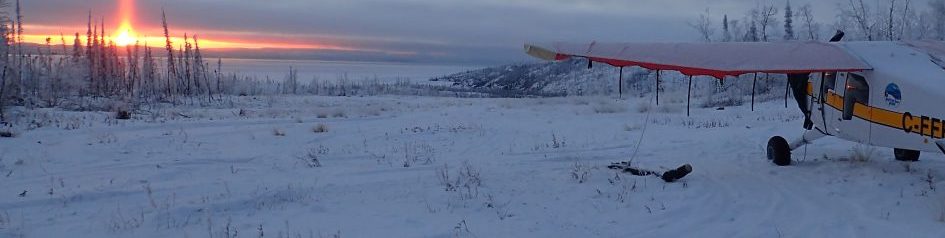
When I came north to Canada for good in the summer of 1987, I stowed two big metal trunks of books and papers into the cargo hold beneath the dogsled-and-sled dog-and-lumber-and-fuel-barrel-cluttered deck of Dave Smith’s trusty freighting boat, the Hearne Channel.  Tucked into one trunk was a sheaf of torn-out pages from a mid-1970’s edition of Mountain Gazette.

Night Driving, by Dick Dorworth, was the long piece (as long as any night drive) that I had torn out a dozen years earlier and somehow, strangely, kept with me for years — years that led me from high school in Illinois to university in Montana, back to college in Wisconsin, and on to cabin life in the border lakes of north Minnesota.

It still strikes me as somewhat odd that I kept this particular piece of writing with me over all those moves and miles. Odder still, if a person who knows me picks it up and reads it, for Night Driving is a hip, rambling 1970’s discourse about long nights of driving, including side opinions on the merits of amphetamines, heavy drinking, dope and ginseng, and more digression down the runs of ski racing, broken love affairs, and on and on.  And on. My own night driving seems to be mostly past now, but my long nights behind the wheel always had more to do with cold northern highways and the steering of trucks loaded with teams of sled dogs. Coffee and chocolate were the strongest stimulants on board. (Dick is nowadays a vegetarian and he writes that “I haven’t had a recreational drug stronger than caffeine in more than 20 years, not even a beer, though a morning without good coffee is unimaginable…”) When I pick up Night Driving again (happily it is out there between hard covers in several editions)  I ponder just what special spark it was that I first found so noteworthy, in its wild and crazy rides along desert and mountain highways.

What I found, and still find, is Dorworth’s trademark blunt wild word-rich prose, and it must have been just that style and flavor that inspired me to tear his writing out and keep it with me for a dozen years and more, until it found a place on the shelf of the cabin we built here at the Hoarfrost River.  I meandered through Night Driving again the other night, and discovered,  in the preamble to a passage describing one very long night drive from Los Angeles to Lake Tahoe, that the 16th of October is Dick Dorworth’s birthday, and that today he will turn 79.  Thus this post.

I had a chance to meet up with Dick one year ago, in Montana.  We have been in contact over the past few years, ever since I had contacted him about a quotation I wanted to use in Kinds of Winter. We share some things in common, it’s clear, but in most day-to-day spheres of our lives we do not.  I am not a downhill skier or an accomplished climber or a denizen of the Mountain West, and he is not a bush pilot or a dog musher or a denizen of the taiga Canadian Shield.  (Dick held the world record for speed on a pair of skis, in 1963, set at 103 miles per hour on a track in Chile, and he still skis almost every day of every winter, at Sun Valley in Idaho.  He is in the Skiing Hall of Fame.) Dick is a practicing Buddhist, while I am some sort of undisciplined amalgamation distilled out of a Lutheran upbringing and faith and heritage, seasoned with a hefty dose of Buddhist inspiration from writers and poets including Matthiessen, Snyder, Storlie, and Dorworth — all stirred together with some unsorted pantheistic tendencies.

When I met Dick in person we talked and walked, and he fed me a good Tofu and bean sprout sandwich, which was the first tasty edible thing containing Tofu that I had ever ingested.  Made an old moose and caribou connoisseur pause.  Today I wish Dick a happy birthday, and I encourage readers to seek out his writing, which is published in at least five of his books now, the latest just out.  Night Driving, The Straight Course, The Perfect Turn, Climbing to Freedom.  The most recent, which I have not read but will soon, is a memoir, The Only Path.

Happy Birthday, Mr. Dorworth, and thanks for so much good writing, so many hard fast runs down steep mountains, so much inspired living…  and here’s to many happy returns.

Below, some snippets I’ve underlined or page-marked in Dorworth’s books:

“The edge has its hardships but at least one can be sure that it is life out there (here?) and not the Barbie-Doll, TV-dinner mentality that plasticland has ramrodded down the gullets of those hordes of iron bellies who can stomach Styrofoam horseshit for dinner, breakfast, lunch, brunch, snacks, feasts, celebrations and sacrifice.” — from Night Driving

“Uninspired is the state of life of the coward who would rather live with an unacceptable comfortable situation, than throw it all over for a chance at joy.” — from Coyote Song 

“Words are incomplete mediums of communication, much as we love them. There is no way to know how it was except to have been there, and the experience lasts in its fullness only as long as the experience. Afterwards, something remains besides the memory, but it is something other than the experience. It is like food for the spirit — it nourishes, giving strength for another day.” — from Climbing to Freedom

“Now I know that strange things happen to your body when it meets the snow at 100 mph, no matter what the position. In the twinkling of hitting the snow I regained a proper respect for speed.  If you are inattentive, as well as somewhat stupid, you may breed a contempt for big speeds, forgetting respect through the grace of being atop your skis each run.  No one on his back at 100 mph will ever after have contempt for speed.” — from The Perfect Turn

“Life is really a thesaurus and everyone wants it to stop at being a dictionary.” — from The Straight Course

“Greyhound wants to cease serving Alaska Highway customers from Dawson Creek to Whitehorse”  — headline, Fort Nelson News, 6 September 2017

On a sunny spring day in 2007 I was sitting on a Greyhound bus a hundred miles west of Winnipeg, listening (because no one in the front half of the bus could help but listen) to a whining passenger a few seats behind me, as she bemoaned her fate into her cell phone. “Yeah,” she whimpered, “they decided I needed to go to this meeting, and now it’s a two-hour trip on the flippin’ loser cruiser.”  I rankled at this, partly because of her sniveling and partly because this was something like hour 36 on the Greyhound for me, having been aboard a succession of buses since departing from Hay River, the roadhead on the southwest side of Great Slave Lake at 0800 the previous morning. I turned in my seat and she, still yammering away, shot me a scornful glance which plainly said “Yeah, I mean you, loser.

I have long been a bus rider — partly because I gave up hitchhiking quite a few years ago, and partly because I am by nature somewhat backwards and contrary.  I like to think that Muir and Thoreau, not to mention a dozen of my other literary and life heroes would have honestly preferred “slow” overland travel by bus and train to “efficient” airline zap-zipping, given any reasonable sort of choice.  Also I think it is demonstrable that short-haul airline travel is an environmental blasphemy — launching kerosene-guzzling pressurized Spam cans to 30,000 feet above a landscape already amply festooned with highways, backroads, expressways, and railroad tracks. The bus is cheap and simple, and can be half-assed enjoyable when compared to other modes of transportation.  I live 160 miles past the nearest terminus of the continent’s road system, and we have not owned a car or truck since 2000, when we more or less retired from the winter road-warrior life of the racing sled dog musher.  When we need ground transportation more elaborate than shank’s mare or a bike, we rent a car, take a cab, or hop on a bus.  (Do the math.)

I like the bus, or I mostly have over the years, mainly for its pace and its straightforward simplicity.  On that 2007 trip, for instance, I flew the Husky to Hay River one evening and rolled out my sleeping bag under the wing for a nice night of sleep on warm green grass (it was early May.) Early in the morning I took my knapsack and hiked a mile or so to the bus depot on the edge of town.  Boarded the bus with my bundle of books and pens and pillow and thermos, a $200 round-trip ticket in hand, and set off to see my sisters and Mom in Minneapolis. It was a long trip, and I don’t know that I would do it again — but Greyhound, driven by our own preferences and assumptions  —  is steadily withdrawing the option.  On that trip I smiled at times, musing that I was saving $15 an hour, over the entire 80-some hours, back and forth across the continent, and at my weariest moments I would imagine a smiling attendant appearing in the aisle every hour on the hour, handing us all our savings, in cash.  .

For decades I told anyone who would listen that they should try the bus, and the train, and I would encourage them to do so. Dare them, even. Now I don’t.  I used to say that airline travel had become just like bus travel — but now I don’t.  Airline travel has certainly become unpleasant, but bus travel, when last I rode (last December, Edmonton to Fort Nelson, 16 hours, $180. 6 hours or so, $600 on Central Mountain Air) had dropped even farther down the scale of petty annoyances and discomforts.  On that trip, at least until we hit the Alaska Highway and things started to become more rural and civilized, that midnight bus from Edmonton really was starting to feel like the loser cruiser. I tried to take it all in a good light, and root for the Hound in the face of WestJet, just like I have tried, with mixed success over the years, to cling to other quixotic notions.

But no.  The bus and the train nowadays choose their own, and until that unlikely day when the lunacy of launching skyward for a 300-mile journey, complete with a requirement to arrive at the airport (miles from the center of town) at least 90 minutes before liftoff, for a battery of X-rays, interrogations, and sniffer dogs, dawns on people — perhaps only through their pocketbooks, which is the only way any real-life decision seems to come to most people — the bus and train routes through the hinterlands of the west and the north will continue to dwindle.

Airline travel was once elegant. The Greyhound has never been elegant, and it never will be.  At best it can be dignified, but nowadays its dignity is faltering right along with the dignity of airline travel.  It is good to travel with a sense of humor, when travelling on the bus — and I suppose nowadays on the increasingly maddening airliners — so that you can chuckle when the bow-legged and thoroughly inebriated cowboy who got on at Manning lurches up the aisle to proclaim in a booming voice that the toilet at the back of the coach is “locked up tighter ‘n a bull’s ass in fly time.”  On the bus this is just standard stuff, like standing alongside the coach under the stars with the driver at three in the morning while he smokes his smoke and whacks the tires with a baseball bat to check their pressure at 35 below zero..

But here, my friends, is the beauty of the bus, and to some extent the trains of the far north (limited as those are nowadays, even more limited than the buses.)  It is the beauty that comes from three words, three words that WestJet, Air Canada Jazz, Delta and all the rest will never rival:  All Points Between. When the voice comes over the loudspeaker at the Edmonton depot, (sadly now relegated to a grim location far from the nightlife and bookstores of Jasper Avenue), announcing a bus “now boarding on Track Two for Grande Prairie, Dawson Creek, Fort Saint John, Fort Nelson, Whitehorse, and all points between — that final phrase is one of the enduring values of bus travel.

To be aboard a bus as it pulls over at a lonely road crossing on the Alaska Highway or the south coast of Iceland or a farmstead in north-central Norway, and watch as someone young or old gathers their bags and steps off, or steps on, greets the driver, finds a place that suits them, and plops down with a happy sigh, just as the bus begins to roll forward again, or to feel the train slow down and stop late on a spring night in northern Manitoba, and watch a Cree family step up from the spruce forest alongside the track to load their packsacks and a canoe and a couple of dogs into the open door of the baggage car… these are the moments and the convenience and the elegance we are now losing, as we lose the loser cruisers. Soon no more bus to Fort Nelson; already no bus south from Hay River, and years since there has been a bus clear north to Yellowknife from points south. There are things I won’t miss about the bus, but I will miss its simplicity and efficiency, and that unmatched access to All Points Between.  Sometimes I wonder if I am the only one.


“The point when a lot of wind becomes too much wind is a difficult but very important moment to identify.” — Kevin Patterson, from his book The Water In Between: A Journey At Sea

Every year there are one or two. Moments, sometimes agonizingly long moments, when the successful outcome of a particular phase of a flight – be it a takeoff, a landing, the safe arrival overhead a destination in gusty winds or reduced visibility or freezing precipitation – is nagged by nerves and uncertainty. Always these moments pass, as moments do, and almost always they pass with “no harm done.” Of course they do, or no one would fly in airplanes, least of all us pilots. But if a bush pilot were to claim that he or she has never, not once, had a moment like this, and if they have been flying for a few years – well, all I could think to say (politely) would be, “That’s incredible. Literally incredible.”
We emerge from the far end of these moments chastened, sobered, and reminded of the physics of flight. And of frailties: frailties of our systems and our aircraft and our oh-so-human judgements and processes of decision. Reminded, too, of the power of wind and weather and water. Emerging, we pick ourselves up and dust ourselves off, and climb back on the horse that just threw or nearly threw us. Sometimes in my work’s tense times I think of a remark I read years ago in an article about Navy fighter pilots, who were –now listen up here – landing jets, in the dark, on the decks of ships. (Yeah, you might want to read that last bit again.) Not that anything I do with my little float-and-ski fart-carts ever approaches that degree of sophistication or savvy, not to mention technological complexity, but there was a snippet from that article that stuck with me: “Night landings at sea are what we get paid for; the rest is just plain fun.”
Some of you already know, reading this, where this slightly ominous preamble is leading. The Reader’s Digest version of the July 18th “aviation occurrence” (sometimes sterile bureaucratic mumble-speak can be so comforting) would read something like this, if only the Reader’s Digest could loosen up its line spacing and punctuation:

Summer morning, unsettled. Blowing 20 at Yellowknife and piping up.
East to the Thelon in one long ride, pushed by that wind.
One sample-site done and on to Dubawnt.
Memories of a five-day blow there, late August of 1996, with Harry.
We land at the usual spot, in the lee of a low tundra spit,
taxi into wind, blowing gusty and hard, but there is shelter there, and the anchor holds.
Stefan and I step out onto the floats, and he does his work – another water sample.
“Windy!” he says. (Master of understatement.)
Anchor raised, we drift back, flaps down, rudders up, letting the wind push us into position for takeoff.
Seas “confused,” as the sailors would say, humping and peaking with some swells
rolling around the tip of the peninsula, some coming in from the west,
and the river’s deep current roils it all.
Messy.
Windy.
I’m gripped, but steady and still confident. Eager to get airborne and westbound.
Throttle forward, power coming in,
and just then a lurch and yaw on a steep crowned wave,
yoke hard over, but the right wing rises,
too high and too fast,
and every inch gives more grip to that gale.
I haul back on the throttle, try to abort.
Too late.
Over we go.
As in over. Upside down. In the water. In the plane.

So that is how it all began, that afternoon. Upside down in the plane, hanging there in our harnesses, as time slowed to a crawl, as it always does in such moments. ELT on, find life-jacket, channel those swimming-pool Underwater Egress training sessions. Door-latch, seat belt, cold water coming in, both of us moving, out and up, a brief struggle and the satellite phone case lost somehow from grip. Now climbing up the struts of clean white floats, which still ride high as the plane settles deeper beneath them. Some vehement cursing, by yours truly.
I take the paddle from its rack on the float and we start trading off, fifty strokes a side, passing it back and forth, more to keep warm than to make any progress. Shouting back and forth to each other in the wind. Drifting very slowly, carried by current and swell, maybe a quarter-mile an hour? Cold. But we are going to do this, and it is okay. We are going to live. I can feel it already, and I think Stefan can too. After maybe an hour of this, the plane stops drifting, about 150 yards off a low shoreline to the north. A concerted effort to get some gear out – without diving back down and into the cabin (a move I briefly consider and reject) – yields some useful things and some trivial things, among them my briefcase, a quart of cream and a bag of carrots, the orange “survival pail” and a couple jerry cans of avgas, and two more life-jackets to join the ones we’re wearing.
The plane has stopped drifting. Shore is way over there, and no one is coming for a long, long time. (We are 400 miles from Yellowknife, nearly 200 miles from Baker Lake.) No tough decision here. Ready? We swim.
Stumble ashore, deeply chilled, strip some layers, find some scrub wood. Pocket match-safe bone dry, and avgas with a Whoosh changes everything. “Fire, brother! This is what separates us from the apes!” We laugh. We are going to do this, and it is okay.
Moved camp after Stefan found a better spot. More wood, more shelter, and my red poncho strung up as a tarp. The wind still roaring, and squalls of cold rain. A long evening, and a short period of Arctic mid-summer twilight. Shiver, move around, heat some soup, shiver, doze. Long talks… we go quite a ways back, Stefan and I. Our conversation circles and loops. Dog-mushing, jobs, raising children. “You warm enough?” “Yep. O.K.”  “I wonder what will come first – A Herc or a Twin Otter?”

There was no real suspense to our twelve-hour wait, because we knew all along we would be found, and relatively quickly. It is 2017, not the 1950’s. Trackers, satellites, phones, and Ops Manuals have changed the game. Kristen, watching the tracker back at the Hoarfrost, had sounded the first alarm that afternoon, and things rapidly spooled up after our “overdue time” came and went with no word from us, no arrival back at base. All night around that hot little fire, we were alive and remaining so, and we knew help was coming. We only wished we could re-assure those who were wondering. Our loved ones, and Stefan’s work colleagues, passed a much longer and more difficult night than we did.

It’s the Herc. 4 a.m., just past dawn. Low to the south we hear it. They circle, drop a handheld radio on a 30-foot streamer. I’m still cold, but is that the real reason my knee is doing the Elvis as I fumble with the radio? And then talking. “Roger, we are both okay, cold and wet.”

“We are going to drop you some gear. Stay out of the way.” Around again, a couple of times. Six-foot heavy sleds on a cargo chute, drifting down. We figure that’s it, and we haul the goods across the stony tundra to our little camp. Open the sleds up, and it’s Christmas in July – parkas, boots and balaclavas, cookpots, stove and food, tent and axe – hell, now we could stay a week, easy!

We tell them so, but they’re coming back. Two jumpers, drifting down, and in a moment walking over. Joel and Darcy –the Air Force is here! We shake hands. “Well, yeah, we know you said you were okay, but when we see a plane like that” – he points at the white floats, upside down, far offshore, with the red form of the wings and fuselage dimly visible in the cold clear water below – “we have a hard time believing everybody’s okay until we look at you.”

Joel gets on the radio. “Two crew, both here. They’re Charlie Green.” (I don’t know the lingo, but I’m guessing maybe C for Conscious and Green for uninjured. “Uniform Red” would maybe not be so good.)

Now it is late August. The Bush Hawk is back at our maintenance base in Fort Nelson, after a 400-mile sling ride beneath a Bell 412 helicopter, and a 600-mile journey south by truck. Insurers, adjusters, and owner / operators (that would be Kristen and I) all conferring with the mechanics and engineers. Estimates, timelines, and conjecture. The coming week will tell whether the airplane is to be repaired or written off. Only a thorough inspection will answer that big question. We are urged by others, more seasoned in this, who advise, “It’s just bent metal. Don’t get all sentimental about it.” Yep, bent metal. Wet metal, in this case, now drying. Just a damaged machine, yet I would have to be carved of stone not to be a little sentimental about a cockpit and a flying machine that has been my workplace for 3000 hours.

On a morning of low cloud and steady drizzle, I sit and ruminate on wind and moments and flying and floatplanes. Stefan is back with his wife and young children in Yellowknife, and has been working again on weather stations or water samples. Whatever the fate of dear old C-GROH, we two are both “Charlie Green” today, and Charlie Green we are happy to be.


July 4 2017, Hoarfrost River

Three years ago this morning Kristen started the day alone, here at our place.  I was away at a camp on the tundra, flying for a graduate student who was doing research on wolves.  Our daughters Annika and Liv were on the distant North Arm of Great Slave Lake, west of Yellowknife, on a canoeing trip with a group of friends.

July 4, 2014 began smoky here, as all days had been for several weeks already, what with a big hot wildfire less than ten miles to the east and northeast of our home. Smoke was the theme of that early summer, and the presence of that big windblown wandering fire was a constant presence in everyone’s day-to-day lives at this end of the lake.  The ice had completely cleared from McLeod Bay on about the first of July, and although the weather had been remarkably cool for June, it had also been remarkably dry.

By the time Kristen had written down the weather and poured herself a cup of coffee a northeast wind was up, and quickly building to the gale force that would change that fire and that day and our lives. By lunchtime she was a harried and exhausted woman, pumping water, driving the loader, dumping sand, hauling propane bottles, making phone call after phone call, unable to sit still and unable to calm down.  The smoke was thick and the winds were stronger than ever, blowing directly down-slope from the northeast.  Precisely from the direction where together we had last studied the edge of the fire, as we circled above it in the Husky, eight miles to the northeast, just three nights before.  By three p.m. she could see flames in the forest just north of the house, and something “let go” inside of her, as she later said.  She somehow pushed the boat out into the crashing waves of the lake, turned all the dogs loose, and changed her strategy, wisely, from fight to flight.

And the rest, as they say, is history.  A tiny piece of history, yes, and inconsequential compared to the losses at Fort McMurray last year or in other well-known wildfire events across the years.  There have been many days like that day, in The North and the West, for this landscape has always burned; it will always burn. 

By the close of that long day, as July 4 became July 5, I was here with Kristen, and with helicopter pilot Sage Suzuki, and three firefighters, John and Eric and Patrick, all based in Yellowknife.  Our four neighbors from Reliance, the first people who came to help, had gone home tired and sad and hungry, having done what they could.  We were trying to rustle up some supper, the exhausted crew was preparing to find their bedrolls, the smoke was so thick that flying was out of the question, and of course the house and guest cabin were gone.  In a poignant moment that still brings a wry smile to my face, I wandered up toward the smoldering ruins of the house and found a young firefighter there roasting a frankfurter over the coals. He turned to me sheepishly, and I told him “Go ahead, man, enjoy your dinner.  We might as well get one more use out of the place.  You got any more of those wieners?”

Three years on, marking the day, I sip my morning coffee on the wide workshop deck.  The workshop which has been home for us for three winters, and likely will be for two more winters yet, before it can at last revert to its role as a workshop.  Thinking.  This morning the ground here is moist and soft, after rains late yesterday and some good drenching rainfalls the day before last.  Yesterday, up at the old house site, Kristen and Annika and Liv, along with three young friends, set to work in earnest after all these years: clearing rubble, knocking down old concrete footings, carting away burned, rusted, twisted hunks of metal:  freezer, woodstove, kitchen range, coiled bedsprings… 

I stayed away, puttering on the details of a system for watering the potato patch with solar panel and a twelve-volt pump, the hardware for which just arrived by mail the other day.

It is not my intent this morning to craft a piece of literature, but just to send a dispatch three years on.  We move forward.  Five main points come to my mind again and again, as the years tick past.

  • We will not be defined by this event. It happened, and it was big, but it does not define us. We move on.  Life moves on.  As Gary Snyder wrote to me succinctly after the fire, when I pressed him for some snippet of wisdom: Wisdom?  We all know that all is impermanent.  It’s how we handle it when it happens that counts. And what we learn from it.”
  • In the aftermath, we do not curry a mood of vindictiveness and anger. Life is too short to wallow in anger and negativity.  We asked questions, in the aftermath, and we got some answers – some satisfying, some not so.  At this point that process of “de-brief” is done.  Onward.
  • The land is healing, but it will look burnt for the rest of my life, even if I live to a preposterous old age. It is scarred, but its scar is a perfectly natural scar.  Fire and the recovery from fire, again and again, are all a part of how this landscape cycles itself from century to century.  Were it not for the loss of the house and the guest cabin, and all those structures meant for and held for us, the fire would be only a magnificent first-hand lesson in ecology.
  • We are beginning to rebuild what was lost. The structures will be new, and fresh, and different, but still small and simple and made mostly from materials that are here. The new guest cabin sits now just above where the old one stood, and it has already held its first groups of students, guests, tourists, and passing pilots.  There are plans afoot for the house, and I pore over them with pencil and ruler.  Re-bar and cement and forms for the pouring of a foundation are being assembled for the first barge of the summer.   
  • We are changed. A loaded statement, and not to be plumbed at all here this morning, except perhaps to say that our life moves now to a slightly different rhythm here.  See Stafford’s final lines below.   

And finally, this poem from William Stafford, which I have quoted so often over the years, because it says so much to me and about our life here at the Hoarfrost River.  Read it.  Really, just skip to it, right past everything I have said above.  Because three years on, all we need to say is here in Stafford’s lines:

Allegiances

It is time for all the heroes to go home
if they have any, time for all of us common ones
to locate ourselves by the real things
we live by.

Far to the north, or indeed in any direction,
strange mountains and creatures have always lurked —
elves, goblins, trolls, and spiders: — we
encounter them in dread and wonder,

But once we have tasted far streams, touched the gold,
found some limit beyond the waterfall,
a season changes, and we come back, changed
but safe, quiet, grateful.

Suppose an insane wind holds all the hills
while strange beliefs whine at the traveler’s ears,
we ordinary beings can cling to the earth and love
where we are, sturdy for common things.


(Summer Solstice Tuesday night at 22:24 MDT, 0424 Z)

From the workshop’s south deck on this warm Solstice morning I gaze south at a breeze-ruffled swath of McLeod Bay. Just offshore, like a fleet of flattened ships at anchor, lie a few acres of mottled gray-white ice pans. For days the pans have lingered there to the southwest, although from the sky on a flight a few nights ago it was obvious, and surprising, that most of the bay – and all of the rest of Great Slave Lake – is now ice-free.  On Summer Solstice!  That is about five or six days “early,” at least by our phenology logbook of past springs here, this being number 30.  We talk and remember other years – of running dog teams and landing planes on twenty inches of ice here on Summer Solstice day in 2004, and of sailing clear to Reliance and back on the tenth of June, two years later.  The timing of these grand and subtle events is endlessly fascinating to me.  (He drones on…)

In more southerly latitudes, by the time Summer Solstice arrives, Winter is already a distant memory.  Not here.  It strikes me that “Ice on Summer Solstice” might be one quick way of defining “The North” or “The High Country” – those two vague place names that get so glibly tossed around.  Of course, there are other factors at play up north and up high, apart from latitude and altitude, factors that help a certain lake’s ice to linger until the first day of Summer.  Depth and aspect and the overall size of the lake play into it. McLeod Bay has it all, being a broad deep trench of the continent’s fifth largest lake, set at a sufficiently high latitude, and plenty deep, with a sounding of 293 meters, or 961 feet, forty miles west of here. (Christie Bay, just over the southwest skyline, bottoms out at 614 meters or 2015 feet.)

Open-water season has come, after all that winter, and I – being somewhat easily astonished, I admit – am astonished all over again by the pace of the ice’s vanishing act. The utter disappearance, over the course of a few short sunny weeks, of that broad white plain upon which we lived and worked all winter, is magical.  No, the rational, logical scientists will rush to intone, it is not magic at all.  Nothing less than pure magic, I retort.  And after another round or two of sparring we will agree that, like almost everything to do with life, Earth, energy, and – well, everything – it all comes back to our dear old star.

Old Sol, on his trek up and down the ridgeline of the sky.  Drawing his arc these past six months, climbing a little higher every day, straining toward the zenith he will not reach – not at this latitude.  That is how I imagine him sometimes.  And, late this evening, he will turn.  No, he will stand: Sol Stice. He will pause, like a gray-bearded mountain guide suddenly feeling all his weariness, and say to us, his eager charges, with a wistful smile:  “Well, I thought maybe I could go up a bit higher, but I’m played right out. Just going to take a breather here for a minute, and then I’m starting down.”

And he does, every year. And every year we follow him down, by small degrees and steps at first, day by day, night by night. Then faster and faster, dropping toward the valley of December.

Yet also as if by magic, the warmth and fecundity of Summer will still come charging onward for weeks after today’s turn-around, fuelled by the stored momentum of all that arduous climbing, stoked by the solar effort that has been soaked up for months by rock and water and sky. The powerful crest of summer’s heat wave is still ahead of us, even while the sun itself starts slipping back from its high point.

________________________________

The past week found me doing the bush-pilot waiting game, with daily flights north from Yellowknife up to a world-famous outcrop of bedrock on the edge of the tundra. On the second of the three long days of ferry flights and waiting, I wrote this:


Coffee on the Rocks


Waiting for Korean geologists; day two of three. 

I crouch in a hollow of bedrock and boulders,

while a billy-pot of lake water

warms on my little gas stove.


Acasta River, 210 miles north of Yellowknife.

Over lunch Panseok and Kim and Lee told me more about Acasta Gneiss. 

It is, by all reckonings, the oldest surface rock on the planet.

Four billion years.


The three of them are busy banging away on it, day after day.

Gesturing and talking, loading samples into pails, for the lab.

I pull out pen and paper while my coffee-water warms.

Let’s see – an eighty-year life – if I am oh-so-lucky as to make twenty more…


Eighty years.  Times what?

Times fifty million, that’s what.

I try, for long minutes, to let this span of time sink in,

hunkered low in cold wind on this knob of bedrock.


Live five lifetimes.

Now do all of that, ten times.

And then all of that…

times a million.


I give up. 

(Again.)

Water’s hot.

Coffee time.


–Acasta River, 15 June 2017


In spring I crave a reunion with solid rock, and when it arrives I savor it and smile.  After six  months of life in snow, moving in and on and over and through that miraculous medium, on sled runners, snowshoes, skis, and snowmobile tracks; feet swaddled in bulky soft warm boots and moccasins, always subconsciously gauging and second-guessing the consistency and depth, the give and take, of that smooth white surface, there is a moment every spring when it ends with one solid step.  (Barefoot will come later – it’s still cold here.)  My love for the feel of firm rock underfoot is bolstered, I suppose, by the fact that once the snow melts right here at home, we live on a wide sand slope – a beach.  The snow melts in spring only to reveal sand.  Pushing a loaded wheelbarrow through sand would account for one good practical reason to love rock.  When we re-build our house, it will be right where the old one was – on an outcrop of bedrock.


Finished with soft flakes,

All done with smooth white curves and muffled footfalls,

creak of snowshoe, hiss of ski, rumble of rubber track – 

had enough of slip and slide –so long, Snow White.


At the evening end of a mid-May day —

chores, repairs, sawing and sharpening —  

I stow the tools and saunter onto seventy miles of white ice

 to kick myself east toward the mouth of the river.


Wood-and-steel spark sled from Norway

comes into its glory now.

A kid’s scooter on metal rails, nothing more.

Just kick and glide.  It goes! 


Sentinel Point in the far distance,

its flank still white with drifts.

East the rise of Pike`s and edge of the barrens,

where May is hardly spring at all.


Beneath me fifty inches of solid ice,

no hint of candling yet.

Another snow-drought winter,

another late cool spring.


T-shirt and old sweater are enough tonight.

Jeans and work boots, wool hat in pocket just in case.

Pepper spray strapped on my belt, for those bears we’ve met,

black and brown, over the years, out on the ice.


Kick and glide, smooth and steady,

frictionless or nearly so.

Across broad pools of meltwater,

spray slinging up from the rails. Kick and glide.


Over a mile out and breathing hard,

I arc back toward the north Twin Island.  

Home and supper ahead,

wind at my back, flyin’ now —  but wait…


That dark island – oh man, that smooth bare bedrock.

I pull in and step off the runners

up onto granite and – yes –

that first firm footfall is delicious.


Sole on stone, crunch of lichen,

steep slope of the rise,

step lively now, and up. 

Terra firma. Boot on rock.


For ten minutes I scamper the crest of the island,

Every solid step a pleasure, like the handshake of an old friend.

I cut up and clamber through the steepest notches. 

Boot on rock, stretch of legs, start of spring.


Turn back to the sled, step onto the ice

and kick for home.


May 14 2017   

Having set myself the goal of posting a piece of writing here once a month, I glanced at the calendar a couple of days ago with a bit of trepidation. Deadline looming, and no strong inspiration for new writing. Surprising, given that the past month has been chock-full of long thoughts, good conversations, and distant new horizons.  From April 8 – 24 we flew far from home, taking in the view from our padded chairs in the stratospheric 500-knot buses that are such a wonder to us low-level bush-pilots. Across to Scandinavia and back to North America, and then south, briefly, to the even more foreign and exotic world of south California, there to glean precious hours with a friend who is now in his early 90’s. And finally home, to a cool and icy late winter here.  Back to work, such as it is, and yesterday more hours of thoughts on a 240-mile solo flight in the little Husky on skis, up to the Arctic coast at the behest of the territorial wildlife department. There I walked alone through a valley of sculpted snow and gravel hills to retrieve a dead caribou’s bloodied radio-collar, and lifted off for home.

Sensing my self-imposed deadline, I thought of a passage from the final chapter in North of Reliance. I will post that brief chapter here in its entirety, below, as a stop-gap against silence.  Thinking about my sudden lack of words, I called up lines from a poem by Wendell Berry, lines which I could not recite precisely.  Now I have fetched his collection, Clearing, from the little bookshelf in our sauna’s outer room, so that I can share them here:

“What is this silence coming over me?

I am curious and afraid

one day my poems may pass

through my mind unwritten,

like the freshenings of a stream

in the hills, holding the light

only while they pass, shaping

only what they pass through,

source and destination

the same.  I am afraid,

some days, that only vanity

keeps me at my words.”

  • From “Work Song” by Wendell Berry, in the collection Clearing.  pub. 1974.


OUTPOST

I often think of our place here as an outpost. Outpost is one of those words I have always liked. It has a rough-hewn crispness to it. Its dictionary definition, though, is prosaic and military: “1. A detachment of troops stationed at a distance from a main unit of forces. 2. The station occupied by such troops.”

In hours of remorse and bewilderment I can apply that military meaning to our efforts here. I can see myself a soldier, drafted by birth into a heartless and destructive army. Our homestead is a small and distant detachment of an invading, well-disciplined force.

Our marching orders are clear: More is better. Technology will prevail. Faster. Larger. Easier. More. Now. Hills and waterfalls are “scenic attractions” or “potential hydroelectric sites.” The migrations of caribou are “eco-tourism resources.” The entire world is reduced to crisp, logical dollars and stark senseless cents.

Our lives at the outpost are full of hypocrisy, cluttered with contradiction, dripping with embellished notions of a romantic past that, if it ever existed, is gone. In a land that George Back claimed could starve a wolf, and can still do so, we are fantastically, extravagantly at ease. Our pantry is stocked with everything from soy sauce to canned peaches; we have communication with the world outside at the flip of a switch. Incoming airplanes bring our mail, friends arrive with fresh fruit from California, wines bottled in France, ground beef from the ranches near Calgary. Here on the rough-hewn romantic frontier, our most consistently pressing concern, our fundamental need, is not food or shelter or water, not tea or tobacco or fur, but money—just cold hard cash, please. The bottom line that rules so many lives makes its power felt even here.

We are an outpost on a distant flank of the main front, a station relying on support from outside, eager for our next resupply, contact with headquarters, news of the campaign.

But out on the flank, alone, we cannot help but glimpse the other side. It is, in the prevalent view, a hostile and alien force. Wildness. The bush. Unorganized, not yet subdued, unpredictable, completely apathetic and aloof to the campaign being waged against it, it sustains itself. It is powerful, patient, and ingenious; cold, vast, and scraped to bedrock, but covered completely by a thin layer of tough, enduring life.

At an outpost the morale of the soldiers can slip. The dogma of the high command and the easy assumptions of the party line can begin to appear ludicrous and false. News from outside may be delayed, solar storms can knock out the radio, and for months each autumn no reinforcements may arrive. Steadily, quietly, the land takes its opportunity: spruce, swan, wolverine, bear, trout, alder, lichen, sky and wind whisper subversively to the sentries who pace the perimeters. Feeling uneasy, beginning to wonder, we turn up the music, tune in the radio, type a few letters . . .

Years pass. Why am I stationed here? When will I be transferred? What does our presence stand for, and what do we stand against? Loyalty falters. Doubts creep in. Where is that fine line I came to tread, deftly balanced at the interface of two worlds?

Clear answers elude me. The wilderness asserts its power, presses its advantage. On some quiet days, alone here or with Kristen, I feel a timeless peace, a meditative serenity, spreading into my speech and movements and outlook. I dispel it and welcome it by turns. I become thoughtful, and for days at a time confused.

I leave the cabin late on a spring night and walk to the mouth of the Hoarfrost. I lie back on a smooth spur of bedrock, look up at the stars through a faint green aurora, and listen to the rush of meltwater fresh from the thawing tundra. Slowly, steadily, what began as an outpost becomes a home.

— final chapter of North of Reliance, original edition 1994; second edition published 2016 by Raven Productions, Ely Minnesota U.S.A.

“The common purity of Nature is something wonderful – how she does so vast a number of things cleanly without waste or dirt.  I have often wondered by what means bears, wild sheep, and other large animals were so hidden at death as seldom to be visible.  One may walk these woods from year to year without even snuffing a single tainted smell… How beautiful is all Death!”

  • John Muir, an undated journal entry, “south side of Joaquin River”, late 1870’s.

“This desert upon which so many have been broken is vast and calls for largeness of heart but it is also ultimately empty. It is hard, it is barren.  Its very nature is stone.”

  • Cormac McCarthy, in Blood Meridian, Chapter 23.

In my work as a wildlife survey pilot, work which has for three decades been the most persistent facet of my flying life, one of the rewards is to have flown over, by sheer luck, and witnessed from a bird’s eye perspective, some unforgettable moments in wild nature. In fact nowadays it is that slim hope of coming upon yet another of these fleeting and rare perspectives – widely spaced as they are by miles and hours of uneventful (lest I say tedious) flights, over broad swaths of pristine but relatively scrawny northern taiga and tundra – that keeps me keenly interested.  The realization that another of these moments and vignettes might be out there waiting, the hope that today might be a lucky day, surges briefly every morning as the skis or floats or wheels kiss niva or aqua or terra firma farewell with one final peck, and the snarling little machine lifts itself into the sky. 

There is always a fatalistic certainty in that moment just after liftoff – because hey, one thing is for certain in this unpredictable world, and that is gravity.  What goes up will sure as hell come down, Mr. Bernoulli’s principle notwithstanding. Alongside that certainty, though, there is a thrilling uncertainty as to what, precisely, each day’s flight-path will bring, or hold, or show…

The other day, on a long transect about 50 miles west-southwest of Yellowknife, we arrived over a frozen tableau.  It stands out as another reminder for me of the realpolitik of wild nature, its web of food and energy. A still-life seen from above:  a bison, a raven, and five wolves; white snow, blue sky, and red blood.

We were droning along at four hundred feet above the taiga plain west of the North Arm of Great Slave Lake, slowed from cruise speed, with some flap down and the power pulled back.  The point of that day’s flight was to spot groups of boreal, or woodland, caribou.  Pancake-flat country, interspersed with old and recent patches of spruce and tamarack, some jack pine and alder and aspen, part of the landscape recently burned and part not.  Dappled across it are pan lakes which in summer are just shallow pools of clear water, and in winter are likely frozen right to the bottom.  It was an exceptionally cold clear day; at take-off from Yellowknife the temperature on the ground had been close to forty below zero.  Miles and miles of empty snow-scape were already behind us by 11 a.m., with no caribou spotted, a moose many miles back, and precious little else.  The usual bursts of sporadic conversation over the intercom, amongst the four of us aboard.

Off to the right, a half mile or so from the survey line we were on, I saw a lone bison in the center of a snow-covered frozen pond.  Likely a lone bull, but he was worth a closer look, to see if there were more around, so we turned off the transect line and headed toward the pond.  As we came closer I saw something that caught my attention. A raven flapped up and flew, seeming to take wing right from the bison itself.  “What’s going on here?” I said to the others, “That raven just flew up from the buffalo!  And it’s not a kill site – the buffalo is standing up!”

Yes, the buffalo, or bison (the words are used interchangeably hereabouts) was standing, but yes, too – it was a kill site.  It was a kill-site-in-progress.  As we arrived overhead the story became clearer.  The enormous bison was standing, and now lurching slowly forward, surrounded by a blood-red area of trampled snow.  East of that spot a few dozen yards, another wide swath of lake was trampled in a wide circular pattern. At the center of that trampled circle was another vivid red stain of blood on snow. 

“Wolves — there on the shore, five of them, lying down!” came a voice on the intercom.  Sure enough, there on the far edge of the little lake, five big dark wolves, furry discs to our overhead view, noses tucked under tails, lay together in a group, and so far they seemed to be oblivious to the plane.  I cranked us around in a tight turn, lowered some more flap and increased the rpm with the prop control.  The plane was now making even more noise, and we had the attention of the wolves as well as the staggering bison out on the ice.

The story was clear enough.  The bison was mortally wounded, and doomed.  Before we arrived overhead, the huge beast had likely been still, and the raven had been right alongside it, maybe even atop it, perhaps already sampling a few tidbits from dangling entrails or pecking at the fresh blood spilled on the snow. The wolves, with the demanding and dangerous part of their hunt now finished, were napping and waiting for their dinner to die. No sense, for them, in continuing the life-and-death struggle to complete the kill.  Perhaps, for all we know, a wolf or two had already been injured or even killed in the battle. 

A cold clear morning in the far north.  A glimpse of wildness and the hunt.  A vivid reminder that Tennyson’s “Nature, red in tooth and claw” can be at times exactly that.  

I handed my camera back to the observer behind me, and she snapped one photo of the scene, through the plexiglass window.  (It did not turn out very well, lest you wonder about seeing it.) Then I climbed higher and we circled one more time.  Two of the wolves were moving out onto the lake, and the bison was still lurching slowly toward the far shore.  The wolves looked a little unsure as to what to do about the noisy circling ski-plane, but clearly they did not intend to let their hard-earned meal just stand up and walk off.

We headed back toward our survey line.  There was work to do.  As we flew along, Jan told us about times when he had seen similar scenarios involving wolves and moose, during his years in the Yukon.  A huge, seriously wounded moose standing motionless, bleeding, with a group of tired wolves resting nearby, just waiting and watching for the chance to start eating — safely.

I have seen other kill-sites from the air, the most memorable the take-down of a caribou on the tundra, by two wolves.  That had been dramatic and unforgettable, and the kill was amazingly quick and clean: an ambush in a brushy ravine, a quick parry and thrust, a leap to the back of the neck, and – wham! – down she had gone, from life to death all in a space of a few seconds.  

For years I have held in my mind’s eye that quick clean image of the wild hunt. Now I will hold onto this other image — not so quick, not so clean.  Mr. Muir, meet Mr. McCarthy.  

“We decompressed into wilderness and silence, spewing residual tension and noise in all directions until we approached the emptiness of our surroundings and could feel again.  Absorb again.”     

— Doug Robinson, from A Night on the Ground, A Day in the Open (Mountain N’ Air Books, LaCrescenta California, 1996)

Over the past forty years I have lived and worked and made long expeditions in Canada’s North, and I have seen many changes in the core elements of wilderness travel.  The gear has changed, yes, and in some ways it has improved.  Canoes, dogsleds, tents, stoves, clothing… the quest for improvement and innovation never ends.  The cleverness of our tool-making is a wonder, and a caution.

Most of these refinements and innovations are not harbingers of a sea change in the realm of back-country travel.  What does constitute a sea change — an upheaval, a revolution — (for no word seems too strong) is the steady infiltration, by an insidious category of innovations and tools, into the daily rhythms (and blues) of expedition life and wilderness travel.   I refer of course to the tools of communication.

I work as a bush pilot and guide, based in Canada’s Northwest Territories.  Nowadays when I drop off a small canoe party out in the vast barrenlands, at the jumping-off place for a long journey down a remote Arctic river, we chat as we unload the packsacks and the canoes and the food barrels.  As we finish, and I prepare to fly away, I take a moment to ask:  “And what are you carrying, for communication?”  It is no longer the older question from years past:  “Do you have any means of communication?”  Rather, these days, two-way communication is assumed, and it is only a matter of inquiring politely as to which of the tools the party is carrying.  And — this is the subtle clue I am seeking as I hear their answers — what is their attitude toward these devices on their journey?

Too often (to my way of thinking) these days, my question is answered with a breathless laundry list of devices and technologies:  SPOT, DeLorme InReach, Iridium, InfoSat, GlobalStar, VHF, ELT, PLB, WeatherLink, and every year or two a new one I have not heard of.  These whiz-bang communication tools have made the HF radio (not to mention Morse code, semaphore, and smoke signals) obsolete, and they allow constant two-way satellite-linked tracking, message-sending, and weather forecasting, all in places where only a short time ago a weekly check-in on a static-buzzing radio channel was considered downright extravagant.  Hearing the list, gauging the tone and inflection of the description, I glean some notion of the party’s motives and philosophy, and their perception of the nature of their journey.  I make a silent guess as to how often I, and others, will hear from them, and under what circumstances, in the weeks ahead.

I listen, and I only speak up strongly, in response, if I gather that everything might wind up depending upon these tools of communication.  For despite all these ways and means, the itinerary for a trip in a landscape as vast as the tundra (think ocean, large empty ocean) should never be summed up by  “Well, we are just going to see how it goes, and call for a pickup wherever we are when we get close to our end date.”  “Not good enough!” I blurt out.  There must be a place the party will try to reach, or where they will remain, a date when they are to be considered overdue, and this must all be written down and handed to someone so that when the — SPOT Iridium InReach Global Talkie Walkie Digital Doo Dad — is crushed beneath a boulder or lost to the river or chewed by a wolverine, we who will be starting to wonder will know where to begin looking, and when.

There is that workaday aspect of all this, and then there is another aspect.  I will not try here to answer for others, but will only pose this question:  How does this new realm and reality of “constant connectedness” change the spirit, the mystery, the intangible essence, of our journeys out into the wild silent spaces of the world?”

As you pack your gear, take a moment to heft all those parts and pieces of this wondrous technology, one at a time, in the palm of your hand.  Consider how you will use these tools, and how you may in fact be used by them.  Think about what you will allow – or not allow – this new option of “connectedness” to become, for you, on your journey.  Your journey!


— The article above first appeared in the journal Tvergastein in December 2016, in the issue devoted to the topic of Travel.  Tvergastein takes its name from the mountain cabin of Norwegian philosopher and activist Arne Naess, the thinker credited with coining the term “deep ecology.”  Tvergastein is online at http://www.tvergastein.com. This month here at the Hoarfrost River we are busy preparing for, hosting, and guiding 13 students and a professor from the University of Alberta, Augustana campus. I will return in March.

“I had learned years ago, though, at the little cabin on Stump, that at least one popular notion of rustic log-cabin life is mistaken. The daily chores which dilettantes and visitors imagine to be so all-consuming – splitting wood, hauling water, feeding dogs – are not the sole substance of one’s days and years. In fact, as seasons pass one’s days are less filled with mundane, repetitive tasks.”

  • from North of Reliance, “Lighting Out”

Reading that passage of mine, it seems a little breezy nowadays, a little too eager to dismiss the day-to-day chores here in the outback as not being of any real consequence. The chores are the chores, was my point, no matter where you live, and my take on this has always been that the basic 3-W’s — wood and water and waste — are not drudgery, nor should they dominate log-cabin life. (And there is this, too, as Will Steger offhandedly remarked to me forty years ago, as we sat in his cabin after a round of water-hauling up the steep cliff shoreline at Picketts Lake – “Hauling water will keep you young, David.”)  Or, as we joke with visitors, “Yep, we have running water.  Just go down to the lake and carry a pail back up to the house.  If you feel like running with it, go ahead.”

Some days, though, light-hearted breeziness blows past, no matter where one chooses to live, or has been chosen to live, and the chores become, well, chores. 

The other night I landed at dusk after a flight in and out from Yellowknife.  I had dropped Kristen off there, and she spent most of last week in town, doing errands, making appointments, and catching up with some friends after three months at home without a trip “in.” Having put the airplane to bed for the night, with all the attendant fussiness of engine and wing and pitot covers, ice stake tie-downs, and so on, I came up to the house.

I was alone – and that prospect was both pleasant and daunting.  Solitude, some simple meals and focused reading, dog runs and wood cutting, some repairs, some tedium with logbooks and flying-business paperwork.  We would have a good week, her there and me here, and at the end of it a reunion and a marking of our 28th wedding anniversary.

That first night, though, what greeted me as I stepped inside our workshop-become-house and flicked on the light was a pile of dishes in the sink, a stove-side firewood bin that was scraping bottom, and a scant few gallons of drinking water left in the pails.  Out in the yard there were three dozen hungry huskies still to feed, and barely enough water on hand for their morning soup.  And as for the final W of the three, the pails under the sink needed emptying, as did the burnable-trash bin, and it had been three full days since the dogyard had been cleaned, to put it politely, or since the dog shit had been scooped, to put it in Saturday-morning English. There was work to do.

Water, I decided, could wait until morning.  Wood was not a big deal.  The main shed was still half-full of spruce and tamarack and I just needed to carry some indoors.  Dishes I could tackle in the evening.   Closing my flight plan by satellite phone was the first thing, and then the feeding of the dogs.  I put a big chunk of frozen lake trout on to simmer for supper, and as I scrubbed dishes I listened to the BBC and its poignant news pieces about the outgoing administration down in the Excited States.  (These are sad, confused, even scary days in this ex-pat household.  And no, I am not going to go there in this dispatch.)

Morning. Windy. Time to haul some water.  The routine is this:  trudge out to the hole (or, to be more efficient, motor out there with the smelly one-lung Bravo skidoo), towing a sled full of pails, clear away the insulating pile of snow, lift the three-foot square plywood-and-styrofoam cover, and then set to work with the ice-chisel.  Open the hole, scoop with the dipper pail, in and out, in and out, filling the pails, then re-cover and heap snow on top of the hole, and pull the sled of full pails up to the workshop. Carry them inside one or two at a time and refill woodstove water tank, main barrel, and the drinking-water pails.  As I stood there on the porch, this familiar process had all the appeal of a session of root canal work.

For I also knew, at this point in the winter, that what was really called for was an even longer and more laborious — but in some ways more satisfying  — project: the creation of water hole number two for the season.  The first hole of the season is always close to shore, and by now the ice has thickened, as ice will always do, and with the very next cold snap, downward-thickening ice will meet up with sandy lake-bottom, rendering the hole useless.  Time to carry the power auger down to the lake, out another ten or fifteen yards to where the water is truly deep. There shovel an area clear, drill a test hole to gauge the ice thickness, and then drill a tight cluster of contiguous holes, a big 30-inch square, being careful to keep the holes all dry, that is, not to hit water with any of them until the entire excavation is complete and cleaned of ice chips.  Then plunge through around the perimeter, lever up an enormous block of clear ice, and –voila – new water hole, sure to last another six weeks or more.  What will render that one un-usable will not be its freezing to the bottom, but instead the tall dike of chips and frozen slush and piled snow which will build up around it, higher and higher, until there is such a ludicrous amount of bending and stooping involved in filling pails that –yep – it will be time to excavate hole number 3.

I decided upon that necessity of making a new hole. After making sure that there was still a gallon of water left to see me through mid-day I brought the ice auger inside the workshop to warm up. As I did so, a little lazy voice in my mind piped up and suggested that it might be worth checking out the mouth of the river.

Although our place has been referred to for years as The Hoarfrost, our cluster of buildings and our day-to-day life has little direct connection with the flow of the river.  “The Hoarfrost” as a label for our location is more a point of reference, and the mouth of the river is half a mile east of our doorstep.  In wintertime we are much more aware of the day-to-day state of the river upstream two miles, where our trail crosses it, than of the changes and patterns that go on at its outlet.  Between December and April It is often weeks between visits there. In winter the patterns of freezing and current make a swift river a dangerous and constantly changing place, and our trails all give the river mouth a wide berth.

Yet there is magic in that moving water, and never stronger magic than in these months of deep and silent cold.  It draws us closer, lures us for a look. Shrouded as we are in thick heavy layers, mitts and mukluks, it is always a delight to stand close to the chuckle and gurgle and whisper of the river, and let thoughts run toward summer.

From a practical standpoint, though, the Hoarfrost as a source of day-to-day water presents problems.  Every year the freeze-up takes on a slightly different pattern, with sloping balconies of undercut ice, deep swift water diving below thin shelves, and sudden eruptions as the current gives up on finding its way beneath the ice and instead overflows and floods upward.

And – the big caution: this all changes constantly from day to day, and even from hour to hour.  Thus our prosaic safe water hole on the lake ice out in front of the homestead, instead of the poetic adventure of stowing the ice chisel forever, and going to the river to dip. One year there was decent access to river water over on the east bank, and we hauled water from there for a few days while I procrastinated on drilling a new lake-hole, but the ice was sloping and the deep water diving beneath it was so ominous that I made a fixed rope fast to a shoreline boulder and put a belay on as we moved back and forth with the pails.  That was a welcome change of routine, and exciting enough for a few days, but the roping-up took most of the pleasure out of the process and we soon abandoned it for a new water hole on the safe, broad lake.

In late afternoon I gathered up the water pails, started the skidoo, slung my rifle over my shoulder (for it is still moose season here, and the cache is still empty, and there was still some dusky twilight) and set off down the shoreline to have a look at the river and see what access to water it might offer. I hugged the shoreline and the west beach of the river mouth, and steered through thick alders on the gravel bar that built up in the big flood of June 1992.

I stopped the machine and walked ahead, axe in hand. This year in that one spot the river has built a thick bank of layered ice, ice that is now nearly four feet thick, with a sheer smooth face dropping straight down to swift flowing water about two feet deep.  This looked promising – easily the most convenient water hole at the river that I have ever seen.  I brought the sled forward, attached a stout rope to the handle of a plastic five-gallon pail, and flung it out and down, into the current. The pail floated a moment, then dove out of sight beneath the undercut ice bank. I felt a solid tug, like the lurch of a whopper fish on a line: full pail. Up it came with an arcing lift to land at my feet and splash a little ice-water over the tops of my boots. Forget drudgery, man – this was downright fun! I threw and lifted the pail again and again, until all ten plus the dipper pail were lined up brimful in the sled.

The day’s light had faded now, and it was dark. I stood for a moment, listening and letting my mind run upstream fifty miles to the wide tundra lakes where the Hoarfrost rises.  Fletcher, Walmsley, Cook, Lac la Prise. Miles of white tundra and taiga, all frozen hard in the grip of January, but just beneath that frozen veneer, even in these long months of steady sub-zero cold, the water-blood of the country still somehow runs and pulses. Groundwater, stream and river, steady and constant, down the falls and rapids to the lake.

Somewhere up there, just off to the west of one branch of the Hoarfrost watershed, but separate from the headwaters – or so we have been assured – are the deep pits of a new diamond mine at Gacho Kue, now in production after decades of planning and construction.  A miniature city of hundreds of workers, enormous craters that dwarf the giant haul-trucks, steady round-the-clock digging and blasting and crushing, jet traffic direct to Edmonton from a mile-long runway, lobster salad and fresh kiwi fruit on the buffet tables at dinnertime.  Video surveillance and security guards.  An exercise gym, T.V. and ping-pong for the off hours. A Mars colony, really, unconnected to any of this, and all in the quest for a few pricy baubles to decorate the pinkies of faraway fiancées and brides.  And lives, entire lives, being spent in that scrabble for shiny stones.  Funny bunch, us humans.  Just upstream, between high rock walls, I could see the steep white rise of Beverley Falls, named in 1833 for a British arctic traveller (who never saw his falls) by his friend Captain George Back of the Royal Navy (who did.)

Below me was the smooth murmur of the river, and downstream a soft hiss as the current slid beneath the shelf of ice leading out into the lake.  Movement slowing, shallow water diving deep.  River becoming lake, poetry settling in to prose.

Reverie ended, I yanked on the starter cord and motored slowly for home.  Once I had lugged the pails up the steps and filled the various water containers in the house, I smiled and took the power ice-auger back outside. “Won’t be needin’ that for a while,” I murmured to no one.  Maybe I will make a new ice hole in the lake out front, one of these days, but for now I’ll just enjoy these jaunts to the river for as long as that perfect access point endures.

Thirsty and tired, I poured myself a jar-full and took a long drink. So cold. So perfectly clear and sweet. Is it just illusion, or does this wintertime river water, super-cooled and aerated as it is down all those miles of falls and rapids, taste better than any water I have ever had?  Running water.  Oh yes, we have running water.