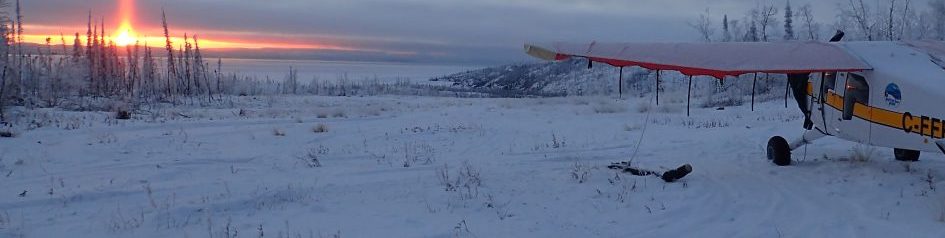
Amazing contrasts  Sad thing is, they stop being striking as a person gets along in their life.  Used to be, coming out of the woods, even into the relative calm of Ely Minnesota, even from a relatively short outing like a Lynx Track 7-day trip, I would feel as if I had been transported into a different dimension. Everything was moving too fast, everyone was talking too fast, it all made very little sense for a day or two.

Now — scary as it is for me to admit, sitting in the Edmonton International (YEG) departure lounge, soon to board a Delta smoker for a three- hour flight to MSP, 600 miles an hour at 36 thousand feet, with a hundred and fifty strangers — this all seems quite normal.

Even though a week ago today, I was sitting alone on a taiga rock hilltop, trying my best to sound like a cow moose, so that I could lure a 700-pound bull moose in close and — very reluctantly, these days, but you gotta eat what grows around you and I have not a single doubt on that point — shoot him dead..

Which I did not, because Bullwinkle never appeared, but which I certainly would have, given a chance.

Never is the transition from off-the-grid to on-the-grid more apparent than in these days of late autumn, when the winter cold and dark are closing in on the Hoarfrost homestead, and our 6 80-watt solar panels are all but useless for about the next three months. (Those pie-in-the-skyers who would power the average upper-middle class North American home on solar and wind power alone, never mind manufacture any of our tools or toys without burning fossil fuels, just ought to try it in November, at, say, the latitude of Chicago or Toronto.)

Here, ensconced among the 1% or at least the 10%*  (which, lest we forget, includes everybody reading this blog, or so I would wager) light bulbs burn sixty or a hundred watts each and the Mark’s Work Wearhouse in Camrose Alberta is selling winter jackets with electric heating wires embedded in the fabric.  Electric clothing.  As if we didn’t have enough gizmos sucking up enough electricity every day already, now they would like us to plug our coats in at the end of the day.  Sheesh.

Scary thing, though, is that none of it really fizzes on me any more, as they say in Canada.  Meaning these contrasts, where clothes tumble dry in electric heat, where phones charge and thermostats do their thing and rubber-tired monsters hurtle in all directions — all as contrasted to that 30-year-old burn on the edge of McLeod Bay, that utter silence, that ancient outcrop,  that 600 or more miles northeast of me on that sunny cold day a week ago, surely the most remote remaining portion of the North American mainland.

I step in and out of two worlds.  Depend on the one to get by in the other.

And — I hope — still recognize, deep down, the vice versa.

Depend on the other to get by at all.

*December 7, 2006 A new study on The World Distribution of Household Wealth by the Helsinki-based World Institute for Development Economics Research of the United Nations University was launched earlier this week. The study shows the richest 2% of adults in the world own more than half of global household wealth. The most comprehensive study of personal wealth ever undertaken also reports that the richest 1% of adults alone owned 40% of global assets in the year 2000, and that the richest 10% of adults accounted for 85% of the world total. In contrast, the bottom half of the world adult population owned barely 1% of global wealth. The research finds that assets of US$2,200 per adult placed a household in the top half of the world wealth distribution in the year 2000. To be among the richest 10% of adults in the world required US $61,000 in total assets, and US $500,000 in total assets was needed to belong to the richest 1%, a group which — with 37 million members worldwide — is far from an exclusive club.

6 October, Hoarfrost River.  Gray and mild, more drizzle.  + 4 degrees C.  

Long time, no write.  If there is truth in the saying that a busy pilot is a happy pilot, I must be just about ready to burst into a fit of wild ecstasy now.  The month of September passed in a blur of flying work.  Luckily, for that work, it was one of the mildest Septembers in recent memory, because floatplane flying is not much fun at temperatures when water does not want to remain in a liquid state.  I had a solid reminder of that the other morning, when I slipped on the frozen float deck and smacked my cheekbone so hard into the wing strut that when I came to, I inspected the strut for damage.  Luckily it was the Husky, because the Bush Hawk does not have wing struts and I would likely have added a frigid swim to the morning’s festivities.  So now I am sporting a shiner which says “float season is almost over.”

At last that long round of work is winding down and I can break out of the routine of gazing at the weather charts over morning coffee, and plotting what might be possible, and tying down the plane in the last light of day.   Moose hunting has been sporadic, and so far unproductive, but there is a young muskox bull hung in the cache and we have laid eyes on two moose so far, east of home.  No shots fired.     

Almost all of my autumn flying has been to the tundra north and east of home these past weeks, and much of it has focussed on caribou.  Native hunters looking for caribou, biologists trying to develop new techniques of photographing and counting them, and far-flung solo forays in the Husky to retrieve radio-tracking collars which have “gone stationary,” in the parlance of the researchers.  This translates to “the caribou wearing that collar is now deceased” about 99% of the time, and “collar prematurely popped off”  every once in a great while.  (The collars have a clasp which is somehow programmed to take a burst of energy from the battery and pop open at a certain date.)  These dropped collars are still sending a VHF signal, which can be picked up from the plane a few miles back, and their last location is still known, so it is usually easy to land and walk and find them, and bring them back to town for overhaul and refurbishment.  Evidently sending a small plane 200 miles out from base to collect a few dropped collars is well worth the cost, because the requests to do so keep coming in.  Good work if you can get it.  A small nimble plane, no passengers, no big loads, nobody on a tight schedule or in a rush for the work to get done.  For a bush pilot, life does not get much better than that combination.  

Surprised yesterday to see four snowy owls in the space of about an hour of flying northeast of Artillery Lake.  That area is familiar enough to me, and I have flown over it, low and slow, frequently enough in the past 26 years, to say that this is either a bizarre coincidence or a real boom in owl numbers.   I suspect the latter.  

Yesterday I came up on one of those owls from behind, with the Husky configured in full-flap slow-flight mode.  He (or she) was striding through the cold air with powerful wing beats, distinctive from the flight of an eagle or a falcon.  I have no doubt he was getting skittish as the plane approached from his 4 o’clock high.  As only an owl can, he turned his head completely around in flight, to fix that amazing owl stare right at the plane.   Magical birds.  An unforgettable sight.  A moment worth trying to share, at least within the paltry boundaries of words.

Daring Lake Research camp, 163 NM north of Yellowknife.  About 65 N X 112 W.

 These are the halcyon days of high summer.   Early August, not every year but some years, holds this for the far north:  day after day, hot pale blue sky with a tinge and a whiff of smoke (more smoke the farther west and south you go, at the latitude of 63 North or so.)  Lakes glassy enough to put a pucker factor into nearly every floatplane touchdown, especially toward dusk, especially in the smoke.  The mosquitoes long past their peak, the tundra now starting to flash a tiny hint of yellow, even in the heat.  Amazing days, and they just keep on coming.  Going on 13 straight now. 

And starvation days, if you happen to be an arctic wolf, and your luck has been running poor.  When the old-timers called the tundra “barren lands” and “country that could starve a wolf” they did know very well what they were saying.   I am forever amazed, chagrined, perplexed, and bamboozled by those who keep claiming that the tundra expanses of northern Canada are some sort of un-identified Serengeti of the north.  You’ve heard it, haven’t you?  “The ‘barren-lands’ is a misnomer – in truth, this is a land teeming with life.”  Perhaps David Attenborough or some similarly sophisticated narrator voiced-over that old line again in a recent documentary on the Discovery Channel, while the screen overflowed with a throng of caribou or geese. 

What I would like to do is get one of those folks airborne over the tundra for oh, say, 60 or 80 straight hours of transect-type surveys.  We don’t have to go in January to make the point; we can go in mid-summer – hell, they can name the date, and they can select the 1500 miles of lines to fly.   We will cruise low and slow, three or four hundred feet above the rocks and moss and lichen and looking-glass lakes.  Maybe David Attenborough would like to come along for the ride and narrate over the intercom.

Or for those who prefer to do their observing from ground level, we could stake out a wolf den site from a hilltop, on the warmest day of the year.  Hour after hour, with a view of 360 degrees and several miles in every direction, sun glaring down, and not a breath of wind.  Not a bird stirring, not a caribou or a muskox or a bear or a lemming to be seen.  Black flies of course, but even those little bastards are feeling the heat.  Everything alive is hunkered down in mid-day, just getting through the heat, and getting through the summer. 

The immensity and emptiness of this landscape is its single most compelling and dramatic attribute.  Silence and utter vastness are at the heart of its magic and its allure.  It is a reservoir of silence.  And as I have written elsewhere, it is more a land of physics than biology.  The life that is here is amazing, mostly because, like life in all deserts hot and cold, it is here and alive at all.

Pity wolf 421.  The female wolf, a lactating mother of pups, was fitted with a radio collar in late June, as part of a study of barren-ground wolves and the survival of their puppies from year to year.  I have mixed feelings on collaring and radio telemetry studies with wild animals – and on the hubris of science as it affects the day-to-day lives of its chosen victims.  As a friend of mine says, “I think those biologists should try wearing one of those things for a year or two.”  But that is beside the point here.  Wolf 421 was alive in early July, when we spent two 3-hour sessions watching from a hilltop 600 meters across a little swale, spotting scopes and binoculars trained on the den site.  Alive, but oddly placid.  Weak, it seemed to us.  I remember Mike’s comment to me – “I wonder if they are starving?” 

Now 421 is dead.  The GPS unit on the collar has not moved in many days, and the VHF radio signal is chirping from deep in the den, and there is the odor of death and decay wafting out on the cool underground air at the den opening.  I recall another wolf, which showed up at the Hoarfrost in mid-summer about 15 years ago.  So weak it could barely stand, so skinny that when I finally shot it (Annika was two years old at the time and the wolf was staggering within a few feet of us all, day after day) I was stunned by its body weight.  It was literally a bundle of bones encased in a sack of skin.  It weighed almost nothing.  It would not have had enough strength to pounce on a mouse, never mind to drag down a moose or a caribou.

I should add that some of the other wolves, and pups, and packs, in this study seem to be having a high time this summer.  They are the lucky ones, for whom sheer luck combined with the shifting movement of prey animals has brought a positive energy balance to early August, just as the pups are pushing twenty pounds and growing like Iowa corn.  It seems to me – a layman, mind you – that the whole summer,and life itself, can hang on one lucky kill just when it is needed the most.  One caribou cornered in a thicket of dwarf birch in mid-July, and you and your pack are home free.  It seems like it could come down to that.   

This is hard country, and even halcyon high summer can be tough times, when your grocery bin is the barren lands, and your shopping method is chase and fang.  Once you fall onto the back side of the power curve, it’s a slippery slope – weakening, restricting, losing muscle mass and gumption day by day.   And sometimes it ends back where it started, in a dark tunnel  of cool sand deep beneath an esker ridge, on one of the brightest and warmest days of the entire year.  

On that cheery note, good night from Daring Lake.

Wasn’t there a movie called that?  Or a novel?  Maybe not, but if there was it was surely not about a kennel of sled dogs in July. 

This summer I seem to be having a crisis of faith.  I have had sled dogs under my care and ownership now since 1981 – and yes that does make me feel old.  Some people who work with dogs at the Outward Bound school in Minnesota passed through here yesterday on a canoe trip to the Coppermine River (they paddled from Yellowknife and got here in a week – 210 miles, so pretty good going so far) and as we talked about the dogteam program there and its origins in the early 1980’s, it struck me suddenly that some of them probably were not born in the years we were discussing.  Yikes. 

But I digress, as usual.  The dogs of summer and my “crisis of faith” as a musher set in with the first heat of late June.  We have a full kennel right now, with 10 pups, half a dozen retired old-timers, and a full 30 working-age huskies 2-11 years old.  This is too many dogs.  We know that.  It is a bulge in our numbers that has to be endured in order to emerge a couple of years from now with our requisite crew of about 32 working dogs.  That number allows us to put five small teams on the trail, for the tourist trips, four big teams on the trail for the college groups, and gives us plenty of power when it is time for the four of us Olesens to hook up and go somewhere together.  32 working dogs is just right, and 47 mouths to feed is 15 too many.  A crisis of kibble, never mind faith.

Over my years as a musher I have accepted the compromises in my life and in the life of our family, and in the life of the dogs themselves, that mushing and sled dogs demand.  Every pursuit and every passion comes with trade-offs.  Dog mushing is no different.  For mushers and sled dogs, high summer is trade-off season.  It is a time to get through.  Sounds crazy to some, i.e. the height of Summer as a test of endurance, but so does owning and feeding 47 dogs. 

The acid test of a musher and a kennel, from the standpoint of ethics and animal care, does not come in winter.  What the animal rights advocates and anti-Iditarod folks might better be inspecting and railing against is not the running of the dogs, but the off-season care and daily summer regimen of a kennel.  That is the true test of a musher and a kennel, I think.  Done perfectly, it is A-O.K.  Done adequately, it is adequate.   Done wrong, it borders on the criminal.

Because summer is tough on huskies.  It is tough on wolves, too.  Huskies and wolves are cold weather critters.  I recently spent a flying job assisting a grad student who is doing his Master’s work on wolf pup survival.  After scouting the area and landing the plane, we walked in and staked out a half-dozen dens, at 500-800 meters, with spotting scopes trained on the den holes.  On the round of this which took place in the very hottest days of early July – which has been the hottest stretch of summer so far – what we saw at the den sites, hour after hour, was almost exactly  what we see in the dog yard at home at this time of year.  A lot of overheated canines lying on hot sand, shifting positions as the sun moved across the sky, with a litter of pups occasionally coming up from their air-conditioned nurseries deep in the ground, playing, peeing, romping, and going back down.  As I sat and watched the wolves, I reflected on the trade-offs that the husky breed had made when humans and huskies struck up their age-old deal:  “will work for food, bug protection, water, and shelter…”  

Clean cool water, decent food, a rainproof dog house, bug protection, daily yard cleaning, some provision for shade, and whatever form of walking, running, or swimming we can offer – these are the basics that all mushers owe their teams in summer.   On a scale of one to absolute perfection, I am still not there.   I am troubled and unsettled by this, but there is flying to do, a living to make, dog food to pay for, and projects here to take up with.  Still, on a 33-degree (almost 90° Fahrenheit) day in July, the dogs of summer have to be right up there on the top of a musher’s priority list, if we are to claim that our keeping of working huskies is ethical, justified, and viable. 

I already watered the dogs this morning.  Later this morning we will clean the yard, move some sand around, straighten some houses and take the pups for a walk.  That is, unless the phone rings and the Forestry boys want to go flying and look at the fire 35 miles south of here.  Which would make us some money, to maintain the airplanes, buy some kibble, and pay some bills.

So here we are, in the thin haze of smoke from a distant fire, the mosquitoes on the wane now, and the darkness starting to impinge on 24-hour daylight (a relief really).  It’s visiting time, family time, and a  time when mushers – unlike our footloose friends – are pretty closely tethered to home by our dogteams – the same dogteams which bring so much freedom to our winter days.   

We just have to get through the summer, and get back into the season where having all these dogs makes sense (sort of?  maybe?) and makes them happy.  Like I said, it really is a crisis of faith.  In a place where winter is an honest six months long, having a dog team still looks like a good deal to me.  If I were writing on July 27th from a place on the planet where winter was not six full months – and in some years close to eight full months – I honestly think I would be giving my 55-year-old head a shake.   Were I still down at the 49th parallel, it might just be time to say enough is enough.   But here, when the snow flies in October, it’ll be payoff time for everybody here – dogs and people.   That’s a trade-off I can live with.  Pencil me in as “still faithful.”

Starting in late winter and on through spring, we get a steady trickle of inquiries from canoeists wanting to charter a floatplane with a canoe tied to it.    Their goal is to find an affordable way into or out of the north country at the start or end of a canoe trip.  Sadly, this flying of canoes (and kayaks, and small boats) strapped to floatplane struts has become quite difficult.  The difficulty is not the process (which, with some strong rope and a little common-sense airmanship, is stone simple), but the legalities and technicalities. 

There is one obvious solution, and that is to turn the clock back 110 years to the time before airplanes, and ask “what did people do then?”  Clearly paddlers in 1902 did not make recreational trips down the Back River, for instance, but they did go canoeing all around the North.   

And there is another solution, which I will mention at the far end of this post.  (Skip to there and go outside, if you like.)

Here it is tempting to rush in and say “Well if they really want to go on a wilderness canoe trek, they should just paddle from start to finish, and skip the airlift and its mechanized boost.” This is a sentiment which I have been known to utter, sometimes in exasperation, but it is good to remember that almost every wilderness trek involves some mechanized transport.  Even if you are going to go on a wilderness freedom walk,  hiking naked and barefoot with your burlap satchel slung over your shoulder on a spruce pole, you will – unless you depart from your front door (or climb out of the front hole of your burrow) – almost certainly arrive at your starting point with a mechanical boost from a car, motorcycle, bus, ferry, train, or airplane…

The history of “external loads” (as canoes on floatplane struts are poetically known in Transport Canada and F.A.A. vernacular) is one of increasing regulation and, unfortunately, much confusion and upheaval  in recent years.   Back a decade or so ago, it was pretty much “do it safely and train your pilots to do it safely, and proceed with caution, but go ahead and tie a canoe onto the struts of a floatplane.  Use common sense.”  Like so many things in our society, the lawyers and insurance underwriters and bureaucrats have unearthed another vestige of that old common-sense approach to life, and banished it more or less forever.   “WARNING!”, says the label on the woodstove:   “HOT WHEN IN USE!”  Really… who thinks of this stuff?

On December 31, 2010, a mere 30 months ago, those good old days of common-sense  compliance with relatively straightforward rules came to a halt.  I gather (but have not researched) that at about that same time, a similar change took place in the U.S.    Up until that date, we who operate commercial bush plane services in Canada were hauling canoes under an “exemption” to the Canadian Aviation Regulations – our beloved “CARs.”  We had all written External Load chapters and diagrams into our government – approved Operations Manuals.  So long as we documented our canoe-hauling, did a test flight after tying the canoe on and prior to carrying passengers, logged that test flight, and filed some year-end paperwork for the purpose of record-keeping, we were happy and legal when it came to canoe-hauling. 

That is all gone.  Now each operator must obtain what is called a Supplemental Type Certificate (STC) or at least a Limited Supplemental Type Approval (LSTA) from Transport Canada, in order to carry canoes strapped to the struts.  Perhaps this is progress.  The real problem for small operators is that each STC must be specifically approved for each aircraft type and model, and – depending upon who at Bureacracy Central  is answering the question  that day – maybe even for the specific length and beam and make and model of canoe you are carrying! 

As a final nail in the coffin of the “common-sense external loads on small commercial bush planes” the mandatory flight testing evidently has to be done under the auspices of a designated aerodynamic consultant, and signed off by a Minister’s Delegate..  I say evidently because no one seems to say for certain that this is the only way to do the testing.  Checking into the possibility of doing this with our Bush Hawk, we received an estimate from a consultant, of $20,000 – with the caveat that any hardware, drawings, and so on would be extra costs on top of that – as would all the costs of doing many hours of test flying.  “Testing” something which was done safely and well by competent pilots for something like 75 years, mind you.  (Don’t get him started…)

In short, I have not completely given up on a return to the common-sense days of tying a canoe to the float struts and hauling canoeists back and forth from the tundra, but it is not a priority for us.   I do sympathize with the plight of the canoe parties too small to justify a larger aircraft, and I would like to provide this service, but right now we cannot do so.  The hours and dollars and piles of paperwork  just don’t match up with the benefits. 

On a lighter note I have tried to point out to the gurus at Transport Canada that Orville and Wilbur Wright were “external loads” at Kitty Hawk in 1903, but no one seems to find this quip quite as poignant and hilarious as I do.   

Bottom line – don’t despair, canoeists, because there are still many small bush plane services which can still legally tie canoes onto their planes, and they are scattered across northern Canada.  What the situation is in the U.S., I am not sure. 

As for our little company, all I can say is that a person has to choose his battles.   I am not sure I am going to fight this one. 

If I may be so bold as to predict the future, I would say that within fifteen  years or so the cost and complexities of chartering a floatplane of any size (from a Cessna to a Twin Otter) will have risen to the point where this mode of starting and ending northern canoe adventures will be relegated to a bygone era.  Already paddlers starting trips in the central Barrens are seeing charter bills for parties of six (with three canoes stuffed into a Twin Otter and a separate plane carrying the passengers)  upwards of $24,000. 

Even when split six or eight ways,  a bill of over $20,000 makes a very convincing argument for finding more affordable ways to reach the remote parts of the north.    Truck, boat, commercial airline, trains, combined with the one truly magical solution (however difficult for some paddlers to embrace):  – collapsible, i.e. take-it-apart-and pack- it-in-a-bag, canoes and kayaks.  

Not as pleasant to paddle as that old reliable Kevlar or cedar-strip or what-have-you, but perfectly welcome on any airline, train, bus, ferry, or floatplane.  Because it’s just a piece of baggage, and last time I checked we can still carry baggage in airplanes.  However, I think someone in Ottawa is looking into the baggage question, so stay tuned.  We may soon be even more protected from ourselves than we already are.

This might seem odd to some readers, but I am always sorry to see our ice melt.  I have concluded by now that the weeks of spring in the high north, as in the high mountains, are the most wonderful weeks of the year.  Under the wheeling sun and 24-hour daylight, the flat smooth plain of McLeod Bay stretches for miles – 72 to be precise – to the south and west, 8 to 12 straight across and southeast. It is a smooth, surprisingly dry surface, beautifully textured for walking and running, landings and takeoffs.  The planes sit on it, tied down to logs laid crosswise beneath drilled holes,  taxiing and landing easily and smoothly on tires,  with the skis in the “up” position if we have not taken them off completely.  We run on it, fish through it, walk and laugh and chase puppies.  Summer, really, with not a mosquito or a tourist in sight.  A little private lake has opened at the mouth of the river, where grayling jump and terns swoop and loons yodel.   

Little by little, hour by hour, day after day, even the big ice goes away.  There are an untold number of variables in the annual progression of spring melt.  It is not a straight-line process, but a wild mess of chaos and physics and climatology. Looked at from above, the bay is a patchwork quilt of enormous trapezoidal pans, each with a slightly different crystalline structure and rate of decay.  Even a dedicated team of scientists could spend many lifetimes trying to unravel and quantify the vagaries of breakup.  And over those decades, there would be more changes.    

One thing, though, is crucial to the process:  heat, from our dear old star.  Even I can understand that.  By this date, June 7th, there is as much heat in a day’s sun as there will be on the 4th of July, because we are on the flip side of the summer solstice.  If I had to hazard a guess, it would be that on average, come June first, out on McLeod Bay,  the ice dwindles at a rate of about two inches every 24 hours. 

A few short weeks ago we had 53 inches of ice out by the hole where we have been collecting our winter drinking water.  As of today that area has become black and candled, a rotting latticework of slender shards creaking and groaning under footsteps.  Beyond that, out away from shore, floating atop water many hundreds of feet deep, the ice is still solid, not yet weakened to the point we call “making noise.”  An airplane could still be sitting on it, landing and taking off — but now that time is over.  The Husky is on floats, using the wide swath of open water at the river mouth for takeoff and landing.  The Bush Hawk is in Nunavut, 230 miles northwest of home, where I write today (we are grounded in slashing rain and high winds).  This plane here is still on wheel-skis, for one final job up near the Arctic coast before the start of float season. (Even bits and pieces of the Northwest Passage are showing signs of loosening up by early June.)

As spring progresses, the tracks of winter, the packed lines of snow left by hundreds of departures by dogsled, snowmobile, ski-plane, and footstep, all emerge briefly into view, then fade, then disappear.  The winter’s slate of stories is wiped clean.  Soon the ripple of open water, then the season of huge floating pans and the tinkle of ice candles (ahh, perfect for evening Scotch),  and finally the deep blue of this inland sea, flecked with whitecaps and the rhythmic surge of honest-to-goodness rollers.

Down the bay the old boat is now floating free in the cove which makes its winter harbor (sorry Brits, I’m an Illinois boy and I just can’t stick that “u” in there!)  I flew past it yesterday as I left home to start this job.  Looking at it, eager to set sail, I knew it would be a while yet.  It will be late June, maybe the first of July.  Far out in the bay the ice still looks so solid and white that I wonder, as I wonder each year, that it will ever melt at all.

Farewell to the ice, at two inches a day.  40 to go, way out there?  June 29?  Bets, anyone?


Readers of these blog posts might be starting to get the idea that all I ever do is collect firewood.  Believe me, on some days in winter and spring I feel that way myself.  It is not true, of course, but it is a much bigger part of our life at the Hoarfrost than I might have been willing to acknowledge 25 years ago.  In fact when I wrote North of Reliance, in 1993 or so, I still clung stubbornly to the notion that “I spend no more time working to heat my home than does anyone who lives in a bungalow in Yellowknife or Duluth.  My work is direct, with saw and sled and axe; that other person’s work is at a job, where hour by hour they earn the cash that buys their heat.” 

            Not true today, and probably not true back then.  I don’t claim to know the specifics of the argument now, because I have no clear notion of what it costs to heat a home in Yellowknife, never mind Duluth, and no clear idea of other people’s take-home pay.  I imagine those dollar figures are as slippery and varied as our consumption of firewood.  We are often asked how many cords of firewood we need to make it through a winter.  My flippant reply lately is often “about a thousand, give or take…”  In the same way a person in Duluth or Yellowknife, after a winter like the one just past, might say, “Heating bills?  Oh, about a million dollars, give or take…”

            Winter is holding on here, tenaciously.  I gather that this is the same story across much of North America.  It is snowing hard as I type, harder than we have seen it snow for quite a few months.  We have lost no significant amount of snow from the trails, and the ice on the lakes is closing in on the five-foot benchmark.  In fact we might soon need a second 12-inch extension for the ice auger. 

            This is all good news from a woodcutting standpoint, because on May 10 all of our backwoods trails are still snowy and usable.   I am happy to report that our woodsheds are very nearly full to the brim.  This has not happened in years, and in fact since we doubled our main woodshed capacity in 2006, I do not think we have ever filled all the bins.  We are tickled at the prospect of doing so within the next couple of days.

            But the really interesting thing that is happening with our firewood saga is that I am now cutting wood exactly where I was cutting twenty and twenty-five years ago.  Another common question from friends and visitors is “how far do you have to go now to find standing dead wood?”  The answer, happily, is “not as far as we did ten years ago.”  The lesson for me here – a truth I never saw coming – is that even with the fairly intensive level of deadwood-collection that we are obligated to maintain, the natural cycles of the local forest keep supplying us with standing deadwood within about a three-quarter mile radius of the homestead.

            This year there are some beetles or bugs browning out one stand of trees on a raised bench across the river, and I will not even come close to getting those down before Spring arrives (we trust that it will.) They will do just fine standing there through the summer, and only if a wildfire takes them out will we lose the use of them.  No one else is going to come along and cut them, and if a wildfire starts that close to us this coming summer, losing those trees will be the least of our worries.

            My friend Mitch down in southeastern Minnesota is more acutely aware of firewood and forests and woodlots than most people, since he is a consulting forester by occupation.  He has been known to rub a little salt in the cuts by nonchalantly mentioning to me that “yesterday I went and finished gathering all my firewood for next winter.  One tree.  White oak.  About 52 inches diameter on the stump.”

            This is one of the cruel ironies that dawns on northern wood-heating people as the seasons go by.  As you move farther and farther toward the treeline and the Pole, and the winters get colder and the stoves get hungrier, the trees get smaller and the good firewood species all thin out and disappear.  Here at 63 degrees North we are left with three flavors of firewood, none of them Grade AA:  spruce (black and white), birch (Alaskan and paper) and tamarack (Larix laricina).  When I go down to visit friends and family in the northern Midwest, I eye those stacks of oak and maple and ash and my knees start to tremble with envy.  Each chunk of oak, split and stacked and dried, is worth about an entire McLeod Bay spruce tree. 

            Oh well.  Firewood forever, spruce and birch and clean hard tamarack.  Not sure if it qualifies as sustainable, and it certainly is not independent, because I didn’t and never can manufacture my chainsaw or temper my bowsaw blades, or refine the fuel for my skidoo.  The consolation for me, when I envy those southern stacks, is just the freedom we have here, to go and find and cut, bound only by our own conscience and guidelines (clean up the slash, don’t cut along the shorelines, keep moving around…), and over the years finding lichen-flecked stumps that were cut a long time ago, by a younger Dave on a sunny spring day.

Further to the remarks in my mid-winter blog post called Two Ravens, I offer this insight from an excellent “science for laymen” book about these fascinating birds.

             “The general explanations for these flights with acrobatic rolls and “rrock” calls is play.  Undoubtedly the birds are motivated by immediate enjoyment.  But play is not an explanation from an evolutionary perspective; it has a function.  I wonder whether the social play of ravens isn’t similar to a dance where teenagers get to know each other.  Doing the raven “rrock” and roll may be another version of doing the twist and shout.” 

Bernd Heinrich, p. 206, Ravens in Winter, Vintage Books, 1991.

It is April third.  I am 225 miles east of our home, and still flying east away from home. Below me the tundra is a solid, unbroken, unmarked sheet of white.  Above and around me, as I sit in the little cockpit of the Husky, is the sky – blue, cloudless, cold, with an invisible headwind pushing more cold air out of the northeast at about 15 knots.  The temperature gauge poking out through the windscreen reads -33 degrees Celsius, about 25 below zero Fahrenheit. I glance for the hundredth time at the engine gauges:  oil pressure, manifold pressure, RPM, exhaust gas temperature, CHT… all is well, all the lights are green, all the needles are pointing at reasonable places on the dials. 

Those are good, all those tiny green lights, because it is no exaggeration today to claim that I may be the most solitary human being on the mainland of North America, right now, 500 feet above the white, droning along through the blue, keeping a watchful, not to say nervous, eye on the greens.

32 years ago, April 1981, I was out here at ground level, not droning, but mushing, with one companion and ten dogs, grinding along at a few miles an hour in a quixotic quest to cross the barrens from Yellowknife to Baker Lake.  In that we failed, I suppose you could say, because we finally turned tail and headed back toward Reliance, from Hornby Point on the Thelon.  Discretion and judgement were the better part of valor, as they still are.  With no radio, no satellite phone, no GPS or Spidertracks reporting, or any other damned widget remotely akin to any of those things, we were on our own out here in a way that today is almost hard to remember. 

My task today is a caribou “recon”  — a scouting mission for a more elaborate spring assessment of the population status of one of the remote herds of caribou in the world – the Beverley / Ahiak group.   These caribou range across the north central barrens, from Artillery Lake on the west to Beverley Lake on the East, give or take, south to the treeline along the NWT border with Saskatchewan, and north to the coast of the Arctic Ocean. 

There are no caribou in this part of the Finnie River drainage today.  I saw some about a hundred miles back, just lying nonchalantly on a patch of tundra hilltop.  But here, at 2 p.m. on April third, at 63° 49’ North by 102° 22’ West, it’s all just  white and blue and cold out there.  On the panel in front of me the little lights all green, and the magic-wizard screen of the GPS which somehow knows exactly where I am and how fast I am going and which way I should turn to find home. 

Stuffed into the plane all around me are things I think I would like to have, were something to go awry out here.  I have a satellite telephone, a little mountaineering tent, a 2-burner Coleman stove, three sleeping bags, a bucket of survival gear, about a jillion different stashes of matches and lighters; axe, saw, shovel, snowshoes, rifle, extra jugs of fuel for the plane, engine covers, wing covers, a pack of playing cards, parka, fur hat, spare mitts…

I don’t really talk to my plane very often, or to my engine, but in the back of my mind a voice is  mumbling “Just keep tickin’ over baby, just keep tickin’ over.   I want to be home by a hot woodstove tonight, easy in the easy chair, back in the spruce and birch trees on the north shore of McLeod Bay.” 

(And of course, now I am.)

As a pilot I wind up walking in to many small towns from their small airports or floatplane docks.  After hours of flying I prefer to be left alone and unhurried while I do my chores at the end of the day, whether they are the winter chores of wing covers and engine heaters or the summer chores of float pumping and dock ropes.  So if it is not too far to town, I just tell my passengers or co-workers to go ahead into town without me.  I will walk in when I am finished, and let the rush and noise of the day clear out of my head and the kinks of seven hours in the small plane unwind from my neck and back. 

Tonight it is Fort Providence, a quiet town of 900 perched on the north bank of the Mackenzie River, just downstream from the outlet of Great Slave Lake.  Here the water of the Mackenzie is first named as the Mackenzie, having made its way this far under several other names — Peace, Athabasca, and Slave.  Taken together, without the name changes, this is the second largest river in North America — the dear old Missouri / Mississippi is bigger still.  To the locals here, the Mackenzie is simply Deh Cho:  Big River. 

The road from the airport follows the river, which of course is frozen on this March evening.  It is still winter here, make no mistake.  30 below each morning recently, but now the sun has strength and can be felt on the face in the afternoon.  Today I saw beads of water on the black tires of the plane as it faced the sun while we re-fueled at mid-day.

The trail I walk tonight runs just off the little highway, and it is a beauty.  It is the groomed trail prepared for the weekend dogsled races — six feet wide, smooth as a sidewalk, white and clean and firm.  A pleasure underfoot.  There is no traffic on the road, and none of the usual detritus of trash and unpleasantness as I near the outskirts of the village.  The snow is deep and fluffy, four feet or more of it lining the pathway, perfectly clean and dry.  The air is crisp. 

The lights of town come on.  The first star, or more likely a planet, twinkles up above.  Faint orange glow in the west where the sun went down.  Fans and fingers of alto-cumulus and cirrus spread across the southwest sky.  I can hear the murmur of the river as it steams through a twisting open lead — a narrow black stripe winding for 200 yards through the three-quarter-mile-wide jumble of river ice.  The open water slithers back beneath the ice, 600 or 700 miles still to go, down north to the Arctic Ocean.

It is easy to love the North on this night.  Spring is not here yet, and I do not yearn for it.