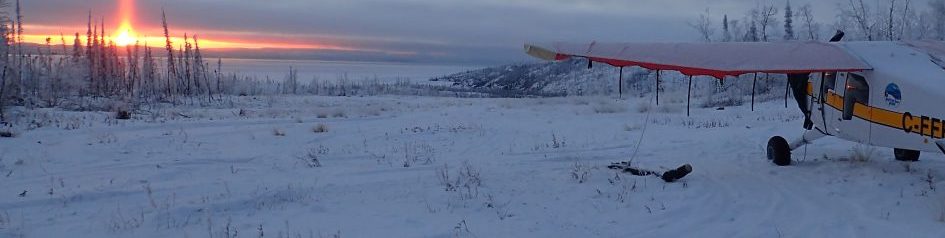
As usual at this season, we await day by day the freeze-up of the immense body of water that is our front yard. With that ice formed, and soon thick enough for walking, and then for running dogteams and skidoos, and then — at a mere eight inches — for landing and taking off in small airplanes, the winter here will truly begin. Freedom!
But the wind just won’t let up, and the catchphrase around here lately has been “Whitecaps don’t freeze.”
“Near Gale” said the wind chart tacked to the wall above the weather clipboard, the other day. The anemometer read 19 knots gusting to 27, and since the actual instrument is down at lake level, I’m giving us a knot to make the gusts 28, and a “near gale.” In the darkness before dawn, it sure sounded and felt like something near to a gale.
Lately, in the morning darkness around an hour before twilight, I’ve taken to bundling up in a floor-length woolen robe with an ample hood – think monk or penitent and you have the right idea – slipping my bare feet into slippers, and stepping outside onto the upper deck that wraps around the cabin. I gingerly make my way to whatever is the lee side. There to stand and sip some hot coffee and listen and watch.
On a morning during that protracted southwesterly blow, I took stock of the scene. High crescent moon, waning, bright shining through broken cloud. Stars winking on and off as flecks of cloud rushed past. Roar of the surf breaking on the ice edge only a few yards out from the shore. Hot flecks of stove ember whipping downwind from the chimney top like tiny meteors, with the slotted stovepipe cap setting up a venturi in winds like this, sucking air up the flue and making it almost impossible to damp a fire completely down.
A wind like this, coming straight at us right off the cold lake, can get wearisome here after a day or so, but in a practical sense a stiff wind is most welcome at this season. A three-day wind is a gift in the lighting and charging department. Of course the freezers are turned off now, until April, but the days are short and the lights are on for hours. The fridge will soon become a true “ice-box” with gallon jugs of ice shuttled in and out from the porch, and the power to it will be cut way back. The windmill on a tall mast out on the rocky point (some years an island, some years a peninsula) has been cranking out electricity since the blow began. The meter on the wall shows a tally for a 24-hour period and this morning it read 5.6 KwH. Kilowatt-hours.
At this time of the year, our motto is “anything for an amp.” Traipse down to the workshop to shut the inverter completely off at night, rather than just letting it “sleep” on Power Save mode. Sneaky appliances — even when sleeping they still suck a little juice, unless you cut them right off at the switch.
What is laughable about our power situation, though, is that a three-day blow like we just had gets us really jazzed up about having brought in, oh, maybe 10 or 12 kilowatt-hours. Enough to run the place for a few entire days, without fussing with the generator. And yet, in town or down south or anywhere but way off the grid, a free gift of 10 or 12 kilowatt-hours is more like someone buying you a small cup of coffee. Or in other words, exciting but pretty ordinary, in terms of cost savings.
The other day a report on the radio got us talking about the cost of electricity. Power bills are soon to go up again in the Northwest Territories, and although that will have no effect on our situation here at the Hoarfrost River, it was all the buzz in town for a few days, I gather. It sounds as though a kilowatt hour may increase in cost to somewhere near thirty or forty cents, across the North, when all is said and done.
Kilowatt-hours. What the heck is a kilowatt-hour? It behooves us all to consider this, no matter where we live. You may be way ahead of me on this, but frankly I doubt it. We all need to be able to imagine one of these units, if we are to make sense of some of the debates and dilemmas and discussions bouncing around. We can probably all imagine a liter of water, a teaspoon of sugar, or a pound or a kilogram of flour or butter. Maybe you can picture in your mind’s eye a ton, or a tonne, or a metric ton, of gravel or concrete. But if all of us electricity junkies are getting our rations doled out in “kilowatt-hours,” and we are paying or laboring or contriving to get us some o’ that goodness, hour by hour, minute by minute, shouldn’t we have a way to envision what a KwH really is?
In other words, forty cents for what? The short answer is “one Little Buddy plugged in for an hour.” Every pilot in the Canadian North knows immediately what I mean. In winter, in the realm of aviation in the arctic, the sub-arctic, and anywhere with temperatures hovering below the freezing mark, when finicky aircraft engines need to be coaxed to happiness with ample doses of warmth before a pilot can even imagining an attempt at hitting the starter, the Temro Little Buddy Heater is the thing. They are stacked on shelves in every northern hangar, tucked into every bushplane overnight kit and every helicopter’s Action Packer.
The Little Buddy is sold (for well over a hundred dollars nowadays) as a “Car Interior Warmer,” and maybe someone somewhere uses their Little Buddy to warm a car interior, but if so I have never come across that car or that person. A Little Buddy is a no-nonsense black sheet-metal box, about six by four by three inches, and inside is a row of wire coils mounted forward of a small electric fan. A cord runs out the back, and a thermal fuse protects the unit from burning up if the fan should stop spinning.
When Little Buddy is plugged into a standard electrical outlet or the side of a portable generator, the little coil of wires glows faintly red, the fan blades spin almost silently, and if you hold the snout of your Little Buddy right up against your cheek, as you stand in the dark alongside your frost-soaked airplane in the pitch darkness of a January morning out on the ice, the effect is about the same as someone you love blowing ever so gently on your face. On a morning of, say, 42 below zero, when you really shouldn’t be trying to heat up an airplane anyway, the breath of the Little Buddy is not all that hot, but it’s a lot warmer than the dark side of Pluto where it feels like you’re standing, and there is hope and courage and inspiration in the warm breath of even one Little Buddy, trust me. You have an ally in the face of the pitiless Universe. You get a couple going, you shimmy them up under the heavily blanketed cowling, you get a third one going and you gently position it in the interior below the instrument panel, and then you wait three or four or five hours. Little Buddy magic takes time, but as any pilot will tell you, with patience the result is PFM.
And one hour of that magic, friends, is one kilowatt-hour. One Little Buddy Heater, plugged in, with a little loss through the length of the extension cord, a little more for the wall socket, and so on back to the source, is a thousand watts. Leave it on for one hour and – voila – you have an in-hand, blow-on-your-face demonstration of one kilowatt hour.
It is a wonderfully direct demonstration. Find something like it in your life, be it hair-dryer, electric tea-kettle, power drill, or whatever. Something that takes a thousand watts or so, and then leave it on for an hour. That is a kilowatt hour. A windmill can make a dozen kilowatt hours in a near gale, and so can a generator or a big bank of solar panels. But the really sobering thing, out where I am writing from, is how one Little Buddy can make one kilowatt-hour go away, in a tiny puff of warm air on a winter morning. Think about it.
 "bushedpilotblog" Dave Olesen